

Hello everyone,
Morpho’s Gauntlet USDC Prime vault on Base is paying about 4.70% net, without token rewards. Pendle offers about 5.32% fixed annualized through November 26. For a $10,000 position held for 35 days, that higher headline rate adds roughly $6 if Morpho’s rate stays unchanged, before gas and slippage.
I’d start with that comparison. A fixed rate can be useful, but the extra yield has to justify the costs and the commitment. The bigger numbers on liquidity pools come with ETH exposure and range management. Aerodrome adds a reward reset: its old emissions are scheduled to stop when Aero launches on October 22 at 02:00 Stockholm time.
In this edition:
One setup each on Morpho, Aave, Pendle, Uniswap, Aerodrome, ether.fi and Ethena.
The difference between withdrawable lending balances and liquidity available to sell a position.
Five news stories and five podcast picks from this week.
Rates and balances checked on October 21. This is a pre-launch assessment of Aero, not confirmation that the upgrade has happened. Returns below exclude transaction costs and assume the stated rate applies. Floating rates can change.
Seven DeFi yields I’d compare
1. Morpho: a liquid USDC starting point
The Gauntlet USDC Prime vault on Base reported 4.70% net APY, about $412.86 million in deposits and $187.95 million available to withdraw. The vault’s fee was zero at the check. Borrowers pay the interest; there were no token incentives in the quoted rate.
That would produce roughly $470 over a year on $10,000 if the rate stayed constant. About 45.5% of the vault’s assets were liquid, which gives me more useful information than the headline deposit total. That balance can change as borrowers and depositors act.
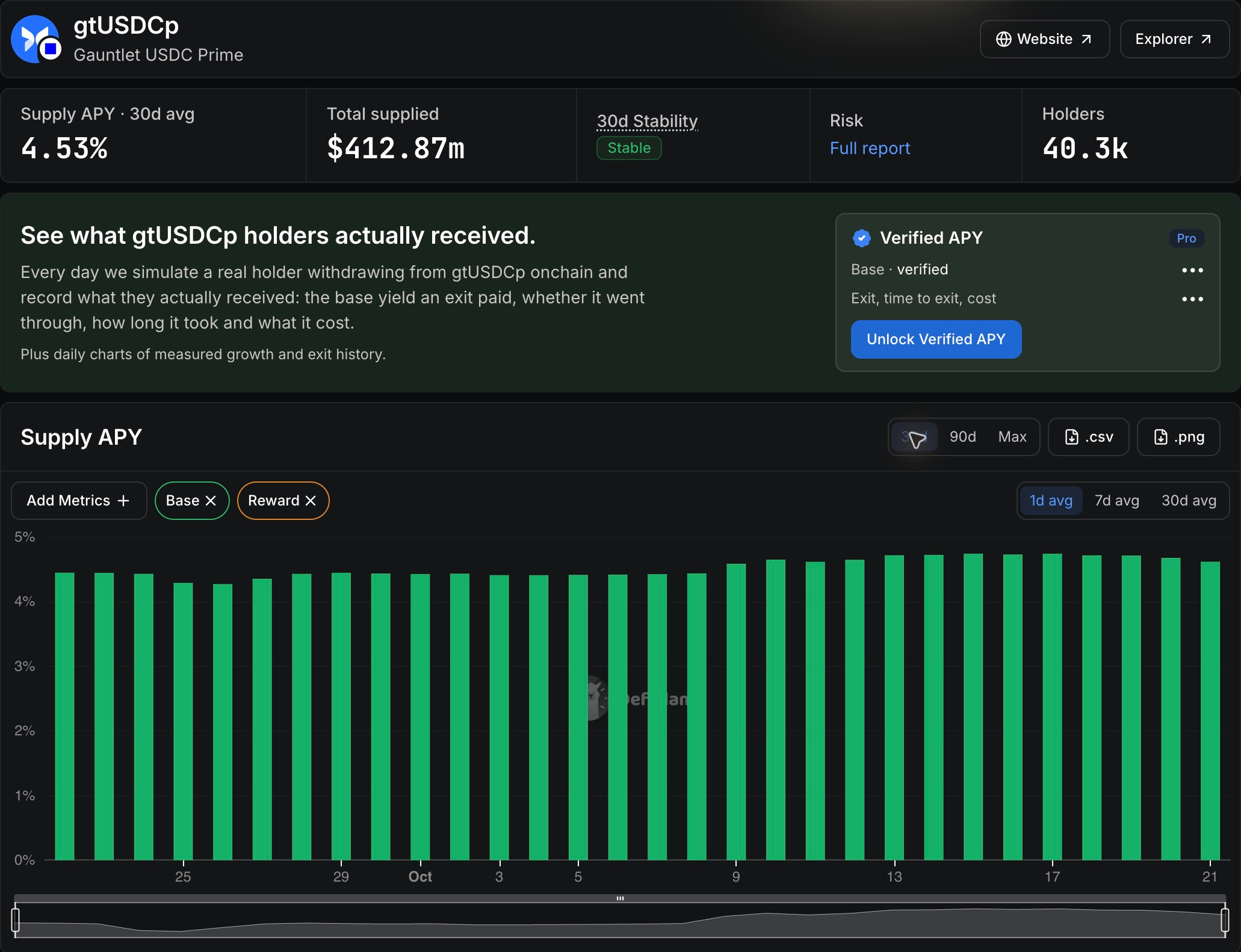
DefiLlama shows a 4.53% 30-day average and about $412.87M supplied. The article’s 4.70% current net rate and available-liquidity figure come from a separate Morpho API check. Source · Captured 2026-10-21.
Depositing USDC gives you vault shares. There is no fixed maturity, but withdrawals depend on available liquidity. Gauntlet’s allocation choices, the collateral and oracles in the underlying markets, and the contracts all matter. I’d use it as the first comparison for liquid USDC, while checking the vault’s current allocations before depositing. Morpho documentation
2. Aave: simpler exposure, less spare liquidity
Aave v3’s Base USDC reserve showed about 3.78% base APY, with $193.46 million supplied and $20.58 million in available cash. Supplying USDC earns borrower interest through the reserve; withdrawing depends on cash being available.
The dashboard’s extra reward is restricted. The Jumper mission requires a qualifying bridge of at least $500 via Jumper into USDC on Base, followed by a new deposit of at least $500 through Jumper Earn. Existing Aave positions do not qualify. The campaign ends October 28, and the displayed reward rate is not a guaranteed payout. I leave it out of the general comparison.
Aave’s base rate is about 0.92 percentage points below Morpho’s current net quote. Its appeal is direct exposure to the Aave market. The reserve’s smaller cash balance, about 10.6% of supplied assets, is the tradeoff I’d watch alongside collateral, oracle and contract risk. Aave security
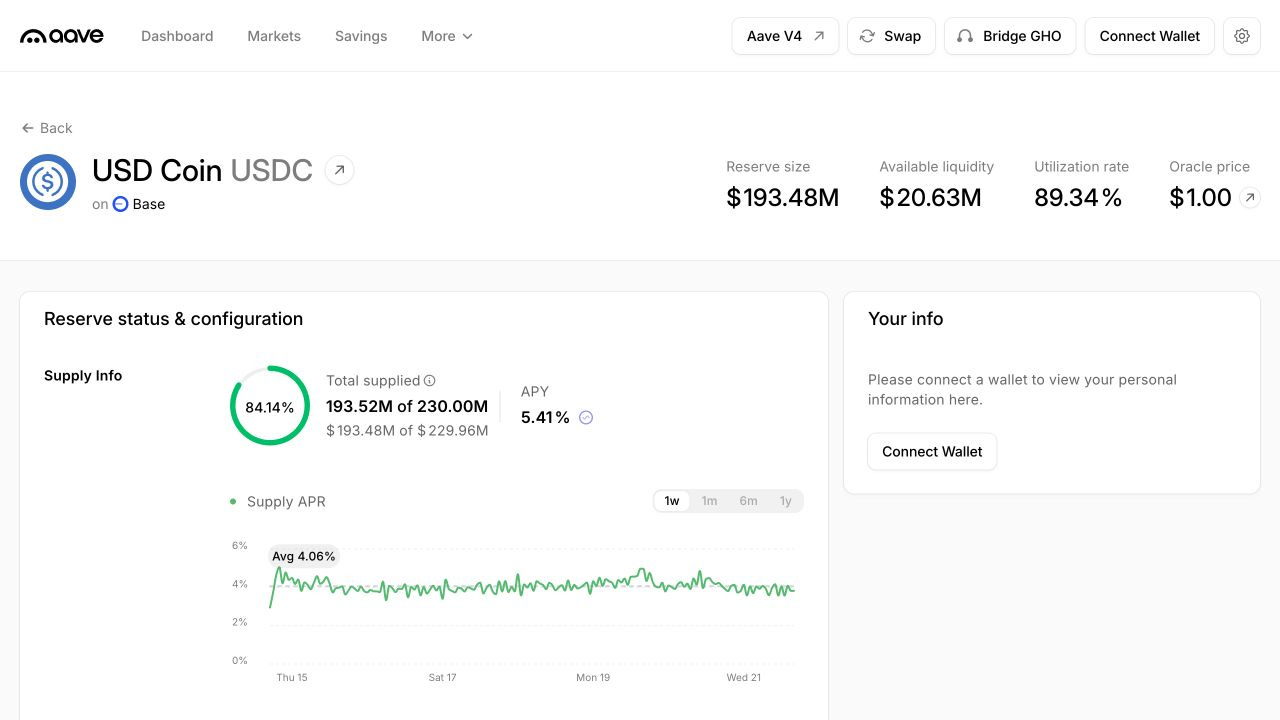
Aave’s reserve screen at 16:29 Stockholm shows $193.48M reserve size and $20.63M available. Its 5.41% headline includes an incentive; eligibility is restricted. The article uses the separate 16:22 base-rate observation and 16:24 cash check. Source · Captured 2026-10-21.
3. Pendle: a fixed rate with a small dollar premium
PT-sUSDS maturing November 26 on Ethereum quoted 5.32% implied fixed APY. The market had about $86.29 million in TVL, with $4.20 million of AMM liquidity for trading.
Buying the principal token at a discount fixes the entry yield if you hold to maturity and the underlying redemption works as intended. Its accounting asset is USDS. A 35-day holding period from October 22 to November 26 would earn about $50 on $10,000, before costs, at that quote. Keeping Morpho’s 4.70% rate unchanged for the same period would earn about $44. That floating-rate assumption can fail in either direction.
I’d consider the PT for money already earmarked for that date, especially if I expected floating rates to fall. I would check the actual swap quote before moving a small position from Base to Ethereum. Gas and slippage can consume a $6 premium quickly.
An early exit means selling PT at the market price. The $4.20 million AMM figure is not a cash reserve promising withdrawals at par. You also retain exposure to Sky’s backing and governance, sUSDS, Pendle’s contracts and the yield wrapper. Pendle mechanics
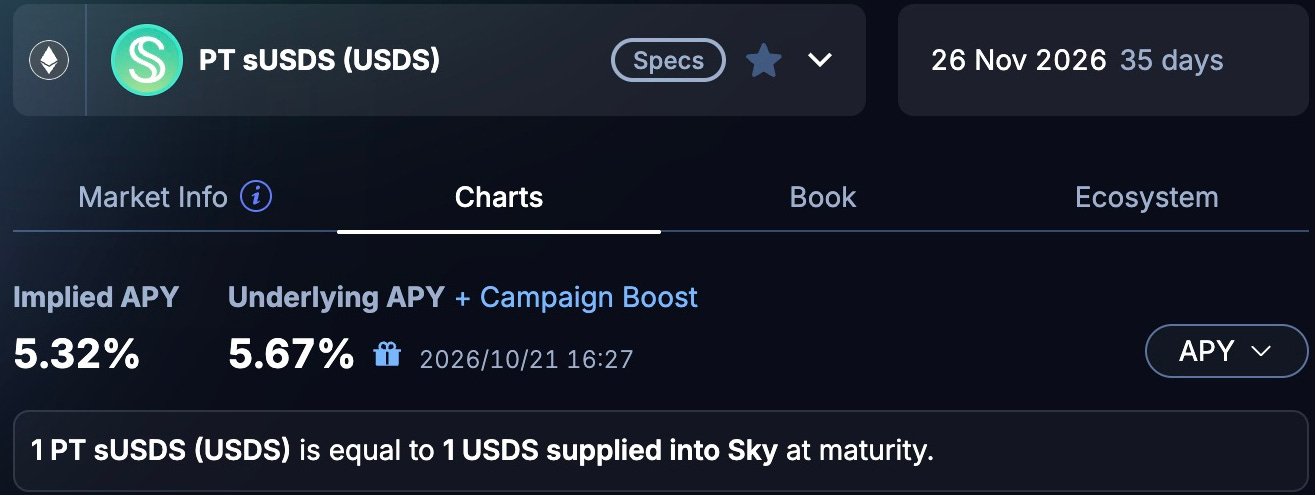
PT-sUSDS quotes 5.32% implied APY and November 26 maturity. The adjacent 5.67% figure includes an underlying campaign boost and is a different return display. The article compares PT with Morpho’s floating rate. Source · Captured 2026-10-21.
4. Uniswap: a fee position that needs a range
The WETH/USDC 0.3% pool on Base is a candidate for someone who wants to provide ETH/USDC liquidity and manage a price range. Its yield comes from trading fees, with no token rewards in the dashboard snapshot.
I would not put a single APY beside it. DefiLlama flags the observation as an outlier, and its daily and seven-day figures use different methods. The seven-day adapter models a hypothetical $100,000 position with bounds 30% above and below the snapshot price; the daily figure annualizes pool fees against TVL. Those numbers do not define a reliable range of investor returns. Pool data
The decision is whether the fees for your range and size compensate for inventory changes, impermanent loss, rebalancing and costs. An out-of-range position stops earning fees. I’d model that position before committing capital, and compare it with simply holding the same assets.
5. Aerodrome: reassess the position when rewards reset
The Slipstream WETH/USDC pool on Base, address 0xb2cc224c1c9feE385f8ad6a55b4d94E92359DC59, is a fee opportunity to reassess around the upgrade. Today’s combined fee-and-reward display is a poor basis for a forward return estimate.
The official Aero upgrade hub schedules launch for October 22 at 00:00 UTC, or 02:00 in Stockholm. Legacy AERO and VELO emissions are due to stop then. Old pools are expected to remain available, and the guide says liquidity can be unstaked to earn fees. Positions do not migrate automatically.
Staked legacy LPs have different fee entitlements from unstaked positions, which can also face a levy. I’d check the exact staking status and upgrade instructions. New Aero rewards depend on new allocations and pool eligibility. There was no verified post-launch reward APY to quote at preparation time. Trading volume could also move, changing the old pool’s fee income.
This needs active management through the transition. Range risk and ETH exposure remain, with migration and new-contract risk added if you move. The official guide also calls for withdrawing the legacy automated-liquidity-management positions as that service winds down. Use the linked official hub to reach the correct instructions; a screenshot of an old APY is not an upgrade plan.

Aero’s published launch schedule, captured before October 22. It describes planned emissions and portal changes; it does not confirm that launch or migration has completed. Source · Captured 2026-10-21.
6. ether.fi: yield on ETH you already want to hold
weETH showed about 2.27% APY in ETH terms, with roughly $5.42 billion tracked on Ethereum. That is staking exposure, so the dollar value still moves with ETH. I’d compare it with holding ETH, rather than with USDC lending. Rate snapshot
The standard exit uses a withdrawal request and queue. ether.fi also documents an instant route with a fee and limited buffer capacity. The standard queue has no fixed completion guarantee; validator exits and withdrawal demand can lengthen it. If you hold weETH on Base, factor in the route back to Ethereum for protocol unstaking, or the price and liquidity of a local DEX exit. Withdrawal instructions
The yield comes with operator, validator slashing and contract risk, plus bridge risk when relevant. I would value unverified points or future rewards at zero.
7. Ethena: a different source of yield, with access limits
sUSDe showed 5.17% reported APY and about $1.19 billion tracked by DefiLlama. The return depends on Ethena’s revenue, including funding, hedging-related income and staking. It can move with market conditions; this is a different exposure from lending USDC against collateral. Rate snapshot
The exit terms deserve a fresh check. The contract returned a one-day cooldown on October 21. The official guide describes a dynamic one-to-seven-day framework, so one day is a snapshot, not a permanent promise. Selling on a DEX provides another exit at the available market price.
Ethena’s staking documentation also says sUSDe acquisition is not offered to EU/EEA residents, alongside other restrictions. Check eligibility before treating this as an available option. Official staking guide
For eligible readers, I’d weigh the modest premium over the lending options against funding-rate, exchange, custody and depeg risk. A higher APY alone would not settle that choice.
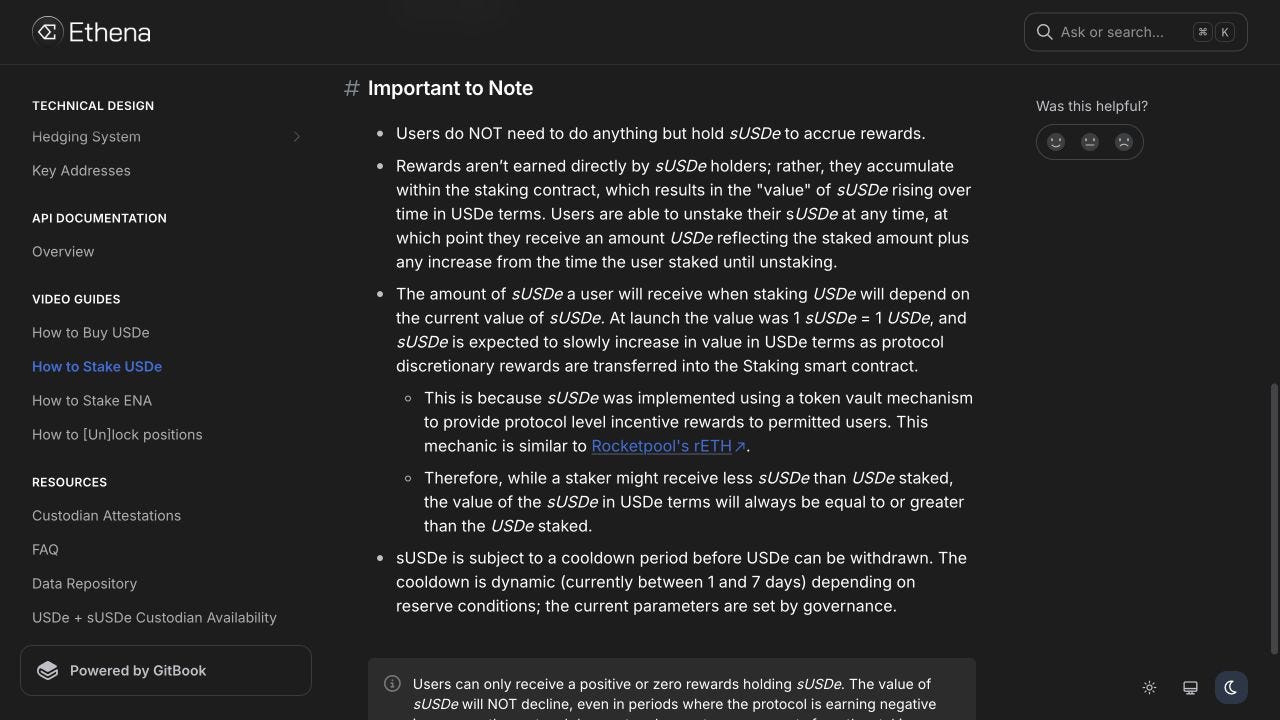
The official guide describes a dynamic one-to-seven-day cooldown. A separate read-only contract check returned one day on October 21; future requests can face different terms. Source · Captured 2026-10-21.
The weekly risk signal: available liquidity
Aave Base USDC had about 89.4% of supplied assets borrowed in the check. Its available cash was roughly $20.6 million, compared with Morpho Prime’s $187.9 million of available liquidity. Both figures can change, and neither is a promise that every depositor can leave simultaneously.
Keep those lending balances separate from Pendle’s $4.2 million of AMM liquidity. Selling PT uses a market and can move its price; withdrawing USDC from a lending reserve draws on available cash. Dividing each by TVL and ranking the percentages as equivalent “exit safety” would hide that distinction.
Before depositing, I’d check the exact chain and contract, the current exit route for my size, any reward eligibility, and whether the expected dollar gain survives costs. On the two LPs, I’d also write down the price range and the conditions for rebalancing or closing it.
This week’s intel
1. JPM Coin reaches Ethereum. J.P. Morgan announced its Ethereum deployment on October 19, adding to Base. The dollar deposit token serves the bank’s institutional clients. That puts bank deposits closer to tokenized assets on Ethereum, but access remains permissioned and usage still needs to be demonstrated. J.P. Morgan
2. More ETH is staked, with a lower gross yield. Bitwise’s October 20 report puts Q3-end stake at 43.8 million ETH, or 35.9% of supply. Gross annualized yield averaged 2.63%, down from 2.81% in the previous quarter. That is a chain-level baseline, distinct from today’s reported weETH yield. More capital pursuing staking rewards can reduce the return per ETH. Bitwise report
3. Kamino expands its fixed-rate borrowing pitch. The October 20 announcement describes term borrowing against tokenized AUTO collateral, funded in wYLDS. The first market actually opened September 21. Fixing the financing cost can make a carry trade easier to evaluate; collateral, liquidation and refinancing risks remain. Figures and product claims come from Kamino’s release. Announcement
4. Mastercard opens agent payments to developers. Agent Pay for Machines entered early access on October 20. Its demonstration used signed payment vouchers within an approved budget, with settlement on Base. Vouchers can be aggregated before redemption, so every service payment need not become a separate onchain transaction. It is a concrete payment use case to follow, with broader adoption still to prove. Mastercard
5. Industry groups push for workable US token rules. The Blockchain Association submitted comments on the SEC’s proposed Regulation Crypto Assets on October 20. It wants clearer treatment of existing tokens and standards for when a project’s managerial role has ended. These are an advocate’s requested changes to a proposal. They do not establish new permissions for token issuers or traders. Submission summary
Five podcast picks
Selected from publisher descriptions and chapters. These notes describe what the episodes cover, without implying full-episode listening.
The Rollup: Alex Cutler: Spot Exchanges Are The Biggest Opportunity In Crypto (Trillions Incoming) · October 19 · 20 minutes. Aerodrome’s co-founder makes the case for Aero’s multichain expansion. Start at 09:18 for liquidity competition. Useful context for the upgrade, with the growth forecast treated as the founder’s thesis.
0xResearch: Pt. 2 Grading Citrini’s Viral Crypto Portfolio · October 20 · 59 minutes. The analyst panel examines Aero, Uniswap, Pendle and other tokenization trades. Aero starts at 03:37, Pendle at 46:55. A useful counterweight to the founder pitch when separating protocol adoption from token value.
The Rollup: Sam Kazemian: The Neobank App Store Era Is Here · October 19 · 18 minutes. Frax’s founder discusses putting stablecoin services behind one account. The Aave segment begins at 07:07, followed by reusable identity at 09:11. Listen for how these products might reach users beyond existing DeFi wallets.
Bankless: The CFTC’s Proposed Rules to Reshape US Crypto Markets | CFTC Chair Mike Selig · October 19 · 71 minutes. Mike Selig and David Hoffman discuss proposed routes for US crypto margin trading and exchange oversight. Start at 27:16 for CTX and 29:22 for CAM. The proposals remain distinct from rules already in force.
The Rollup: Avalon Ingram: Banks Are Done Experimenting With Tokenization · October 16 · 24 minutes. Swift’s digital-assets business lead compares stablecoins and tokenized deposits at 10:05, then discusses settlement constraints at 17:35. A useful companion to JPM Coin’s Ethereum launch.
Where I’d start
For liquid USDC, Morpho Prime would be my starting comparison. Pendle earns a place when fixing the rate and matching a maturity serve an actual need. Aave offers direct lending exposure with less spare cash in this reserve. weETH belongs in an ETH allocation, while sUSDe requires a separate view on Ethena’s risks and access rules.
I’d keep the two LPs in an actively managed bucket. With Aero about to reset its rewards, I want to see the new pool terms and actual trading activity before projecting its yield.
Would you fix a rate through November 26 for roughly $6 more on $10,000, or leave it in floating-rate lending? That is the comparison I’d make before reacting to 5.32% versus 4.70%.
For the longer background, revisit last month’s Aave, Morpho and Pendle comparison and the Morpho Midnight fixed-term discussion. Their rates are historical; the questions about costs, maturity and exits still apply.
Thanks for reading,
Yannis
For more DeFi commentary between editions, follow me on X.
This newsletter is for information only and is not financial, investment, legal or tax advice. These products carry smart contract, collateral, oracle, liquidity and other risks. LPs add price exposure and impermanent loss; fixed-term positions add early-exit risk; staking and synthetic-dollar products carry their own operational and counterparty risks. Rates and access terms can change. Verify current terms and only risk what you can afford to lose.