

Hey, welcome back.
An extra percentage point on $10,000 is about $100 a year before costs. That is the scale of the decision across much of this week’s stablecoin shortlist. Add Ethereum gas, an early exit or a few swaps, and the difference gets smaller.
There are five setups below, including a higher-risk LP and points strategy. The question for each is whether the extra return pays for the extra exposure. One apparent double-digit opportunity failed the source check, so it stays off the shortlist.
In this edition:
Five stablecoin yield opportunities on Ethereum and Base
Five important stories across DeFi and Ethereum
Onchain analytics: TVL, rates and available cash
Five podcast picks on yield, markets and DeFi
Five yield opportunities to compare
Snapshots from September 27, 2026, around 17:50–18:15 UTC. APYs are annualized estimates, not the return for the remaining holding period. Rates, incentives and liquidity can change. Transaction costs are excluded.
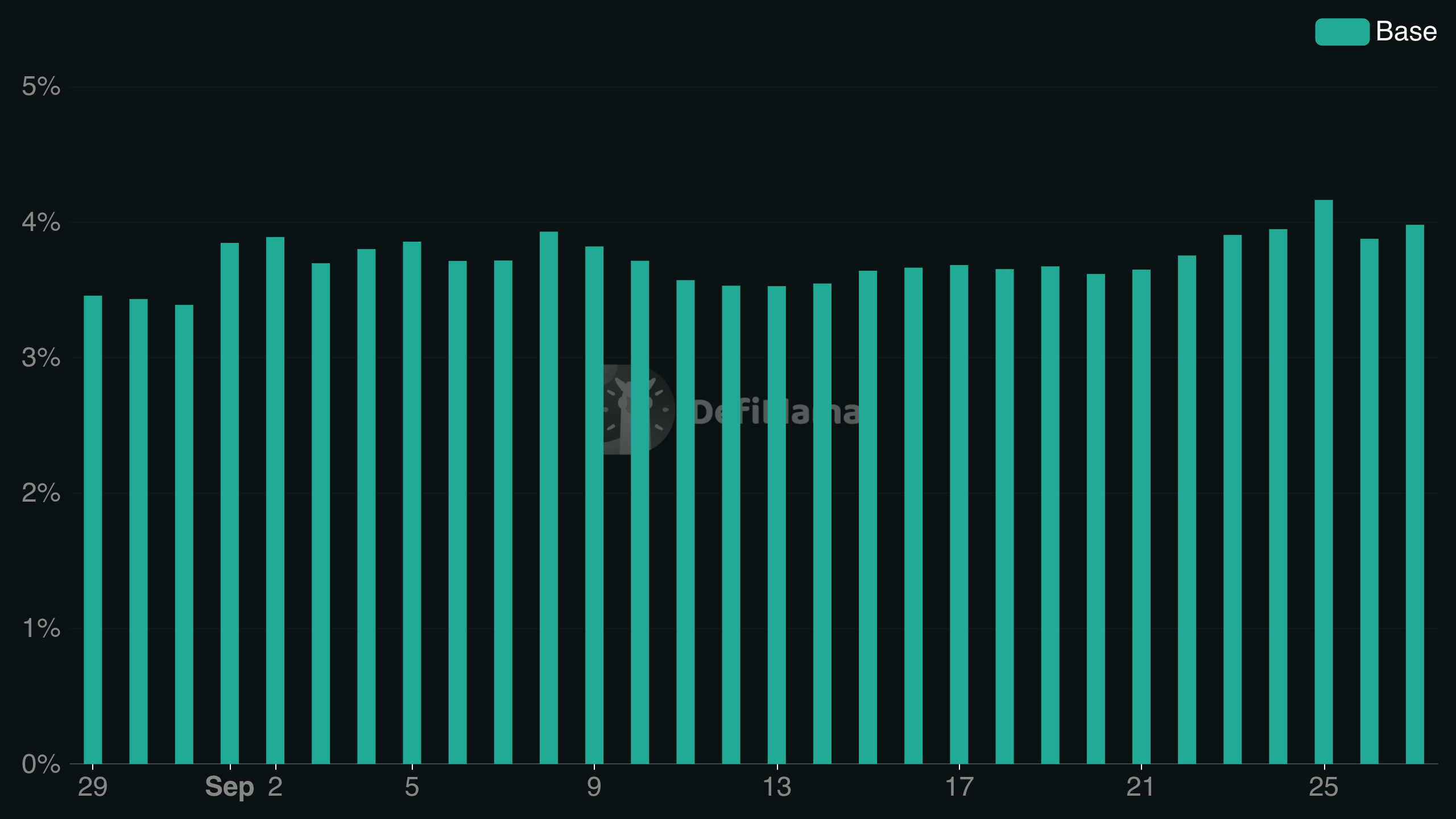
1. Sky sUSDS on Base: 3.60% variable APY
The simplest USDS option here. sUSDS accrues the governance-set Sky Savings Rate, funded from the protocol’s aggregate surplus. Sky can change that rate. The Base pool tracked by DefiLlama held about $12.03 million; that is its size, not a promise that the full amount is immediately withdrawable. Sky · Base pool data
This makes sense to compare if you already want USDS exposure. USDS backing, smart contracts and the Base deployment still matter. Before entering through Spark’s Base savings page, check the route back into the asset you actually plan to spend. A savings rate does not remove conversion or bridge risk.
2. Aave v3 USDC on Base: 4.10% variable APY
Borrowers pay the interest. DefiLlama’s 30-day average was 3.72%, which is a useful reminder that today’s quote is one point in a moving series. Rate history
The onchain check found 179.49 million USDC supplied and 17.32 million available, or roughly 90.35% utilization. Withdrawals depend on available cash; deposited capital already on loan cannot all leave at once. This is a straightforward USDC lending option, with Aave, collateral, USDC and Base risks. The quote is only half a percentage point above Sky, with a different underlying asset. Open the reserve · Withdrawal mechanics
3. Gauntlet USDC Prime on Morpho Base: 4.40% net variable APY
This vault spreads USDC across lending markets selected by Gauntlet. Morpho’s API showed $415.25 million deposited and $175.68 million of liquidity at the check. The return was only about 0.30 percentage points above Aave, roughly $30 a year on $10,000 if both rates stayed unchanged. Vault and allocations
That small spread is the reason to examine the collateral list, market caps and oracle choices. A large vault can still hold a market you would never choose directly. I would compare it after reviewing those allocations and the withdrawal queue, rather than treating the curator’s name as the risk assessment.
4. Pendle PT-sUSDS, November 26: 4.83% implied fixed APY
On Ethereum, this PT is bought below its maturity value. The displayed rate applies if the position is held to November 26, 2026, subject to the underlying and contracts performing as intended. An earlier exit happens at the market price. PT holders give up the underlying floating yield and points; the Sky savings rate is not an extra payment on top. Live market · PT mechanics
At roughly 60 days to maturity, 4.83% annualized works out to about 0.78% over the remaining period, or around $78 on $10,000 before costs. Holding a constant 3.60% savings rate for the same period would earn about $58. That roughly $20 difference can disappear into execution costs.
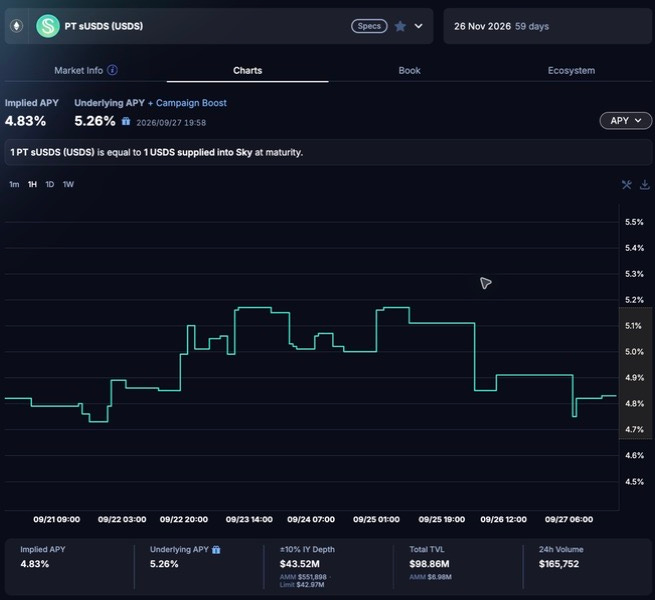
This is a way to fix the rate for a defined period. It is not automatically the highest-paying sUSDS route: the screen’s boosted underlying yield was higher. Check campaign eligibility, the executable quote and exit slippage before deciding.
5. Pendle sUSDe LP, November 26: 5.58% estimated APY, plus points exposure
This Ethereum pool adds Ethena exposure and liquidity provision. The live screen showed 5.58% LP APY, split into 5.17% in USDe-denominated return and 0.41% in PENDLE incentives, with about $4.02 million in AMM liquidity. It combines PT, the yield-bearing side of the pool, trading fees and incentives. These figures move. Live pool
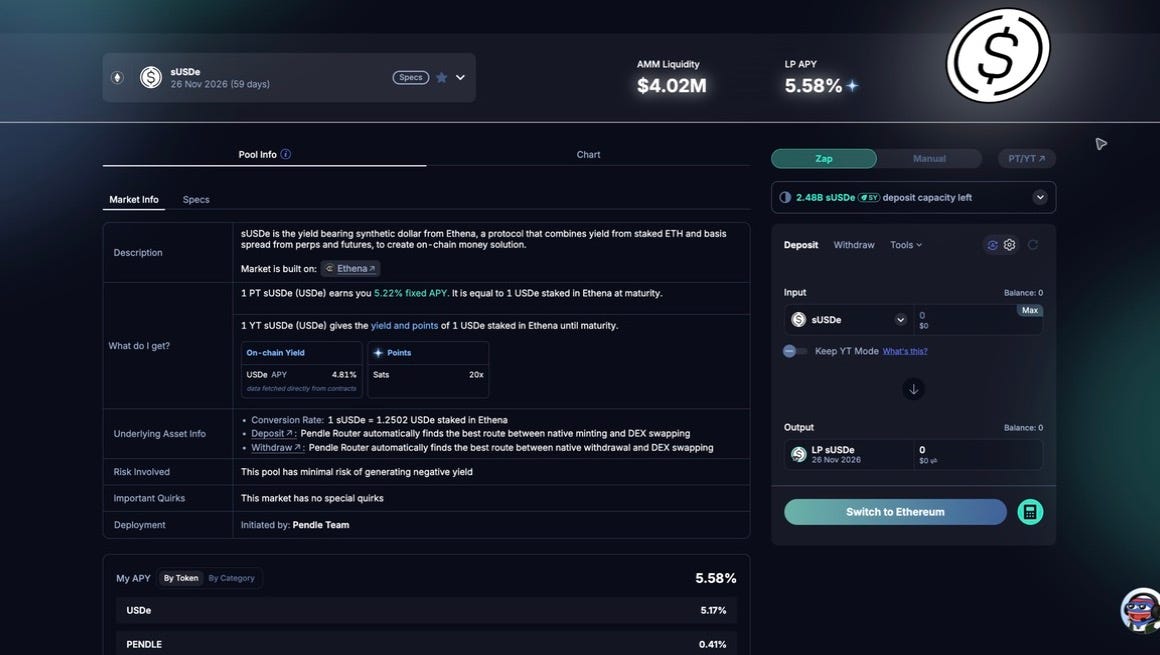
For the points version, Keep YT retains a separate yield-token position. That preserves more points exposure but leaves less of the starting capital earning the displayed LP rate. YT reaches zero at maturity; its yield and points must be assessed alongside the PT component. You cannot apply the 5.58% LP estimate to the entire combined position and then add a made-up airdrop return. LP mechanics
The market displays 20x Sats for YT exposure. That multiplier is neither a dollar yield nor a multiplier on the whole LP deposit. I would assign points zero value in the base case and check eligibility before entering. Points mechanics
Ethena brings funding, custody, exchange and backing-asset risks; Pendle adds contract and exit-pricing risks. A single-token exit can incur slippage, and unwinding the LP may leave PT and yield-bearing assets to redeem or sell. This is the experimental end of the list. At these rates, points need a separate thesis to justify the extra work. Ethena’s risk disclosures
Why Aerodrome missed the shortlist
Aerodrome: the attractive number needed a second look. DefiLlama showed about 15.93% APY for the Base USDC/USDT CL1 pool, combining a fee estimate with AERO rewards. Aerodrome’s docs say LPs earn emissions when staked or swap fees when unstaked. The native app also marks this pool MIGRATING. Its fee and emission estimates use different denominators and can differ sharply from an aggregator. I would resolve the migration destination and quote for the intended range before considering an entry. Aggregator · Aerodrome docs · Pool listings

This week’s intel
Five developments from September 21–27, 2026.
1. Aave brings stock collateral to Base
September 25. Aave V4 opened an Equities Hub where eligible users outside the US can borrow USDC against seven Coinbase stock tokens, including Apple and Nvidia. The initial borrowing cap is 21 million USDC. This gives tokenized equities a practical use beyond trading. The wrinkle: Chainlink’s feeds hold their last price over weekends while interest keeps accruing, so reopening can bring a sharp collateral repricing. This is a separate market from the Aave v3 reserve in the shortlist. The Block · Aave announcement
2. Ethena takes USDe’s basis trade into equities
September 25. Ethena announced an expansion of USDe’s backing strategy using Binance’s bStocks paired with short equity perpetuals. The aim is to earn funding from a new market while hedging stock-price exposure. For sUSDe holders, that broadens the sources of return and the risks behind them. The published risk framework flags thin weekend pricing and concentration within Binance’s group. I’d watch the actual allocation and net returns before assuming this will lift sUSDe’s yield. The Block · Risk framework
3. Vitalik sets out Ethereum’s direction after Hegota
September 27. Vitalik Buterin’s new essay describes Ethereum combining onchain verification with more computation performed across decentralized infrastructure outside the chain. Zero-knowledge proofs, privacy and parallel processing sit at the centre of that vision. My takeaway for DeFi: application design could increasingly determine how much cheaper and more private transactions become. This is a long-term technical direction; the post leaves substantial engineering challenges open and does not announce a live upgrade. The Defiant · Vitalik’s essay
4. SEC staff clarifies staking receipts and token buybacks
September 25. New SEC staff FAQs place qualifying staking receipts in non-security categories and say a buyback announcement for a non-security token on a functional crypto system does not, by itself, promise essential managerial efforts. Those conditions matter for staking providers and protocols considering buybacks. A receipt issuer’s ability to lend or pledge the deposited assets changes the analysis. The FAQs express staff views, carry no legal force, and give no blanket clearance to every staking or buyback design. The Defiant · SEC FAQs
5. Bitget’s hack estimate reaches $387.5 million
September 24–26. Bitget raised the loss estimate after adding assets missed in its initial accounting. The exchange says its protection fund covers the loss. Its announced withdrawal restart begins with BTC on September 28, followed by ETH on September 29, USDT on September 30 and other assets on October 2. As of this issue, those are planned dates. For anyone funding DeFi positions through an exchange, the practical lesson is that an intact account balance does not guarantee immediate access to the funds. CoinDesk · Bitget’s withdrawal schedule
Onchain analytics
Ethereum TVL rose 2.45% over the week. DefiLlama’s completed September 26 observation was $53.55 billion, versus $52.27 billion on September 19. These are dollar valuations. They do not establish how much fresh capital entered. Ethereum data
Base grew faster from a smaller starting point. The same dates show $6.25 billion, up 5.95% from $5.90 billion. Asset prices and changes in positions can both move TVL. This supports watching Base’s lending and trading markets, without treating the whole increase as new deposits. Base data
Aave’s rate history puts the current quote in context. The 4.10% supply APY is above its 3.72% 30-day average. Available USDC was about 9.65% of supplied USDC in the onchain snapshot. For an unlevered lender, the practical check is how much can be withdrawn when needed, alongside the collateral risks supporting the loan book.
Podcast picks
1. Guy Young on Ethena’s next markets, The Rollup, September 22. The conversation covers the founder’s thesis for RWA perpetuals and Ethena Pay, alongside buybacks and investor selling. Useful context for the sUSDe end of the shortlist. Treat it as the founder’s case for the business, not evidence that a particular yield will persist. Listen
2. Will Peck on tokenized money-market funds, The Rollup / Convergence, September 22. A discussion of WisdomTree’s onchain fund growth and how funds fit alongside stablecoins. The useful question for this issue is what a tokenized wrapper changes about access and trading, and what it leaves unchanged about the underlying asset’s liquidity. Listen
3. Ryan Connor and Ayyan Rahman on reinsurance collateral, 0xResearch, September 23. The guests explain how ONyc earns from reinsurance premiums and can be used as collateral on Kamino. The published chapters also cover catastrophe losses and the extra risks from DeFi leverage. Start at 14:38 for the source of yield, then 26:47 for what could wipe it out. Listen
4. Ryan Sean Adams and David Hoffman on the rally’s breadth, Bankless Rollup, September 25. The hosts debate whether this is an early bull market and why tokens with revenue or buybacks have attracted attention. They also cover Zcash, NEAR and rising bond yields. A useful companion to the onchain section: listen for the evidence behind their market call, rather than treating their confidence as confirmation. Listen
5. Kain Warwick, Taylor Monahan and Austin Griffith on ETH perp activity, Uneasy Money / Unchained, September 24. Kalshi’s reported volume sparked a debate over wash trading and paid market makers. The hosts examine competing explanations and whether the activity improves price discovery. Useful for judging exchange dashboards: turnover alone tells you little about who is trading or why. Listen
For cash needed soon, exit flexibility deserves more weight than a small rate spread. A fixed-rate position makes more sense when the holding period matches the maturity. LPs and points add a different job: monitoring the position and deciding whether the incentives still pay for its risks.
If this comparison helps, subscribe for the next issue or share it with someone comparing stablecoin yields.
This newsletter is research, not personalized investment advice. Stablecoins can depeg, contracts can fail, and exits can become expensive or unavailable. None of these returns is insured or guaranteed. Check current rates, fees, eligibility and withdrawal conditions before committing funds.