

In this edition of The Weekly Alpha:
UNI’s rally meets a tougher revenue test
AERO’s fee position, and the emissions I would watch
A new stablecoin LP setup and Pendle’s November trade
🧐 Three onchain signals behind the move
📚 This week’s intel and two podcast picks 🎧
Hello everyone,
ETH is up about 13% over seven days. UNI has gained roughly 54%, with several Ethereum-related tokens moving even faster than ETH. The opportunity now is to work out which protocols can turn that attention into durable revenue.
In our September 6 issue, UNI and AERO were two of the places I wanted to investigate. This week’s follow-up is less comfortable: UNI’s tracked holder revenue fell over the latest completed week, and AERO’s recent chart is dominated by one exceptional day.
I still want to follow both. But I would set a different bar for buying a liquid token, locking into a fee position and earning on stablecoins while waiting.
What Has Already Moved
At the September 23 snapshot, ETH traded near $2,724, up 12.8% over seven days. UNI was up 54.1%, ARB 42.5%, OP 45.5% and ZRO 51.8% over the same interval.
That is a broad improvement in risk appetite. It also means “Ethereum is waking up” is already reflected in several prices. I would want a more specific reason to buy after these moves.
UNI: I Want Revenue to Catch Up
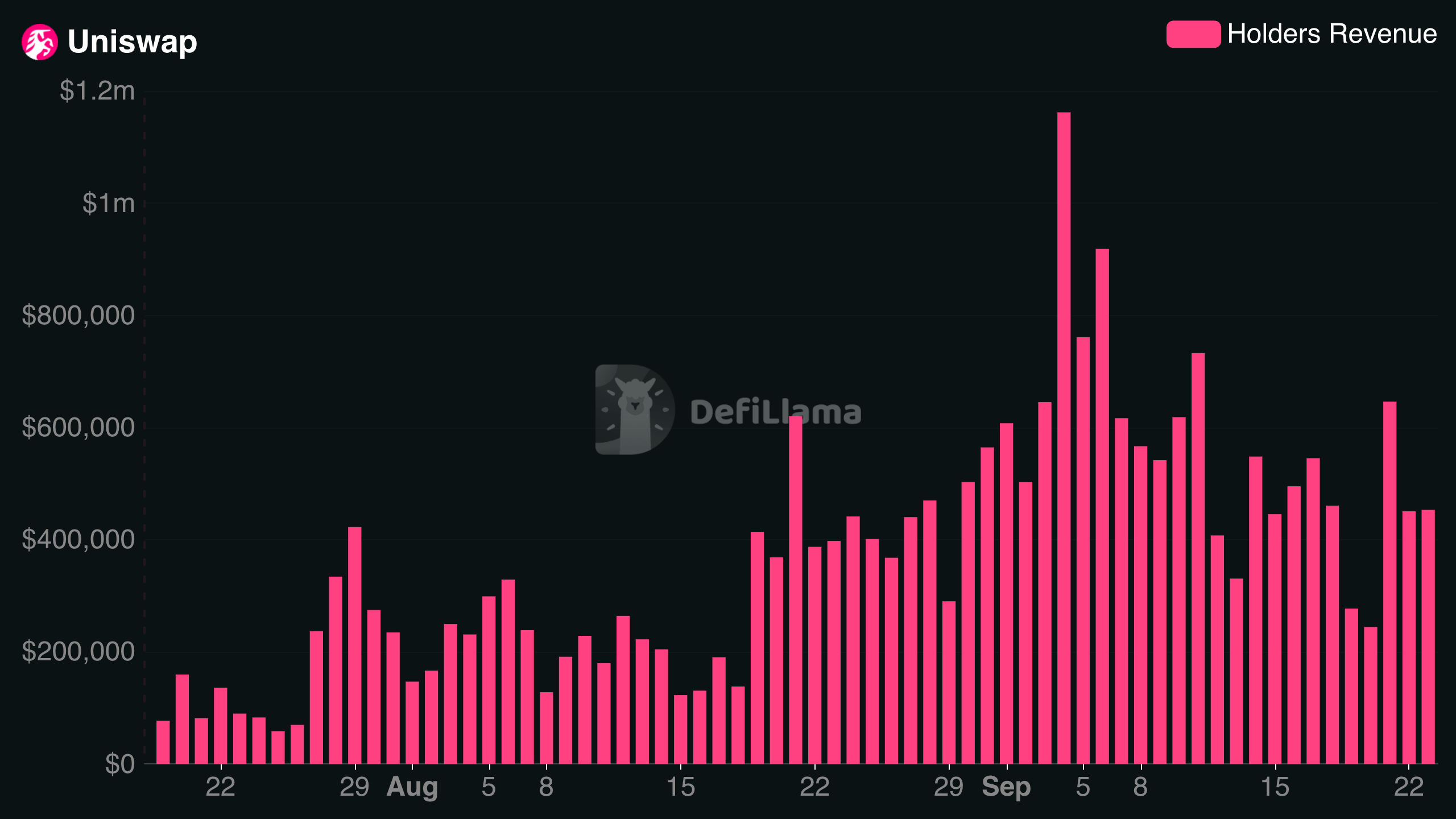
Uniswap’s appeal is that there is now an operating mechanism connecting eligible protocol fees to UNI burns. The v4 fee activation proposal executed on July 27. This is more concrete than waiting for a future fee-switch vote.
But the recent numbers do not yet justify extrapolating the token rally. DefiLlama recorded $3.12M in holder revenue from September 16–22, versus $3.63M from September 9–15, a decline of about 14%.
The dashboard’s roughly $209M in 30-day trading fees should not be treated as money accruing to UNI. Its corresponding protocol and holder-revenue measure was about $16M. Those are different parts of the economics, and a burn mechanism is not a cash dividend.
Robinhood Chain contributed about $1.31M, or 42%, of the latest completed week’s tracked holder revenue. That makes retention there worth following. One update to our earlier issue: Robinhood’s eligible network-fee promotion now runs through December 31, so September 29 is no longer the test date.
What would make me interested: several completed weeks of improving holder revenue, with activity broadening beyond a single subsidized venue. A pullback would help the entry price, but I would still want those operating numbers.
What would make me pass: another sharp rerating while the revenue trend keeps weakening. I would also avoid valuing UNI on total LP trading fees. The burn can work as designed while the token remains expensive.
AERO: Follow the Fees, Then Price the Lock
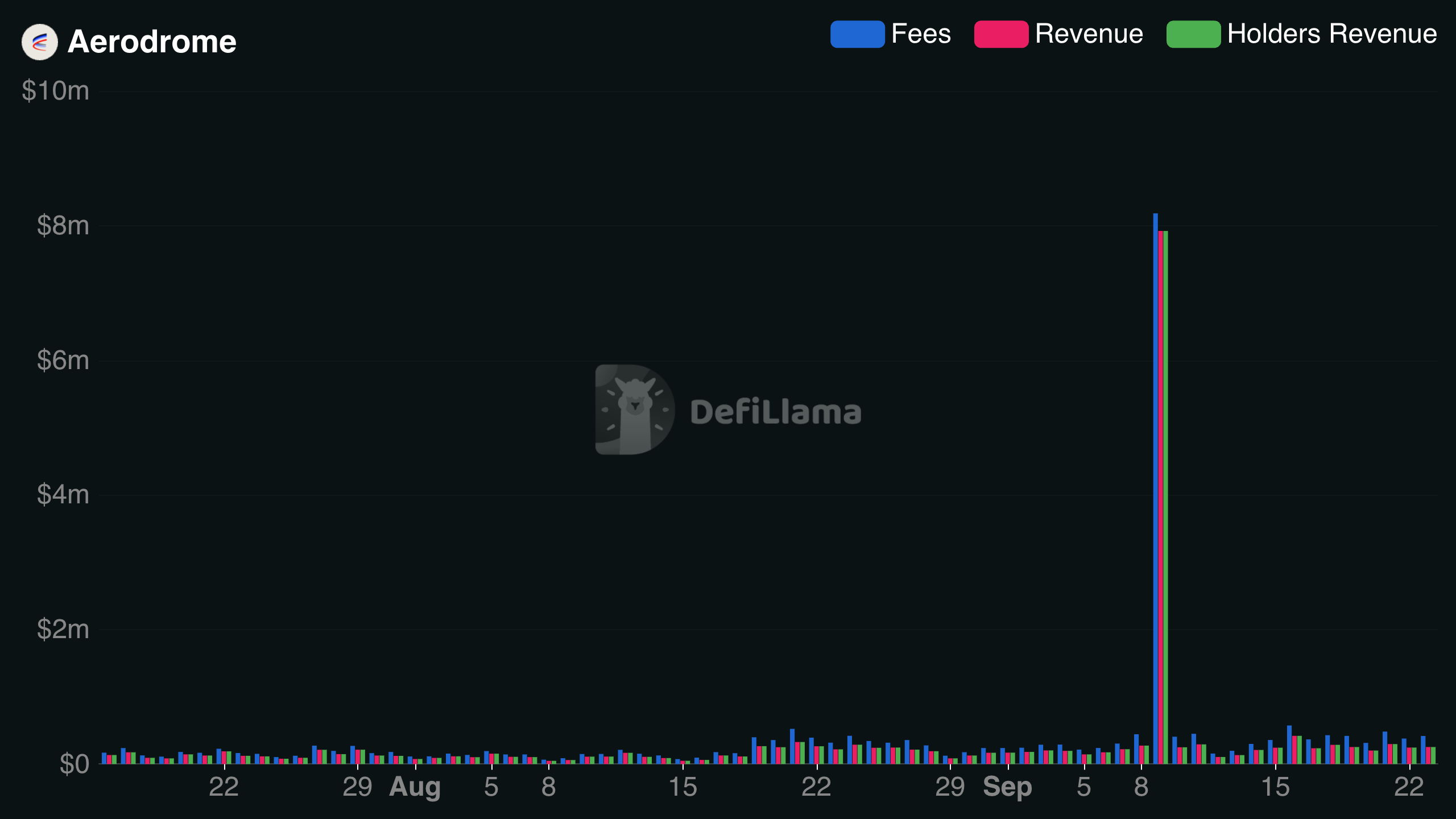
Aerodrome handled about $3.11B in DEX volume over September 16–22, up 7.6% from the preceding seven completed days. It generated roughly $2.96M in fees and $1.93M in tracked holder revenue during that latest week.
That is enough activity to keep AERO on the list. It is not a reason to annualize the unusually large revenue day visible in the chart. I would want the repeatable baseline, especially before accepting a long lock.
The position also matters. Holding liquid AERO does not automatically collect those fees. Under Aerodrome’s voting and reward model, users lock into veAERO and vote to receive the relevant rewards. LPs have a different return profile, including emissions, pool exposure and possible impermanent loss.
The dashboard reported about $2.28M of token incentives over its seven-day window. That is a material subsidy beside the fee numbers. I would track both before describing the return as sustainable.
My entry test: inspect the specific pool’s fee history, the voting rewards available to the proposed lock and the lock’s exit terms. I would model a quieter month and a lower AERO price, rather than assuming the latest rewards persist.
My pass condition: the attractive APR relies mainly on emissions or one exceptional day, or the lock lasts longer than I am willing to hold the token. The liquid token and the fee position should be evaluated separately.
The LP Design I’d Investigate: StablePair
Uniswap’s new StablePair hook is worth a closer look for USDC/USDG and USDC/USDT liquidity. It changes the fee according to the pool’s deviation from a reference price and the direction of the trade, aiming to leave more of the rebalancing value with LPs.
The appeal is a potential improvement in fee capture on familiar stablecoin pairs. The unanswered question is how much an LP actually retains after adverse selection, costs and any incentives.
I would compare realized returns with an ordinary stablecoin pool before depositing. I would also review the hook’s upgrade controls and what happens when one stablecoin loses its peg. A reference price does not guarantee that either token can be redeemed at that price.
For now, this is a research watch, not a quoted yield opportunity. I do not have a verified, executable APR that would justify recommending an entry. Uniswap’s September 16 technical explanation and pool links
Pendle’s November Trade: What Is the Lock Worth?
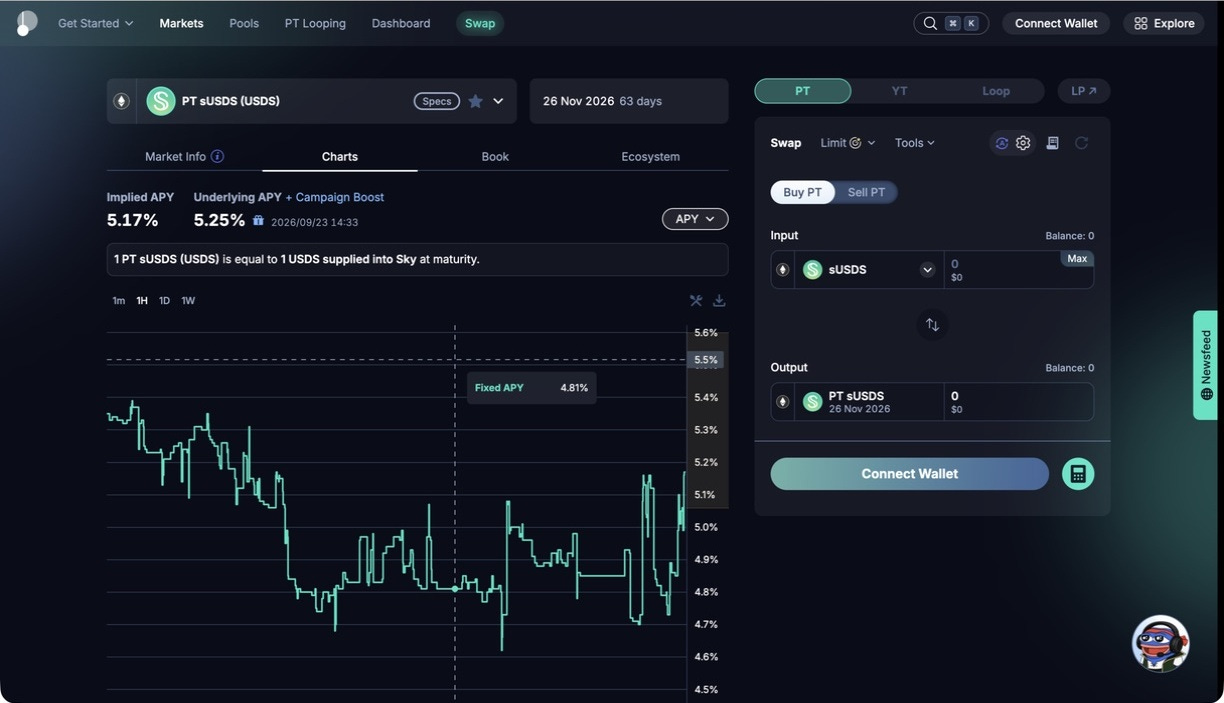
For money I can leave until November 26, PT-sUSDS quoted about 5.17% implied fixed APY, with roughly 0.88% return remaining to maturity. The return comes from buying the principal token below its redemption value. The Sky savings yield does not stack on top.
On $10,000, that remaining return is about $88 before costs, assuming normal redemption and a stable USDS peg. The unboosted Sky savings rate was 3.60% in the earlier same-day snapshot, worth roughly $62 over about 64 days if unchanged. That puts the extra return near $26 before gas and swaps.
Pendle’s interface separately displayed 5.25% underlying APY including a campaign boost. That is another reason to inspect the promotion’s eligibility and duration before choosing between PT and a floating position; comparing PT only with the unboosted rate would miss part of the decision.
I would consider PT when the money has a November job and the executable quote still leaves enough return after costs. I would pass if I might need an early exit. Selling before maturity introduces price and liquidity risk, and “fixed” does not remove USDS or contract risk.
Flexible USDC While I Wait
The short list on Base is Aave v3 USDC at 3.91%, Gauntlet USDC Prime at 4.42% current net APY, and Steakhouse High Yield USDC at 5.24% current net APY. These are floating snapshots, not promised returns.
Gauntlet is the first curated vault I would investigate, with Aave as the direct-lending comparison. Gauntlet reported about $172.55M of liquidity against $415.81M deposited. Aave had 17.52M USDC available against 177.82M supplied; withdrawals depend on unborrowed liquidity.
Steakhouse’s premium over Gauntlet is only about $7 on $10,000 over 30 days, assuming unchanged rates. I would want to understand the extra collateral and curator exposure. Its normal withdrawal route reported $5.56M, with another $7.40M separately recoverable from zero-penalty adapters. Those routes should not be reduced to a single misleading “available” number.
September 23, approximately 12:11–12:19 UTC: Aave market, Gauntlet vault, Steakhouse vault. Morpho net rates already reflect applicable fees. Check current allocations and an exit quote before depositing.
Onchain Analytics 🧐
1. TVL Is Rising Faster Than Stablecoin Supply
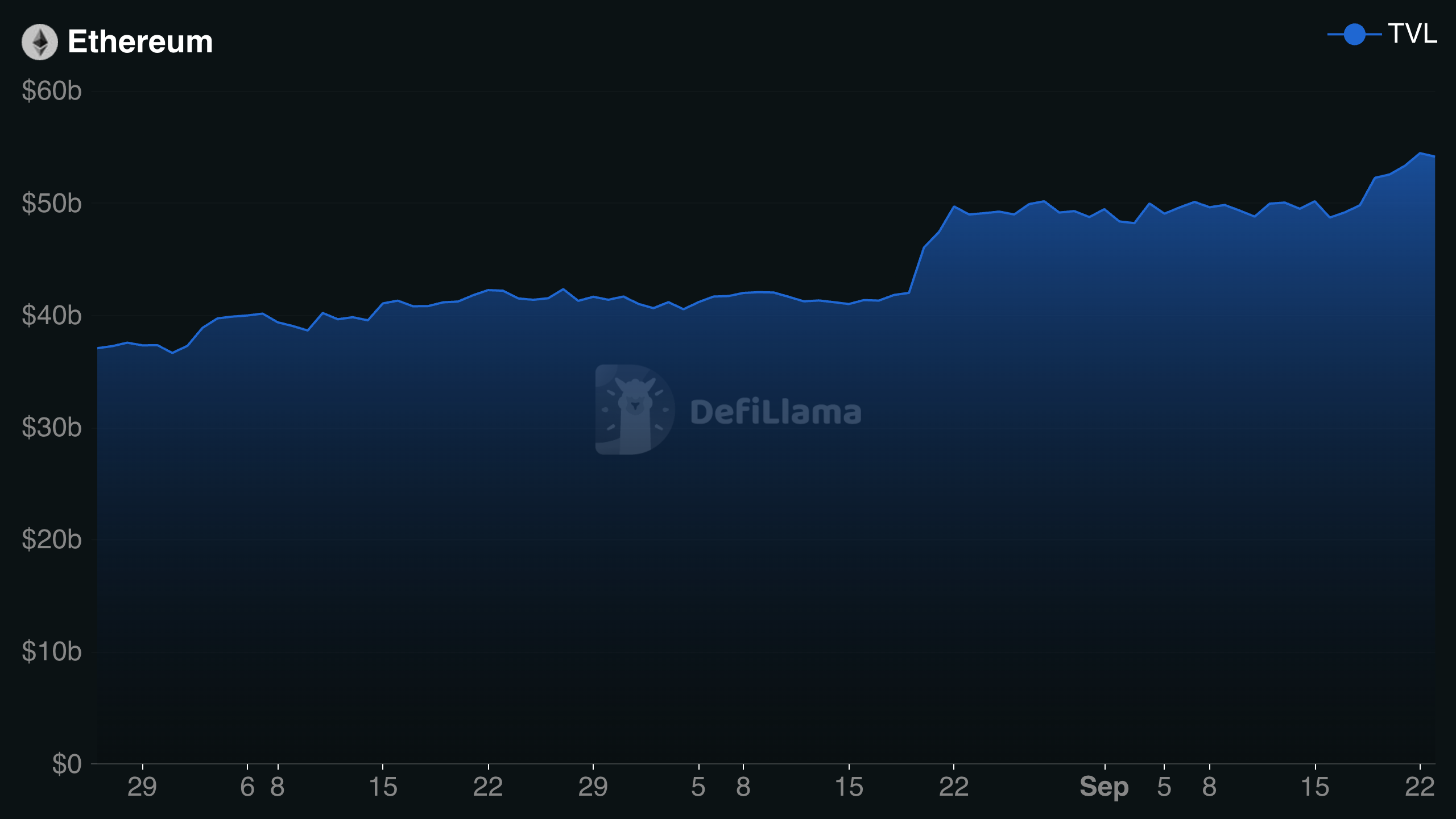
Ethereum DeFi TVL reached $54.47B on September 22, up 8.56% from September 15. Base reached $6.25B, up 10.63%. Higher token prices can lift dollar TVL, so these changes do not establish equivalent net deposits.
Over the same dates, growthepie’s stablecoin series showed Ethereum at $162.36B, up 0.09%, and Base at $4.94B, up 0.97%. Its coverage differs from DefiLlama’s stablecoin dashboard. I would look for sustained stablecoin growth alongside TVL before calling this a rush of fresh capital.
2. Base’s Transaction Count Has Yet to Confirm the Move
Base processed 9.50M transactions on September 22, versus 10.48M on September 15, a decline of about 9.4% between those daily observations.
That does not establish a falling weekly trend, and transaction counts do not measure economic value on their own. It does make “everything on Base is accelerating” too strong. I would watch whether activity catches up with the higher value deposited in DeFi.
3. Ethereum’s Fee Growth Is More Modest Than the Token Rally
Ethereum users paid about $466,000 in fees on September 22, up 4.4% from September 15. This is another daily comparison, not a change in weekly totals.
The price move is stronger than this usage signal. For now, my working view is improving risk appetite with uneven operating confirmation. That keeps me interested in specific fee-generating protocols, without treating a broad bull market as settled.
This Week’s Intel 📚
Robinhood’s fee-promotion deadline has moved. The official terms now cover eligible Robinhood Wallet swaps on Robinhood Chain through December 31, 2026. Transfers, bridges, third-party wallets and the in-app dapp browser are excluded. This replaces the September 29 date in our earlier issue and pushes back the clean test of demand without that network-fee subsidy. Current terms
Uniswap is live on Arc. The September 16 launch covers v2, v3, v4 and UniswapX, with app, wallet and API support. Another distribution channel is useful; sustained volume and LP returns will tell us more than the launch announcement. Uniswap Labs
Circle’s Arc mainnet is open. Circle announced the public launch on September 16, with native USDC integration and a founding institutional validator cohort. For DeFi users, I would examine bridge routes, validator assumptions and actual liquidity before treating a new venue as interchangeable with Ethereum. Circle announcement
EU central banks want tighter stablecoin yield rules. The ESCB’s MiCA review response recommends extending the remuneration ban to indirect returns through lending, borrowing and staking, and discusses DeFi arrangements. This is a policy recommendation, not a newly enacted ban on the products above. The Commission’s consultation closes September 30 at 23:59 CEST. Primary response · Consultation
The ECB prepares to buy tokenized securities. Its September 21 announcement concerns a small share of its own funds, initially euro-denominated public-sector and supranational securities, with settlement through Pontes. Timing and operational details remain open. It is an institutional adoption signal, not a plan to buy DeFi tokens. ECB announcement
Podcast Picks 🎧
Bankless: The Bull Market Test · September 18
Ryan and David discuss whether the market’s resilience to bad news signals an early bull phase. A useful companion to this week’s price moves and mixed onchain readings. Their market call is an interpretation to test against the data. Listen and read the transcript
Bankless: Arc Mainnet, AI Agents, and Tokenized Markets · September 16
Circle’s Nikhil Chandhok explains Arc’s launch, stablecoin gas and permissioned validator set. Useful context for the new Uniswap venue, with a clear distinction between the operator’s ambitions and evidence of sustained adoption. Listen and read the transcript
My order of work this week: follow UNI’s revenue, price AERO’s lock using ordinary weeks, and keep the stablecoin decision tied to when I need the money back.
Hit reply: which protocol’s fees would you trust to keep growing if token prices went sideways for a month?
For the earlier comparisons: Where I’d Look After UNI’s 45% Rally · Would I Lock My USDC?
Thanks for reading,
Yannis
If this helped, share it with someone looking beyond token prices.
This newsletter is for information only and is not financial, legal or tax advice. DeFi positions can lose capital through token volatility, smart-contract failures, depegs, collateral losses, oracle failures, curator decisions, bridge failures and limited liquidity. Fixed rates do not guarantee repayment. Rates and access rules can change. Do your own research and only risk what you can afford to lose.