

Welcome back to Weekly Alpha — your curated edge in DeFi, tokenomics, and macro shifts before they go mainstream.
In this edition of The Weekly Alpha:
📚 This Week's Intel
🎧 Podcast Picks
🔓 Vesting Watch
🚁 The 2025 playbook for Airdrop
🚁 The 2025 playbook for Airdrop
🧐 Onchain Analytics
🎯 Airdrop Alpha
📊 Token Watch
This Week's Intel 📚
The signal from the noise, this week's developments that actually matter for your DeFi positioning.
I've filtered through the endless stream of headlines, hot takes, and crypto Twitter drama to bring you the stories moving the ecosystem forward. These aren't just news updates; they're intelligence briefings on where capital is flowing, which narratives are gaining traction, and what regulatory shifts could reshape your strategy.
Skip the timeline doom-scrolling. This is your weekly intel drop.
Saylor’s Strategy started buying Bitcoin 5 years ago. It's now up 2,600%

My Personal Take:
Strategy's execution has been brilliant. Five years ago, they started their Bitcoin accumulation strategy, which has helped their share price surge nearly 2,600% since 2020 and revived the company from a 20-year lull. What makes this even more impressive is that early Strategy investors actually outperformed Bitcoin itself during this period—a leveraged play that paid off spectacularly.
The timing couldn't have been better. Strategy's share price had been stuck mostly floating around $10 to $20 for two decades after their accounting scandal in 2000. Bitcoin gave them a second life, and they executed flawlessly.
Now we're seeing the same playbook emerging with Ethereum. Companies like Sharplink and Bitmine are building ETH treasuries, potentially setting up similar opportunities. While there are no guarantees, I believe the risk-reward profile is compelling enough to warrant strategic positioning in these ETH treasury plays.
The thesis is simple: As ETH prices rise, these leveraged corporate holdings should amplify returns. But the downside risk is equally real—if crypto enters a prolonged bear market, these stocks could get crushed.
My position: I'm willing to take calculated risks on this emerging trend, but investors need to understand they're essentially buying leveraged crypto exposure through traditional stocks.
Read the full Cointelegraph article here
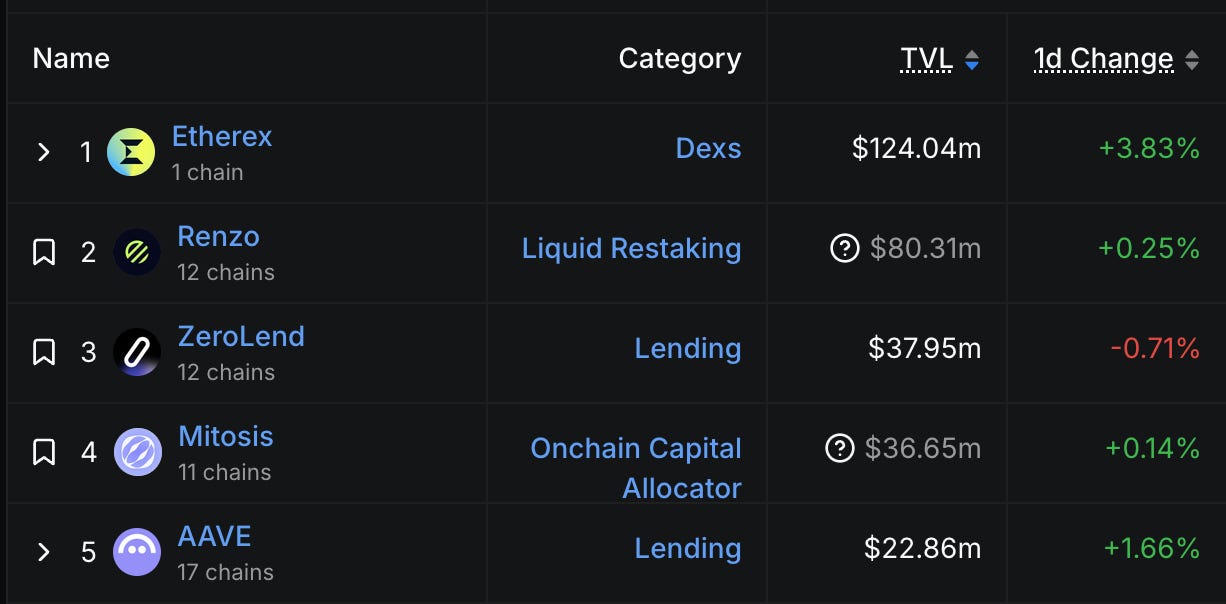
Etherex on Linea Crosses $120 Million TVL Mark Through (3,3) Mechanism
Etherex, the recently launched V(3,3) DEX, has achieved significant traction since its token launch, surpassing $120M in Total Value Locked (TVL) and establishing itself as the most-used DApp on Linea. This milestone reinforces the continued strength of the V(3,3) model, which has proven successful across multiple chains—most notably with Aerodrome dominating Base and Velodrome leading on Optimism.
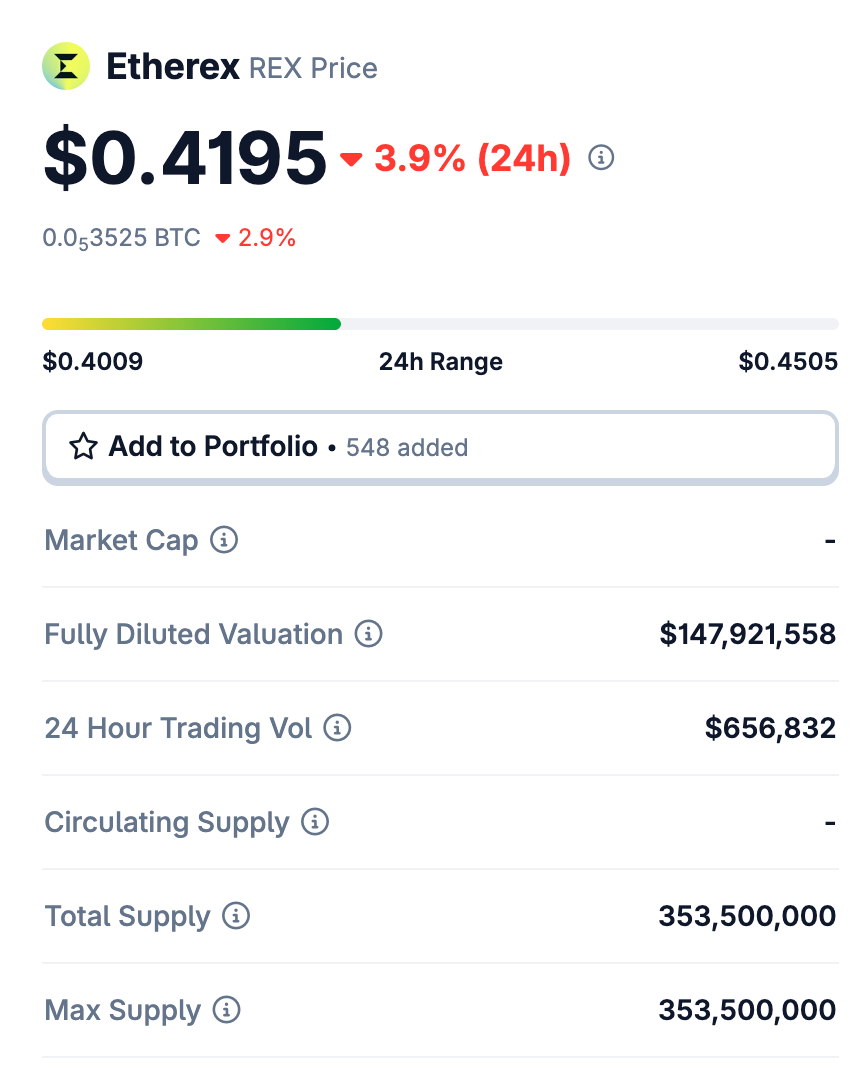
Token Metrics:
Current price: $0.41
Fully diluted valuation: $147.9M
Max supply: 353.5M REX tokens
For investors seeking exposure to the Linea ecosystem, REX presents an intriguing opportunity—assuming the protocol maintains its growth trajectory. The investment thesis extends beyond the protocol itself to include a bet on Linea's broader adoption.
Market Context: To put this in perspective, Aerodrome Finance currently holds $599.54M in TVL, suggesting significant upside potential if Etherex can capture a similar market position within the Linea ecosystem. This makes REX both a protocol play and a strategic bet on Linea's continued development as a Layer 2 solution.
Read the full The Defiant article here
Abstract mining game Bigcoin plots comeback after BIG crash
Bigcoin, an Abstract-based crypto “mining” game that boomed and then busted earlier this year, is making a comeback under new community-led management. Originally launched by an anonymous creator known as “Bigtoshi,” the game let players buy virtual rooms, install quirky pixelated rigs, and mine the in-game token, BIG. After an April surge to nearly 70,000 users, activity and token prices crashed — down 93% from the peak — amid Ponzi accusations. Now, led by prominent community member “BoredElon” and others, Bigcoin 2.0 has turned its rigs into 29,000 NFTs on OpenSea to fund development and improve liquidity. Over half of mined BIG has been burned, and early buyers of the new NFTs suggest some renewed faith in the project’s “fair token launcher” vision. Whether this revival will stick remains to be seen.
Read the full Blockworks article here
Lost your crypto password or seed phrase? Here’s what actually works in 2025
In 2025, losing access to your crypto wallet remains a common and sometimes costly problem, but recovery options depend heavily on the wallet type. Custodial wallets from exchanges like Coinbase or Binance can often be restored through password resets and ID verification, while non-custodial wallets like MetaMask or Ledger require the seed phrase for recovery. Without both the password and seed phrase, regaining access is usually impossible. The article warns against scams from fake recovery firms, advising users to seek services with no upfront fees, transparent processes, and verified track records. For high-value cases, advanced methods like brute-force tools, blockchain forensics, or legal action may be worth considering, though success is never guaranteed.
Read the full Cointelegraph article here
Podcast Picks 🎧
This week's audio alpha—handpicked conversations that shaped my thinking and could shift yours too.
I sift through hours of DeFi content so you don't have to. These are the episodes worth your commute, the insights that made me pause and rewind, and the perspectives that are moving markets before they hit mainstream media.
Queue these up and stay ahead of the narrative.
The Rollup: We Asked an RWA Expert About Asset Tokenization. - listen
Bankless: Vitalik Buterin: How Ethereum Becomes The World Ledger - listen
Forward Guidance: Markets Are Underestimating the Risk of a 10–15% Correction - listen
Bell Curve: The Best of Bell Curve - listen
The Chopping Block: Circle’s Arc & Stripe’s Tempo Chains; Monero 51% Attacked - listen
Vesting Watch 🔓
Token unlocks to watch this week. Expect potential volatility around these dates as new supply hits the market.
KAITO (10.85% of released Supply) - August 20
MURA (1.09% of released supply) - August 23
VELO (0.83% of released supply) - August 25
VENOM (2.28% of released supply) - August 25
The 2025 playbook for Airdrop 🔗
Airdrops aren't dead—they're just getting selective.
While crypto Twitter debates the "death of airdrops," I'm quietly positioning for the next wave. Projects like Hyperliquid prove that quality airdrops still reward early, genuine users with life-changing amounts.
I've been fortunate to catch major airdrops including Uniswap ($12k+), dYdX ($15k+), PENGU, 1INCH, Paraswap, and dozens of smaller wins. The difference? I focus on authentic usage patterns rather than mechanical farming.
In this section, I'm sharing my complete 2025 airdrop methodology—from identifying promising protocols early to building the exact onchain footprint that gets rewarded.
Building Onchain Credibility
The key to future airdrops isn't transaction volume—it's building legitimate onchain reputation. While others chase quick farming strategies, I'm focused on creating the behavioral patterns that protocols actually reward.
Smart airdrop hunters are already adapting their approach. Here are the specific methods I'm using to maximize credibility for the next wave of quality airdrops:
Vote on Snapshot – Earn Influence:
If you hold governance tokens like ENS, OP, ARB or many others, you can help shape the future of your favorite protocols by voting on proposals via Snapshot.
Voting on Snapshot is free. It only requires a quick wallet signature to prove you own the tokens. No gas fees and no token transfers.
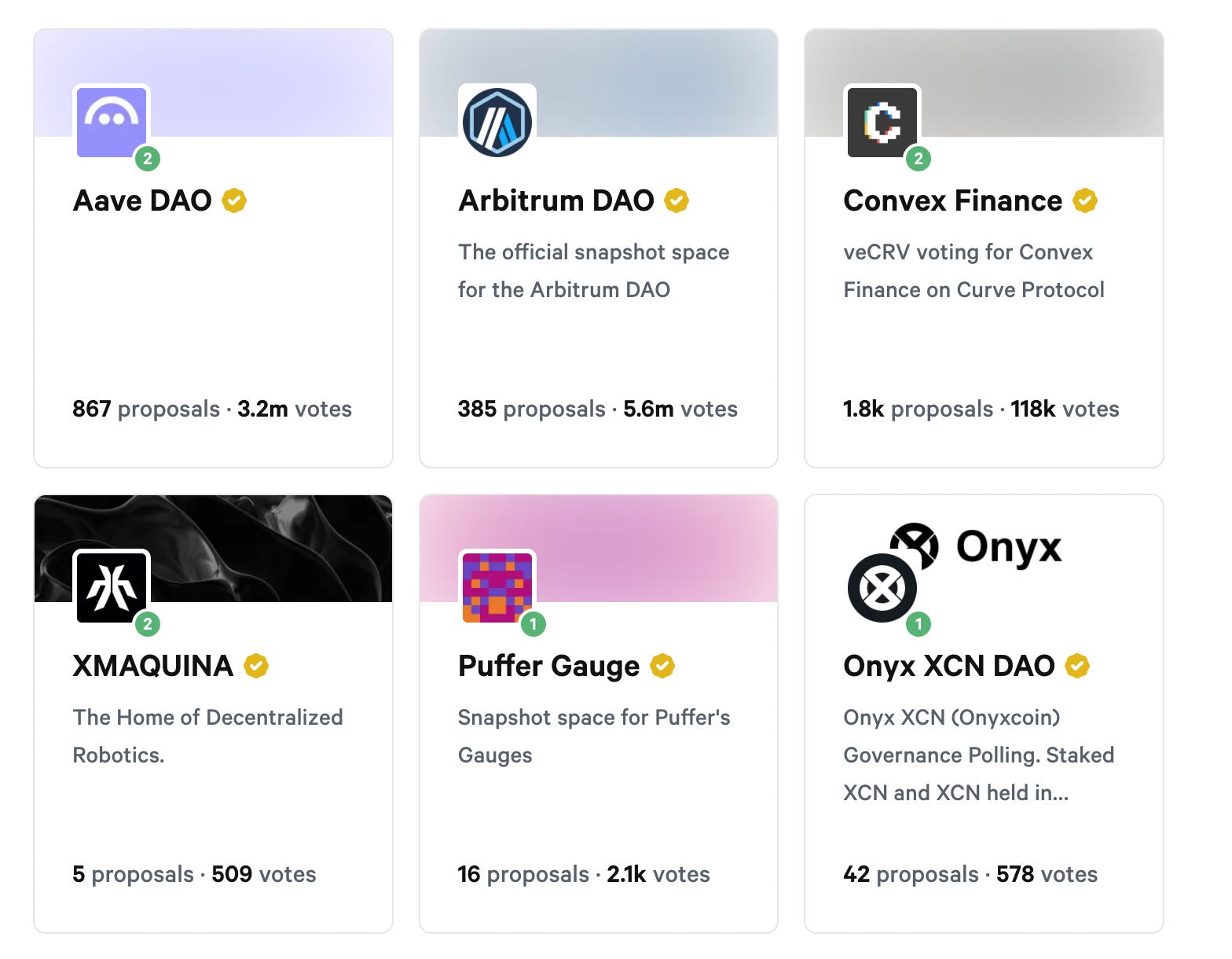
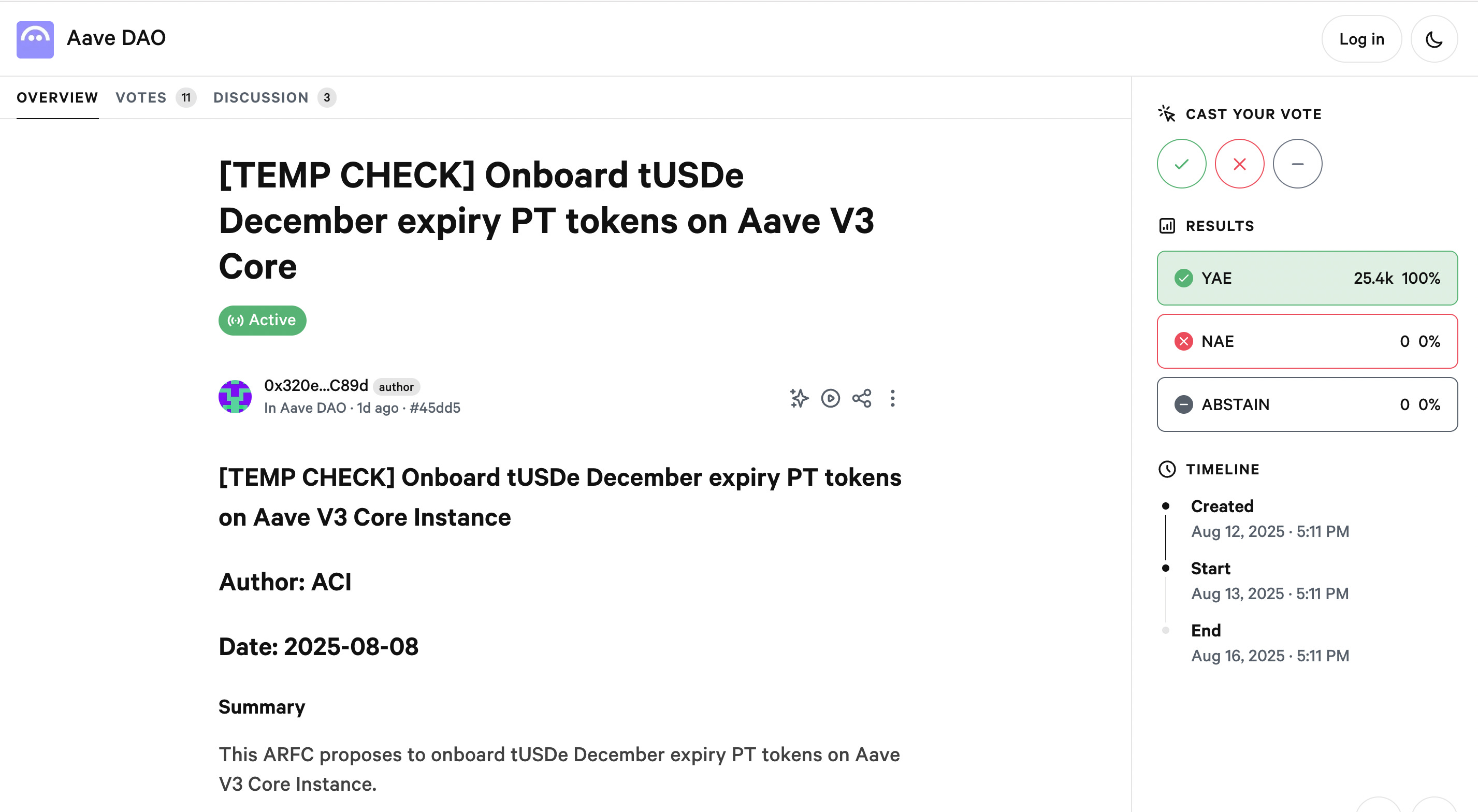
With Snapshot, you can easily find governance proposals and cast your vote, often just by clicking Yes or No. This activity not only helps steer projects you care about but also shows other protocols (especially those without a token yet) that you are an active governance participant.
Why is that important? Some protocols have rewarded active Snapshot voters with airdrops. Your governance history could one day make you eligible for future distributions.
Past examples of protocols that rewarded Snapshot voters include:
Optimism (OP)
Seamless Protocol
OIP (Open Custody Project)
Maverick Protocol (MAV)
Active governance is not just good for the ecosystem. It could be good for your wallet too.
Use DeFiLlama to your advantage:
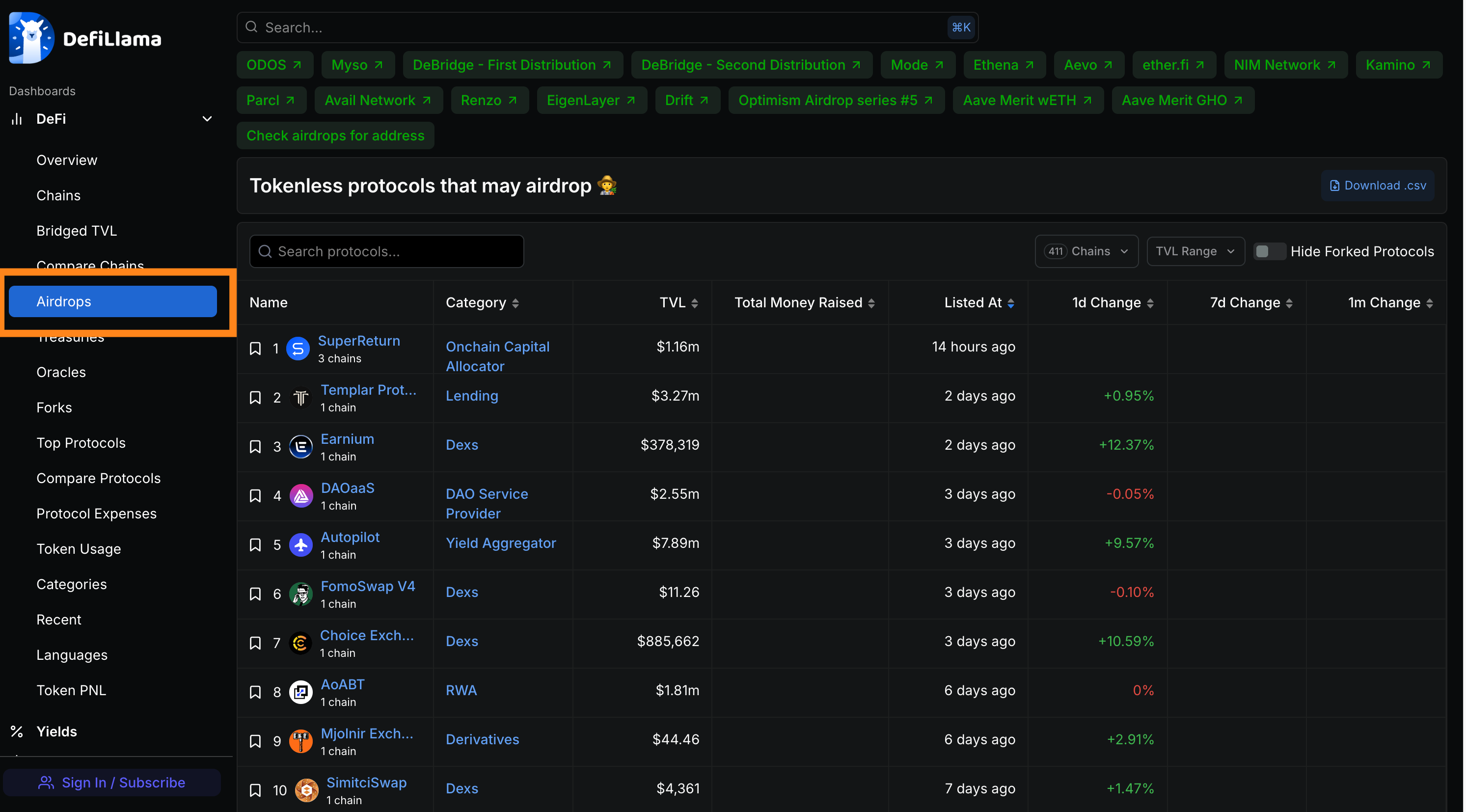
DeFillama is a very great tool that I constantly use to find new airdrop, you have a dashboard specifically made for protocols that does not have a token yet, and most DeFi protocols needs a token for governance proposition and voting.
To access the dashboard, click on Airdrop, and here you will see all the tokenless protocols, but be careful, because by default, they are sorted by listed date so there is a lot of noise from this page.
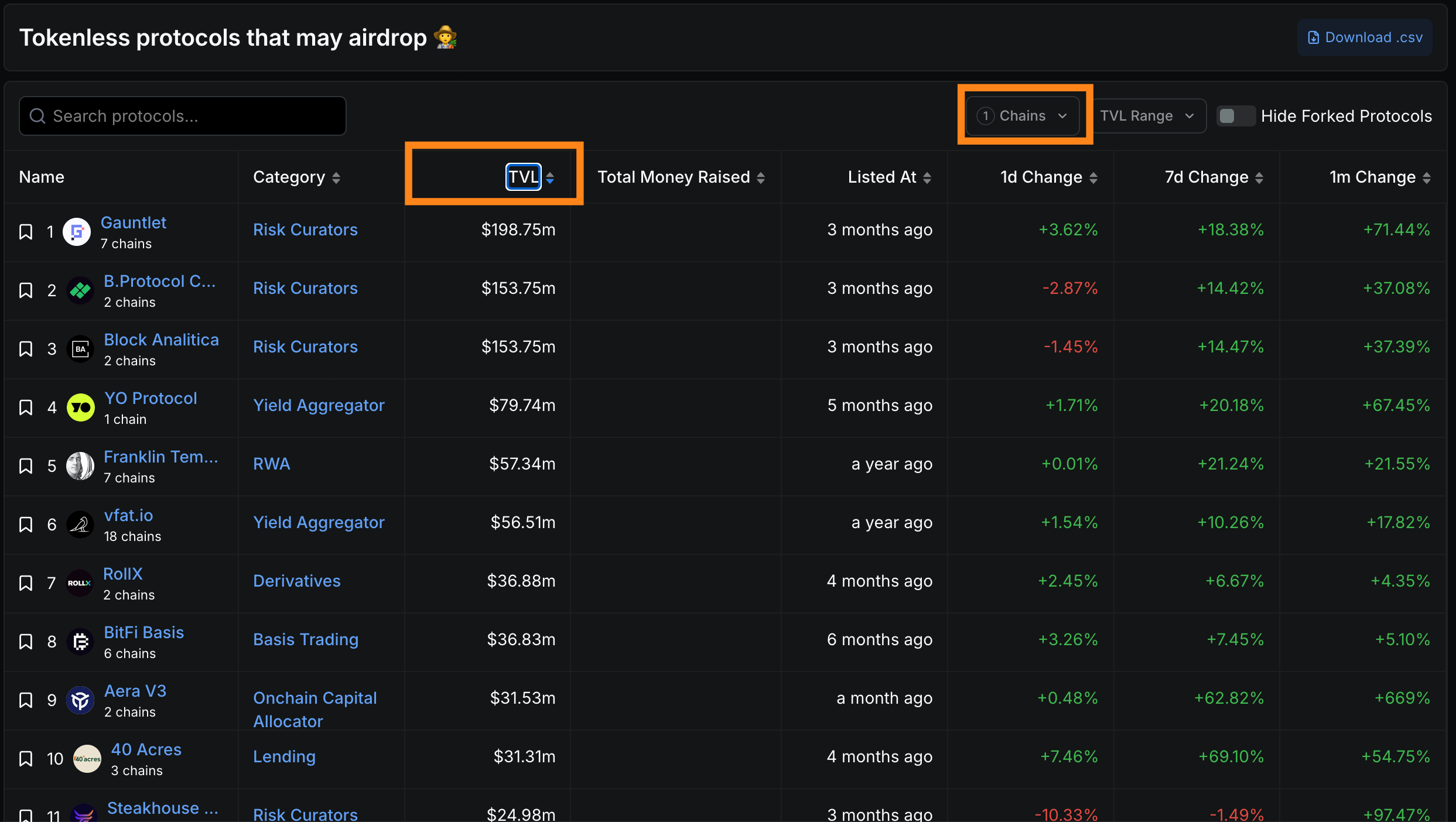
In that case what I recommend you to do is select a chain, in example Base, and you want to sort by TVL.
In the example below, we selected Base as the chain and we filtered by TVL, so as you can see we have the top DeFi protocols on Base that does not have a token, from that list, I will probably do some reasearch on Yield Aggregator such as Yo Protocols, or derivatives such as RollX
If you want to filter the noise, you can also filter by TVL Range, in example, you want protocols with only a TVL above $3M.
And even tho low TVL protocols are interesting to explore, they are much more risky, even if it is a fork of AAVE or other protocols, so for me I prefer to play it a bit more safe and think long term.
By doing that, I managed to score multiple high quality airdrops over the years, stuff that you can miss on crypto twitter with all the noise
Airdrop Alpha 🎯
Every week I share the airdrop opportunities I'm personally targeting and the exact strategies I'm using to position for them.
My approach focuses on high Total Value Locked (TVL) protocols to minimize risk while maximizing opportunity.
Symbiotic
Symbiotic uses permissionless restaking: it allows validators to secure multiple networks by staking assets once (not just ETH), maximizing capital efficiency while maintaining robust security.
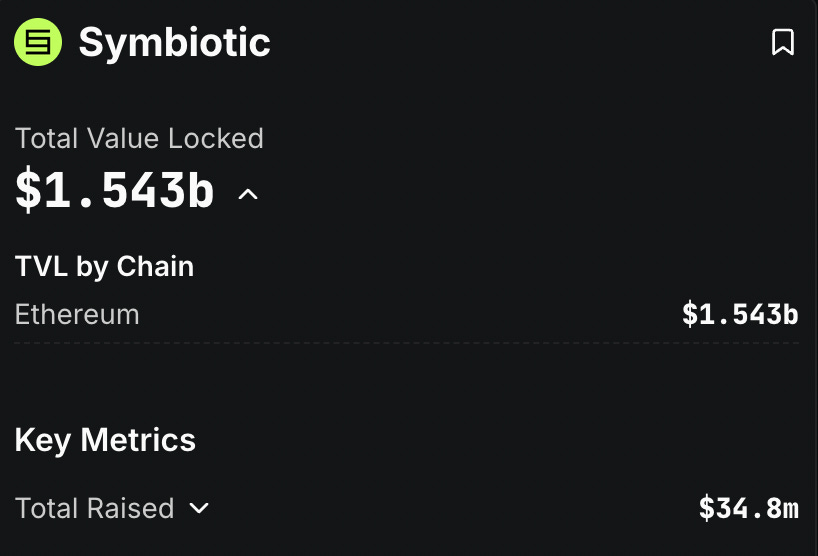
The protocol currently holds $1.542B in TVL and operates exclusively on Ethereum mainnet. This Ethereum-only deployment is actually a strategic advantage for potential airdrop hunters, as the high gas costs on mainnet naturally deter industrial-scale farmers who typically operate hundreds of wallets. This creates a more favorable environment for genuine users to qualify for potential rewards.
The Strategy:
Step 1: Access the Deposit Page Navigate to the Symbiotic website and click on "Deposit" to begin the staking process.
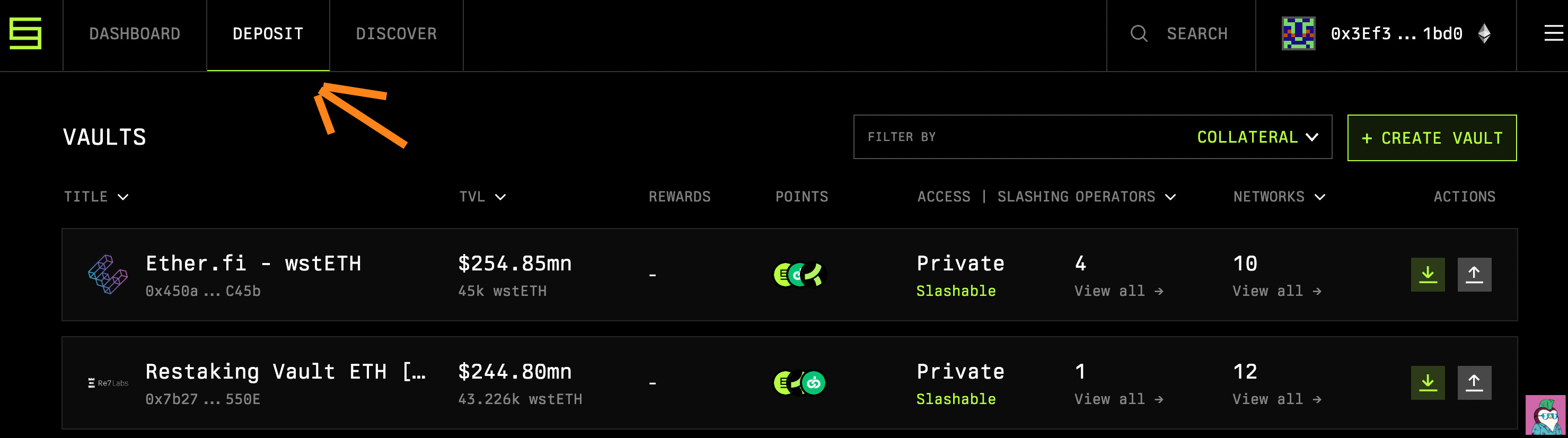
Step 2: Select Your Vault You'll see a table displaying multiple vault options. For this tutorial, choose a Public vault that's actively running (not in pre-deposit status). We'll use the Gauntlet vault as our example.

Step 3: Review Vault Information Before depositing, examine the vault details including:
Total Value Locked (TVL)
Vault contract addresses (Burner, Delegator, Slashers)
Asset type and requirements
Step 4: Make Your Deposit This particular vault accepts wstETH deposits. Enter the amount you wish to stake based on your risk tolerance. Remember that all deposits carry slashing risk - only invest what you can afford to lose.
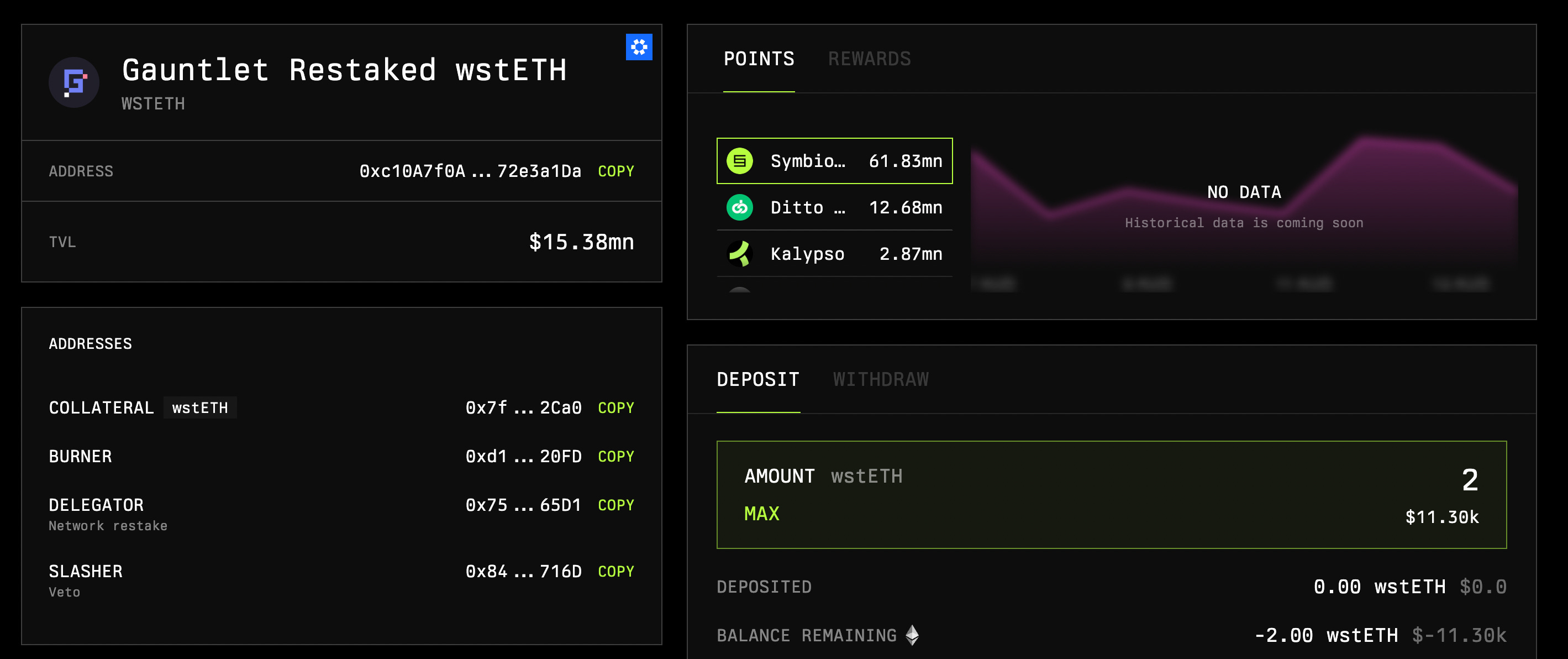
Step 5: Start Earning Once your deposit is confirmed, you'll immediately begin accumulating Symbiotic points. These points will likely convert to future rewards or airdrop eligibility.
Dashboard Overview You can monitor your progress anytime through the Dashboard, which displays your total deposited amount across all vaults and your accumulated Symbiotic points. This gives you a complete overview of your staking positions and rewards earned.
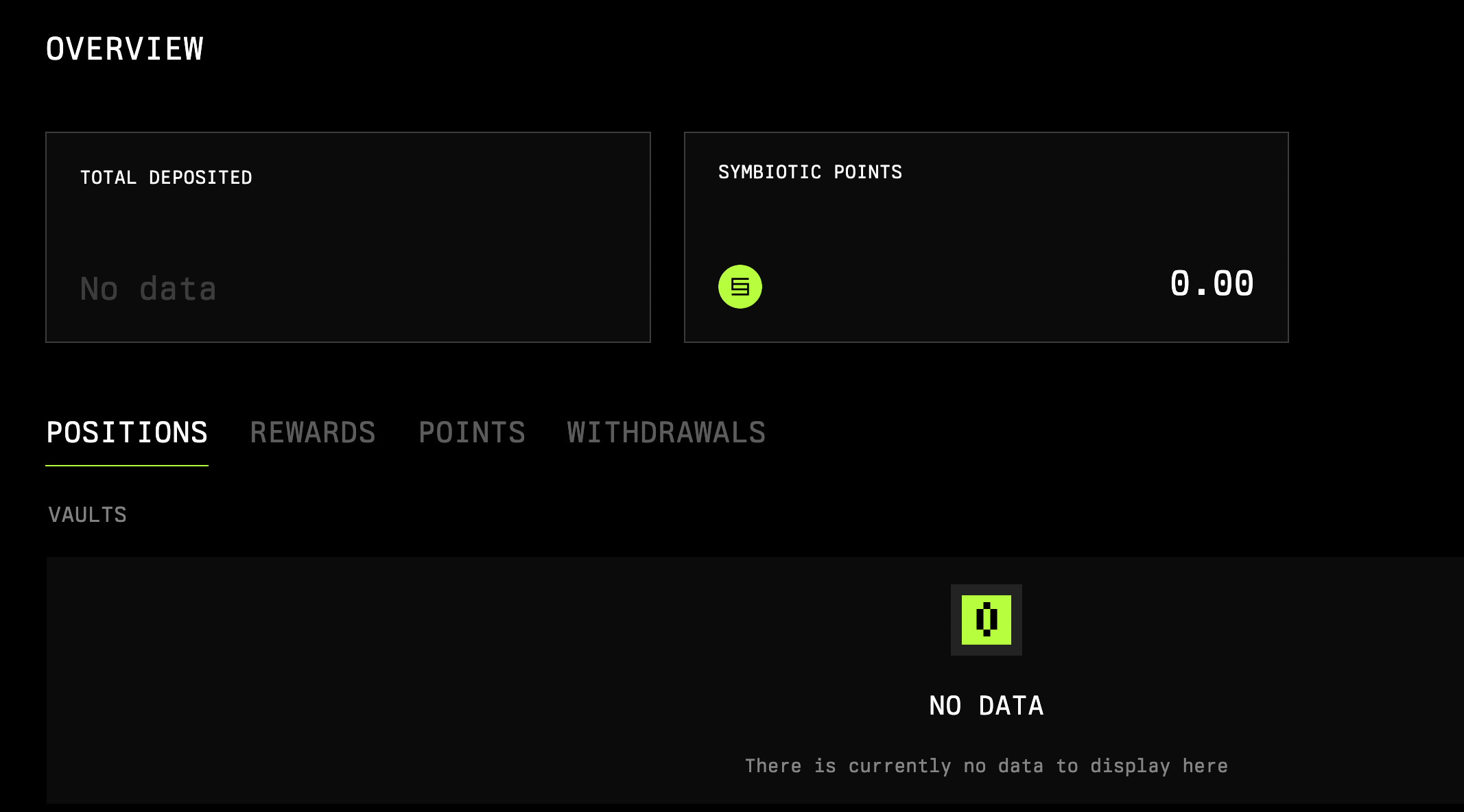
⚠ Important Reminder: Always understand the slashing risks before depositing. Your funds help secure networks, but validators can be penalized for misbehavior, potentially affecting your stake.
Symbiotic Points - Simple Breakdown
What is it? Symbiotic rewards users with points for helping secure decentralized networks by staking their crypto assets.
How to earn points:
Deposit crypto into Symbiotic vaults (1x points)
Actively delegate to secure networks (2x points - better rewards!)
Supported assets: ETH, liquid staking tokens, other ERC-20 tokens
Key Strategy: Don't just deposit and sit idle. Actively delegate your assets to networks for double the points.
Why it matters: Points typically convert to airdrops or governance tokens later. The protocol has $1.542B TVL and runs only on Ethereum mainnet, which reduces farmer competition due to high gas costs.
Strategy Summary This is a straightforward approach, but with Symbiotic's impressive $1.542B TVL on mainnet, this protocol has serious potential for a significant airdrop. The high-value, single-chain deployment suggests this could be one of the bigger opportunities this cycle.
Advanced Opportunities For more experienced users, creating your own vaults opens up additional earning potential. If you're interested in exploring vault creation strategies, feel free to discuss ideas in the Substack chat - I'm always happy to share insights on advanced techniques.
Bonus Airdrop Potential Here's a key advantage many miss: by depositing into Symbiotic vaults, you're not just positioning for the Symbiotic airdrop. You can also earn points from other protocols building on top of Symbiotic, potentially making you eligible for multiple airdrops with a single deposit. This "airdrop stacking" effect significantly increases your potential returns per dollar invested.
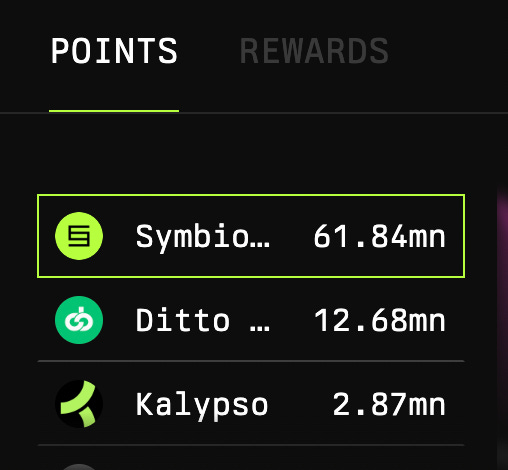
Bottom Line Simple execution, high TVL protocol, multiple airdrop exposure - this checks all the boxes for a quality opportunity that doesn't require complex strategies to participate in effectively.
Token Watch 📊
PENGU
With the upcoming Abstract chain TGE, PENGU stands out as one of my top picks for the year. The token has pumped 178% over the last 3 months, but I believe there's still momentum left in the tank.
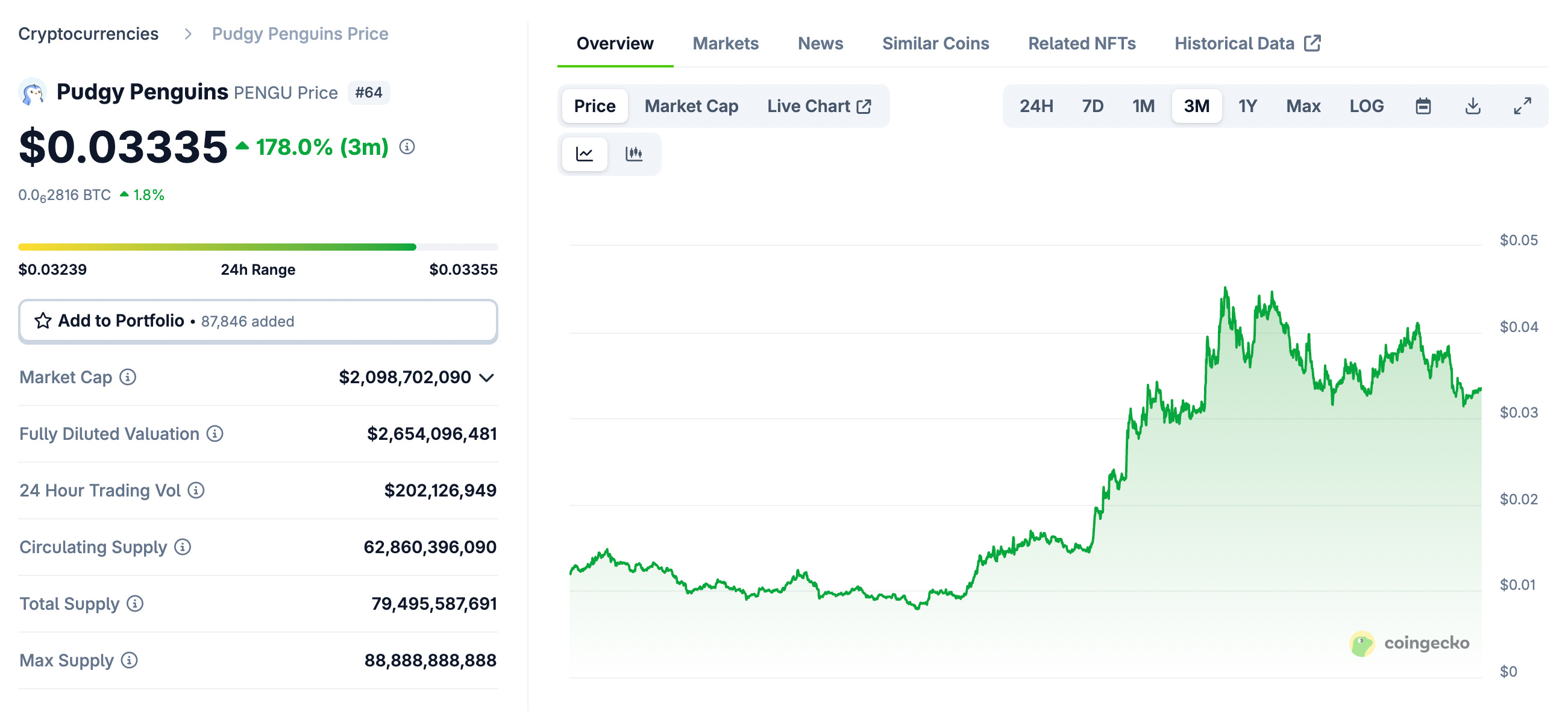
Multiple catalysts are aligning: we're likely entering an NFT season where Pudgy Penguins should outperform, Abstract is gaining TVL traction, and the Pudgy team has consistently shipped throughout the entire bear market. This execution track record makes a DCA strategy into PENGU compelling.
Currently trading in a range after a 14% pullback over two weeks, this looks like healthy consolidation before the next leg up. When markets go parabolic, having PENGU exposure should pay off significantly.
The smart money agrees. According to StalkChain data, PENGU has been the most accumulated token by whales over the last 3 days, and this pattern has repeated for weeks. These players clearly see something brewing.
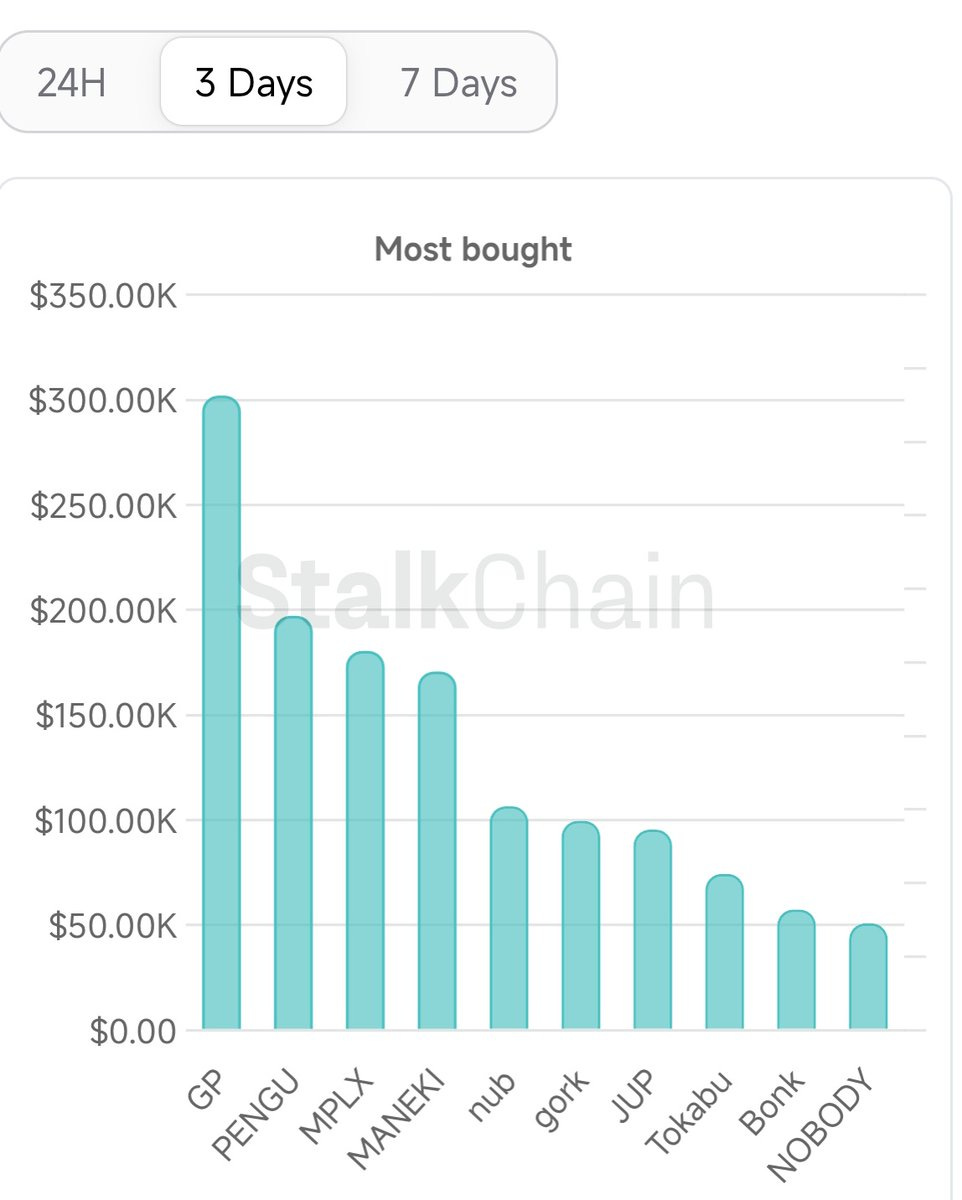
Given PENGU's volatility, I'm holding my position while initiating a small DCA to capture multiple entry points. Post-Abstract airdrop, I'll reassess and likely trim some exposure since this is my only memecoin allocation. But unlike most Solana memes, I'm betting on the Pudgy team's long-term execution rather than pure speculation. They've proven they won't rug, and that's rare alpha in this space.
Onchain Analytics 🧐
Aave's Capital Efficiency Revolution: From Speculation to Utilization
Aave's lending metrics reveal a fundamental shift in DeFi capital efficiency across market cycles. During the October 2021 peak, the protocol maintained $19.1B in TVL with $12.0B borrowed, achieving a 63% utilization ratio. Fast forward to August 2025, and despite TVL nearly doubling to $37.6B, borrowed amounts have surged 129% to $27.5B, pushing utilization to 73%. This isn't just growth; it's optimization. The market has learned to actually deploy capital rather than simply park it for speculative yield farming.
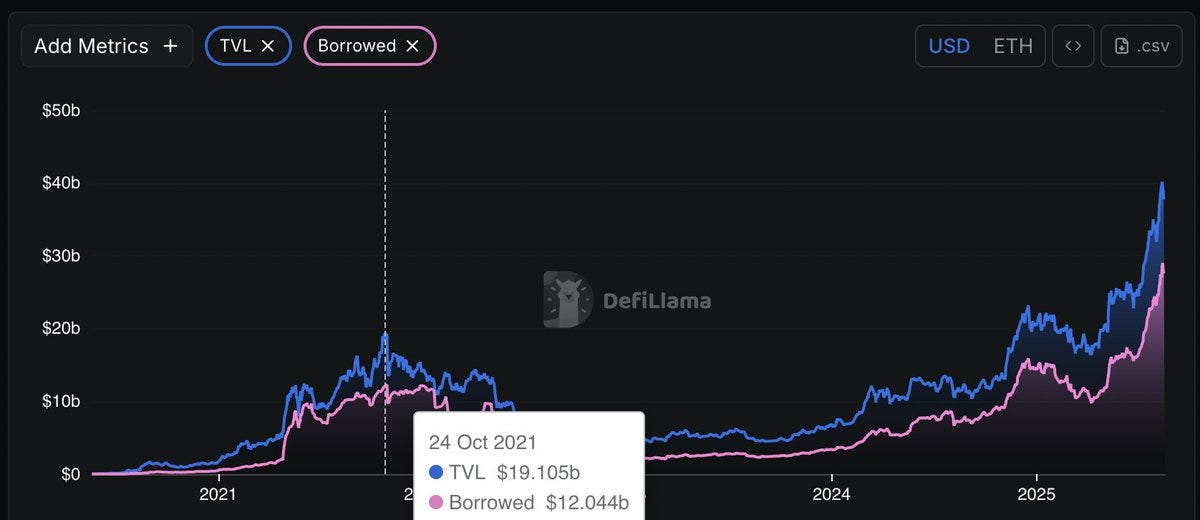
This utilization improvement tells a deeper story about DeFi maturation. Higher borrowing ratios mean depositors earn better yields, protocols generate more fee revenue, and capital allocation becomes more productive. The 2021 cycle was characterized by liquidity mining rewards inflating TVL without corresponding borrowing demand. Today's 73% utilization suggests genuine economic activity: users borrowing against collateral for real financial needs rather than farming tokens. When utilization rises alongside absolute volumes, it signals that DeFi infrastructure is finally fulfilling its promise of efficient, programmable capital markets.
Tether's Fee Engine: $449M in Monthly Revenue Signals Stablecoin Dominance
Tether's fee generation has reached a staggering $449.3M over the past 30 days, showcasing the economic powerhouse behind the world's largest stablecoin. The steady climb from mid-July through August reveals consistent demand for USDT across global markets, with fees representing the cost users pay for minting, redeeming, and transacting with the token. This isn't just impressive revenue; it's a direct measurement of Tether's utility as financial infrastructure. At an annualized run rate of $5.4B, these fees demonstrate that stablecoins have evolved from crypto curiosities to essential monetary rails for the digital economy.
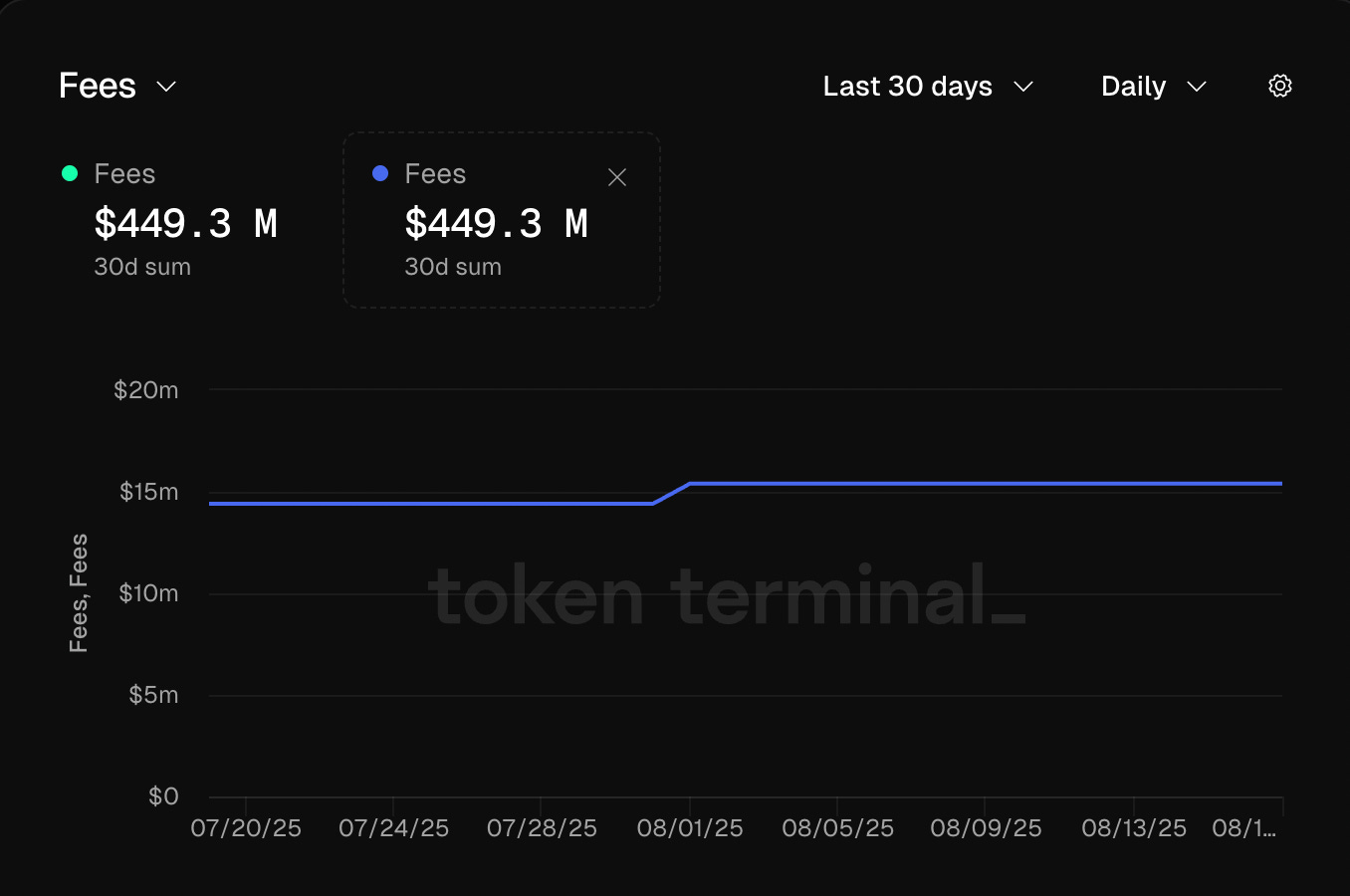
The fee trajectory tells a compelling story about market maturation and Tether's moat. Unlike speculative DeFi tokens that generate fees through temporary incentives, USDT fees stem from genuine economic necessity: businesses need dollar-denominated settlements, traders require stable base pairs, and emerging markets demand access to digital dollars. The consistent upward trend through August suggests growing institutional adoption and cross-border payment flows. When fee generation grows this predictably, it indicates that Tether has achieved something rare in crypto: sustainable product-market fit with defensible economics that compound over time.
Ethereum vs Solana
Ethereum's capital flows tell a tale of two ecosystems diverging. With $21.9B in inflows against $13.3B in outflows over the past three months, Ethereum has maintained a healthy $8.6B net positive flow, demonstrating sustained institutional and retail confidence. Meanwhile, Solana shows a more modest $1.25B inflow versus $1.2B outflow, resulting in just $54.5M net positive. The stark difference in absolute volumes reveals Ethereum's continued dominance as the primary entry point for crypto capital, processing nearly 17x more inflow volume than Solana despite the latter's narrative momentum.
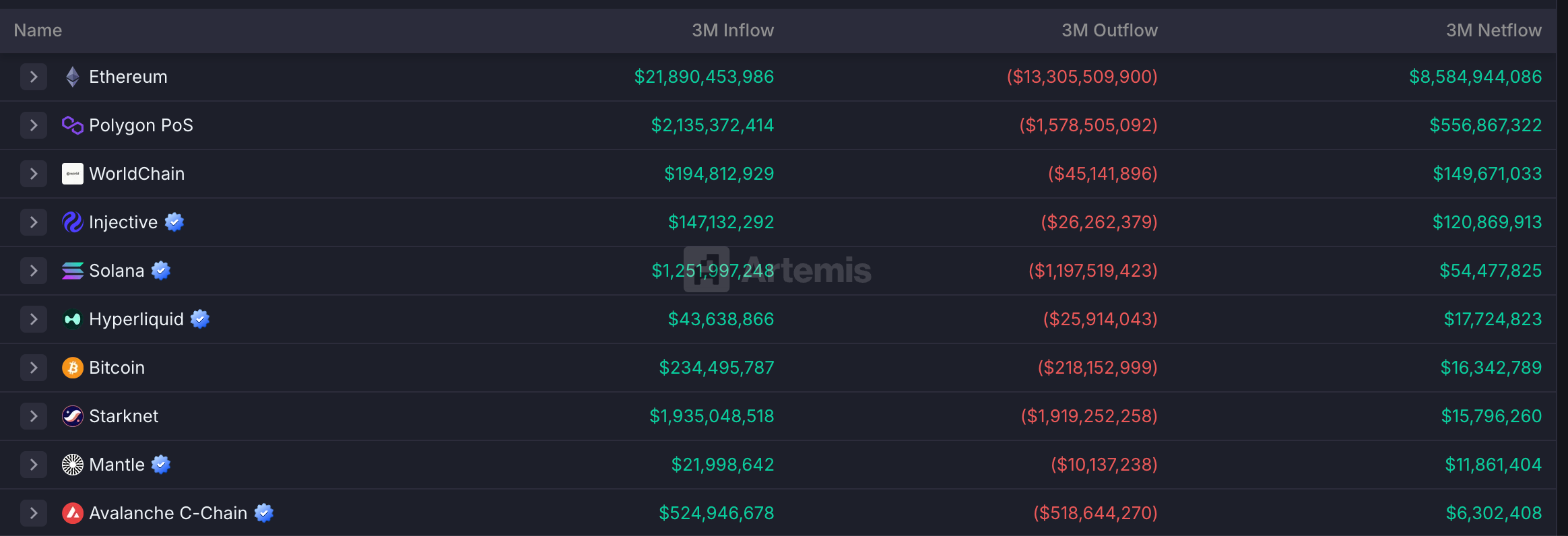
The netflow dynamics expose deeper market psychology around these competing ecosystems. Ethereum's massive inflow advantage suggests it remains the primary vehicle for new money entering DeFi, whether through ETFs, institutional adoption, or whale accumulation. Solana's comparatively balanced flows indicate a more retail-driven, trading-oriented ecosystem where capital rotates quickly rather than accumulating for long-term holds. When Ethereum captures $8.6B in net flows while Solana barely breaks even at $54M, it signals that despite all the "Ethereum killer" narratives, serious money still views ETH as the safer, more established store of value in the L1 wars.
That’s it for this week.
If you found this edition valuable, please consider sharing it with your network.
None of the information in this newsletter constitutes financial advice. While I personally use most of the protocols that I discuss, it's important to understand that they involve substantial risk. Don’t invest what you can’t afford to lose