

At a glance
Exit window: Abstract closes on December 15. Check your assets and withdrawal route before the deadline.
The business: consumer spending reached its apps, while Igloo kept funding the chain.
For Pudgy: renewed attention needs to become collector demand or a concrete mechanism that benefits PENGU holders.
Five developments from October 1–7 and five podcast picks follow the analysis.
Hello everyone,
I own a Pudgy Penguin. Seeing the floor around 2.9 ETH on October 8, alongside Abstract’s closure news, felt rough. I still think Pudgy can recover. I want people to have stronger reasons to buy and hold than hoping for another airdrop.
Abstract announced on October 6 that the chain will close on December 15, 2026. It warns that assets left on the network after that date will become inaccessible. Official announcement.
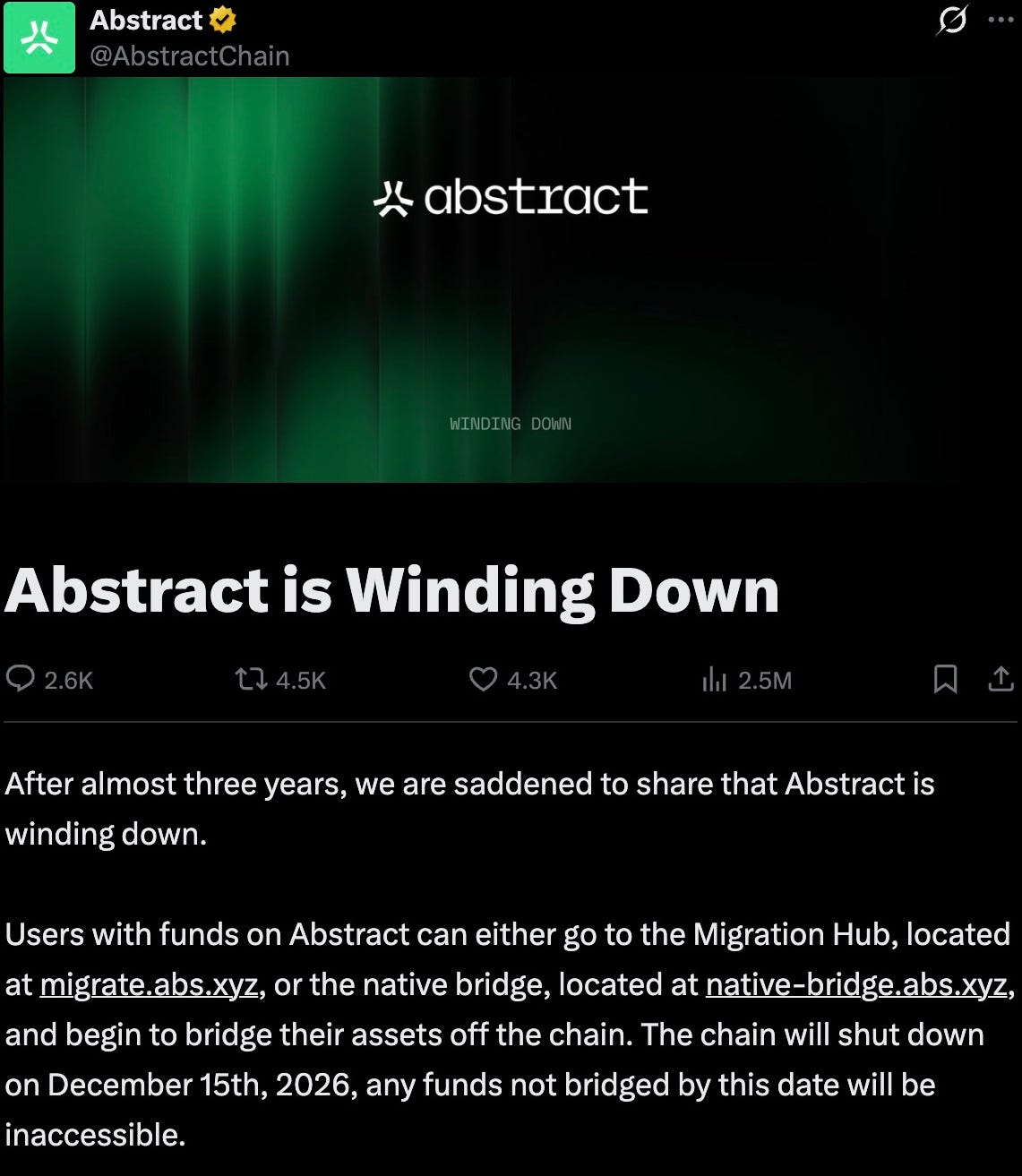
Abstract’s official wind-down announcement, published October 6. Screenshot captured October 7, 2026. Source: Abstract on X.
My conclusion: Abstract made its apps easier to use, but Igloo decided to stop subsidizing the network. Holders have an exit to manage now. For Pudgy, I would watch repeat customer demand and the specific benefit to NFT or token holders before treating the change in focus as an investment case.
In The DeFi Digest, I look at where DeFi returns come from and what could go wrong. Subscribe to receive the next breakdown.
What Abstract got right
Abstract launched on January 27, 2025 as an Ethereum rollup using the ZK Stack and ETH for gas. It focused on games, trading and digital collectibles. L2Beat’s project profile.
Abstract Global Wallet let users sign in through email, social login or a passkey and carry one smart-contract account across apps. Apps could sponsor gas. Limited session keys let a game act without prompting for every signature; their permissions can expire or be revoked. AGW overview, wallet architecture and session keys.
That removed friction for players. Sponsored gas still has a payer, though, and easy transactions tell us little about returning customers or the revenue the operator keeps.
The rise and retreat in Abstract’s TVL
DeFiLlama records $6.72 million of TVL at launch, a $57.84 million peak on August 14, 2025, and $27.21 million by September 1. The September 1 daily point fell roughly 36.2% from the day before.
TVL recovered to $41.90 million on November 1, then fell to about $9.8 million by July 1, 2026. The October 7 daily point was $8.44 million, about 85% below the peak. Live balances and prices update separately. Historical chain series and Abstract dashboard.
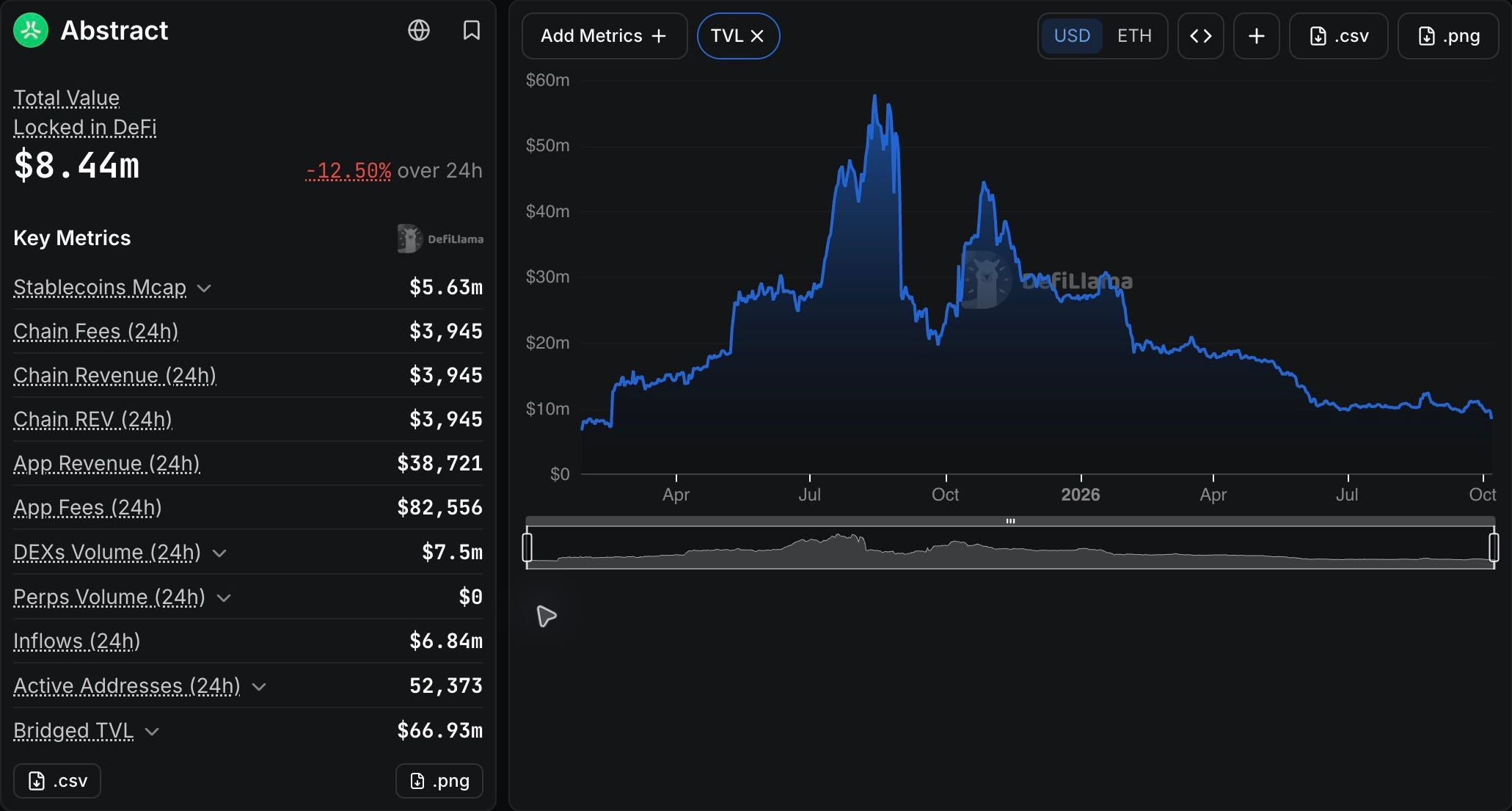
Abstract’s DeFi TVL history and key metrics. Snapshot captured October 7, 2026. Source: DeFiLlama.
The retreat began well before the shutdown announcement. This week’s news cannot explain the whole decline.
SakuraSwap’s pools held $28.16 million, nearly 49% of chain TVL, at the August peak. Aborean’s held $24.44 million, about 58%, at the November rebound. The recovery was concentrated in another DEX. SakuraSwap AMM, SakuraSwap CLMM, Aborean AMM and Aborean CL, using Abstract balances.
Dollar TVL includes token prices and deposited amounts. An 85% drop cannot tell us how many depositors left or what a typical investor lost.
Base held $4.86 billion on Abstract’s peak day and $6.23 billion at the latest October 7 daily point. Abstract was roughly 1.2% and 0.14% of those totals. Base historical series.
That shows the difference in scale. It does not trace Abstract’s former deposits into Base.
Where the business struggled
At the October 7 snapshot, SakuraSwap held about $4.1 million and Aborean $2.51 million, together roughly four-fifths of reported DeFi TVL. Morpho Blue’s Abstract balance was about $73,000. Protocol rankings.
Lending existed: Morpho’s Abstract TVL reached $1.53 million in March 2026 and Kona’s $1.50 million in January. Both later shrank, limiting the depth available to borrowers and strategy users. Morpho history and Kona history.
DEX TVL also cannot promise a good execution price. Capital may sit in other pairs or outside your trade’s price range. Check the quote for your asset and size, including its route home.
Application fees did not pay every chain bill
The latest 30-day application-fee aggregate was $2.44 million. Gacha TCG contributed $2.10 million and DYLI about $237,000, together roughly 96%. Abstract fee rankings.
Gacha’s fee measure is gross USDC.e card-pack purchases. After card buybacks, its revenue measure was $498,000 over 30 days, before operating costs. DYLI uses a different net-card and marketplace methodology. These figures cannot be compared as profit margins. Gacha fees, Gacha revenue and DYLI methodology.
Abstract’s own gas-fee series reported $118,000 over 30 days. Its dashboard showed $3,945 in chain fees beside $82,556 in app fees for the latest completed daily observation. Customers paying an app does not mean that money reaches the chain operator. Abstract chain fees.
We do not have a full account of payroll, incentives or infrastructure costs. These fee totals cannot establish profitability, and annualizing a wind-down day would mislead. DeFiLlama’s fee definitions.
Points made retention harder to judge
Abstract awarded XP for app activity and trading. CoinGecko’s February 2025 guide documented the early program and warned that participation did not guarantee an airdrop.
I would look for repeat purchases and returning players after rewards fall. Transaction counts alone cannot separate product demand from reward expectations.
Farmers pay fees, slippage and asset risk today for an unconfirmed payout. That does not make every user a farmer, but it makes incentive-driven activity harder to interpret.
Abstract’s Panoramic Governance whitepaper explored governance tokens, escrowed voting and sequencer rewards. It documents a proposed model, not a launched token or guaranteed XP allocation.
Why Igloo stopped funding it
Luca Netz said on October 6 that Igloo funded Abstract for 18 months and lost tens of millions of dollars over two years without finding product-market fit. He cited limited DeFi activity, thin liquidity, little institutional overlap and high costs. These are his claims, not audited accounts. Netz’s statement.
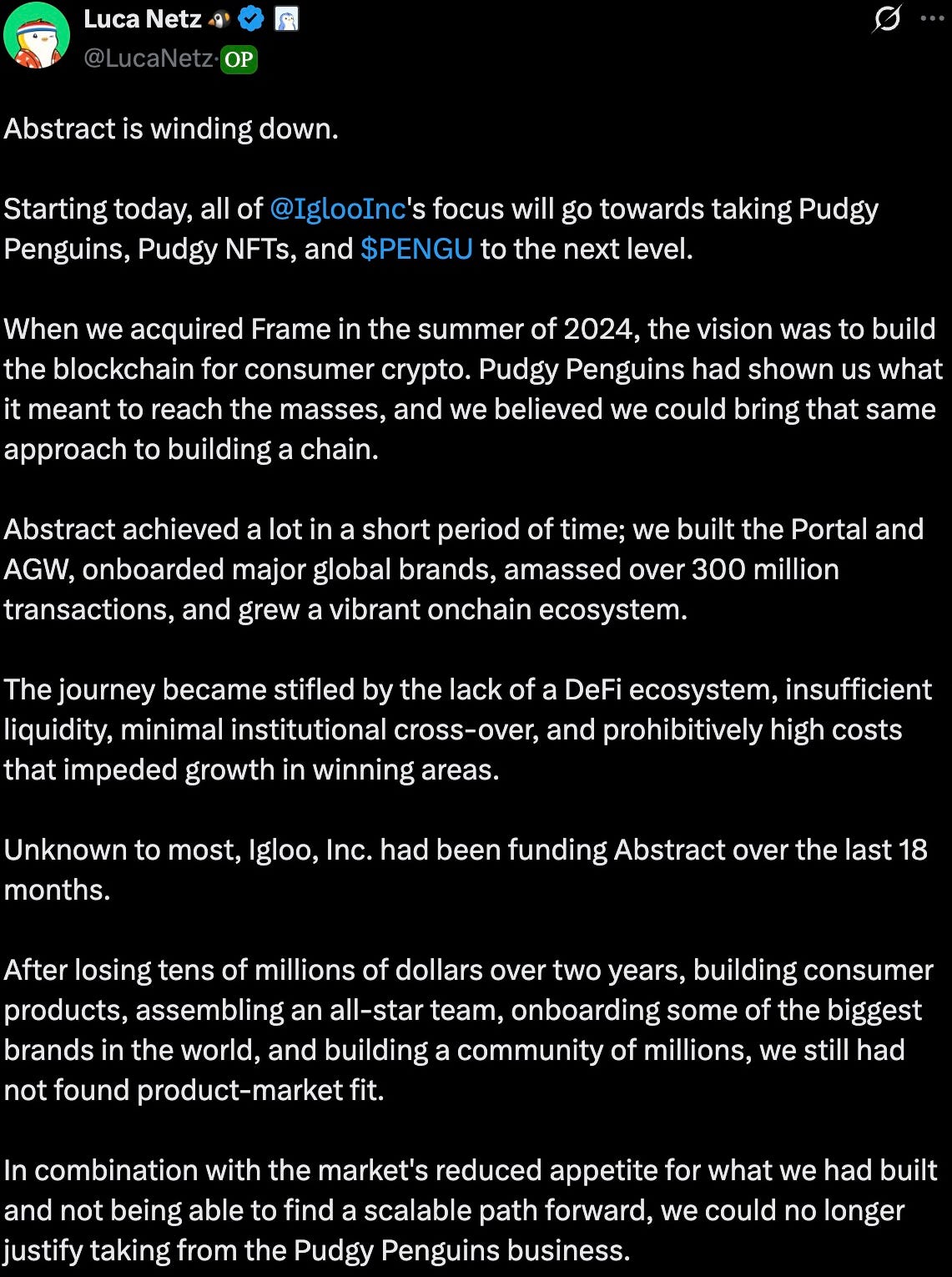
Excerpt from Luca Netz’s October 6 statement. Funding and losses are his claims, not independently audited figures. Source: Luca Netz on X.
Netz also said Igloo declined to launch a token or ICO to fund it further. I respect that choice. Raising another round would still have left the problem of sustaining the business.
What the wind-down means for PENGU
Netz says Igloo’s focus returns to Pudgy Penguins, Pudgy NFTs and PENGU. At 19:12 CEST on October 7, PENGU traded around $0.00852, with a $536 million market cap and $234 million of 24-hour volume. It was down about 9% over 24 hours and 15% over seven days. These windows include other market moves and cannot isolate the announcement’s effect. CoinGecko market data.
Kung Fu Tea’s October 1–15 collaboration includes blind boxes at 100 participating locations and a Walmart-powered New York Comic Con presence on October 8–11. The brand still reaches customers outside crypto; that reach does not establish PENGU-holder income. Kung Fu Tea’s September 30 announcement.
Closing Abstract could conserve Igloo’s cash and attention. PENGU holders have no automatic claim on those savings: the issuer-linked whitepaper gives them no equity or dividend rights. I would look for an implemented mechanism that creates token demand or distributes value to holders.
My view as a Pudgy holder
I own a Pudgy Penguin, so this is personal too. On October 8, I posted about how it felt to see the NFT floor around 2.9 ETH. I still believe Pudgy can recover, but I want stronger reasons for people to own the original NFTs.
Some sellers may have bought for future airdrops. I haven’t traced their wallets, so that remains a hypothesis. What would make me more confident is new collectors buying and holding without needing another reward. The brand can keep growing while that demand takes longer to develop.
Read my post and the discussion on X.
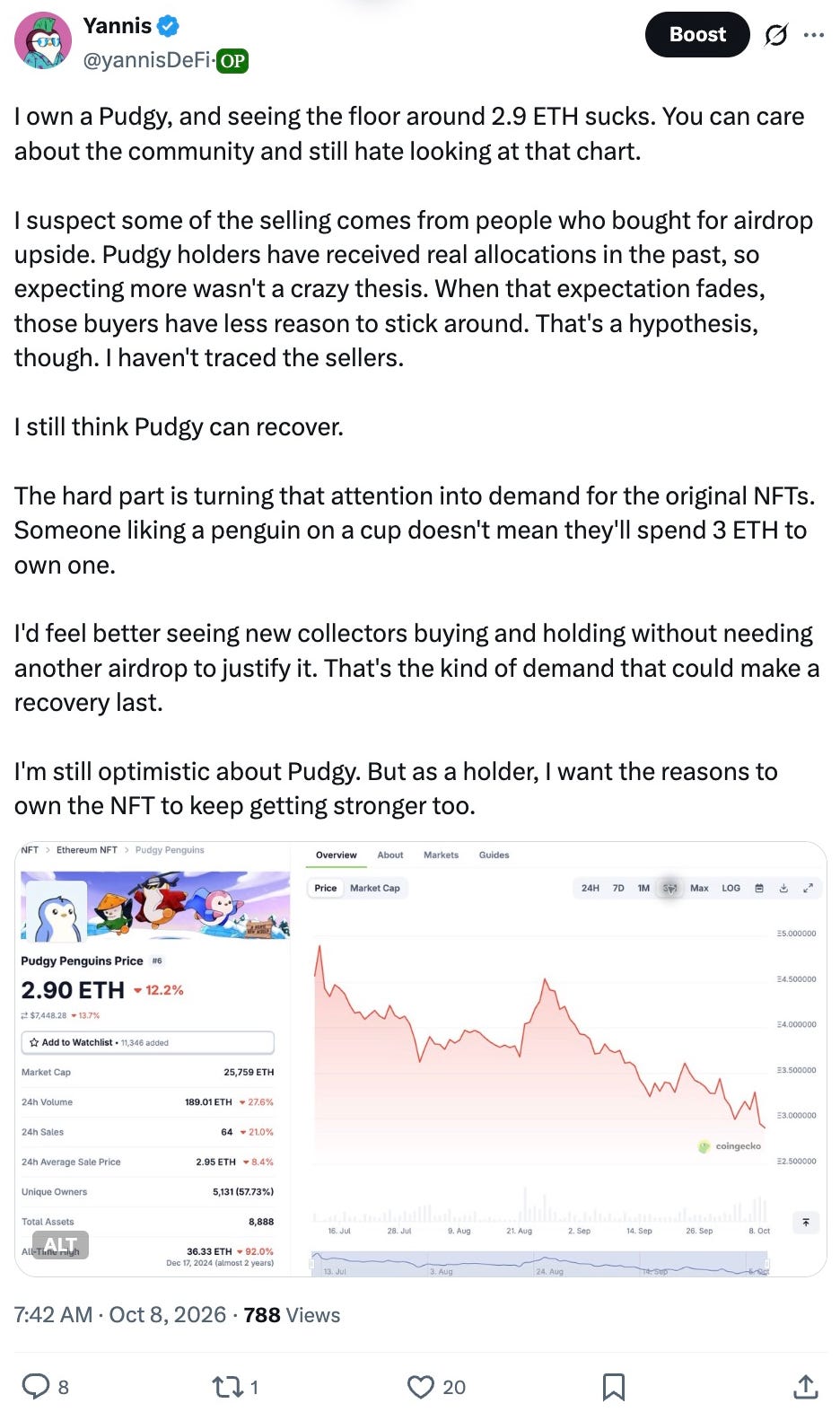
My October 8 post and its floor-price chart. Engagement shown is a snapshot.
Onchain Analytics
Three dollar totals describe different things
The October 7 snapshots show $8.4 million DeFi TVL, $36.09 million total value secured and $66.93 million bridged assets. Each measures different, overlapping exposure. Adding them would overstate the assets involved. DeFiLlama and L2Beat.
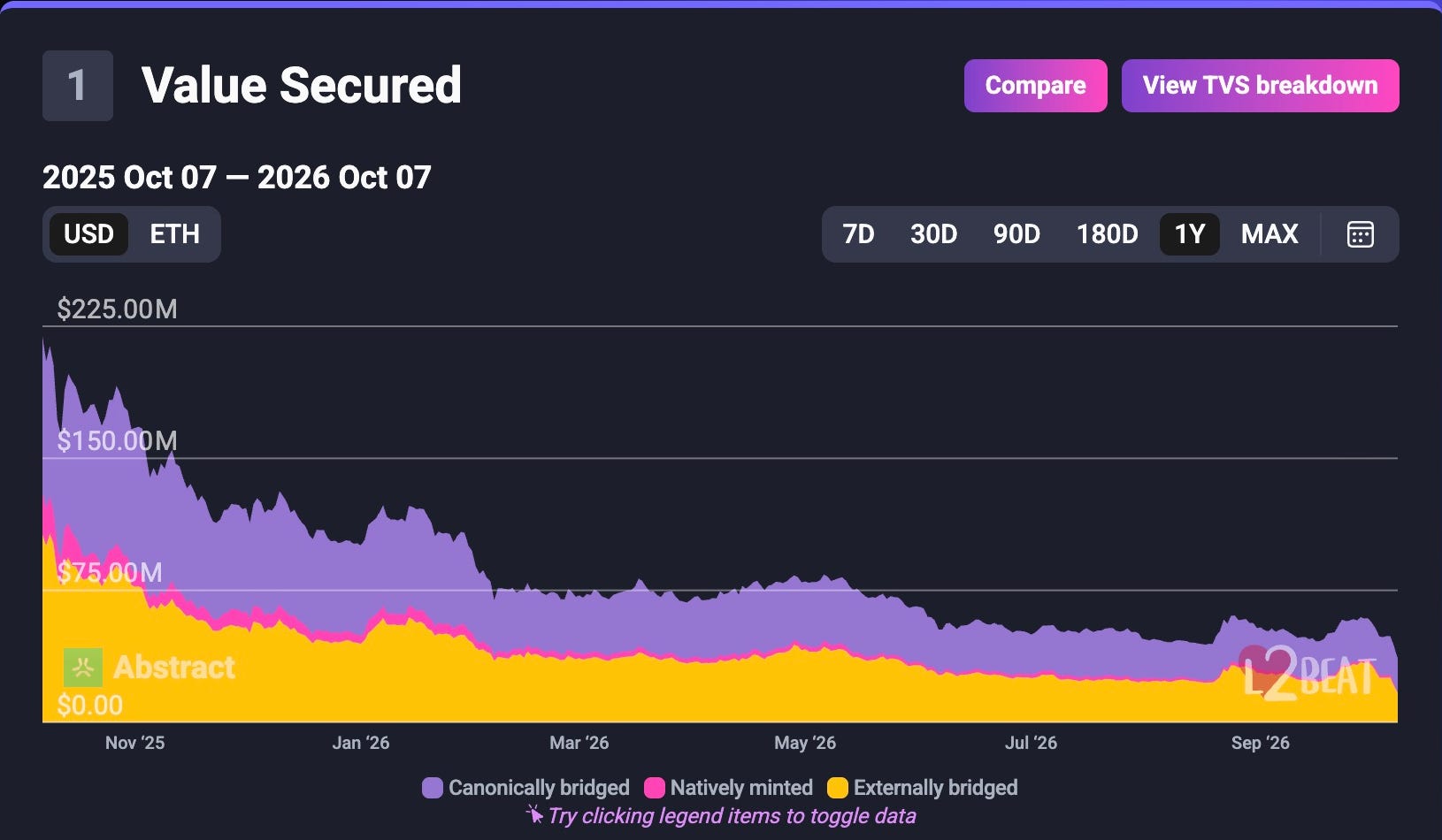
Abstract’s value secured, October 7, 2025–October 7, 2026. TVS measures different coverage from DeFi TVL. Source: L2BEAT.
Transfers show movement without proving a sale
At 19:18 CEST on October 7, L2Beat’s 24-hour panel showed $2.12 million inbound, $12.70 million outbound and a displayed $10.57 million net outflow. Gross volume was $14.83 million across 34,570 transfers. Display rounding accounts for small subtraction differences. Volume and flows.
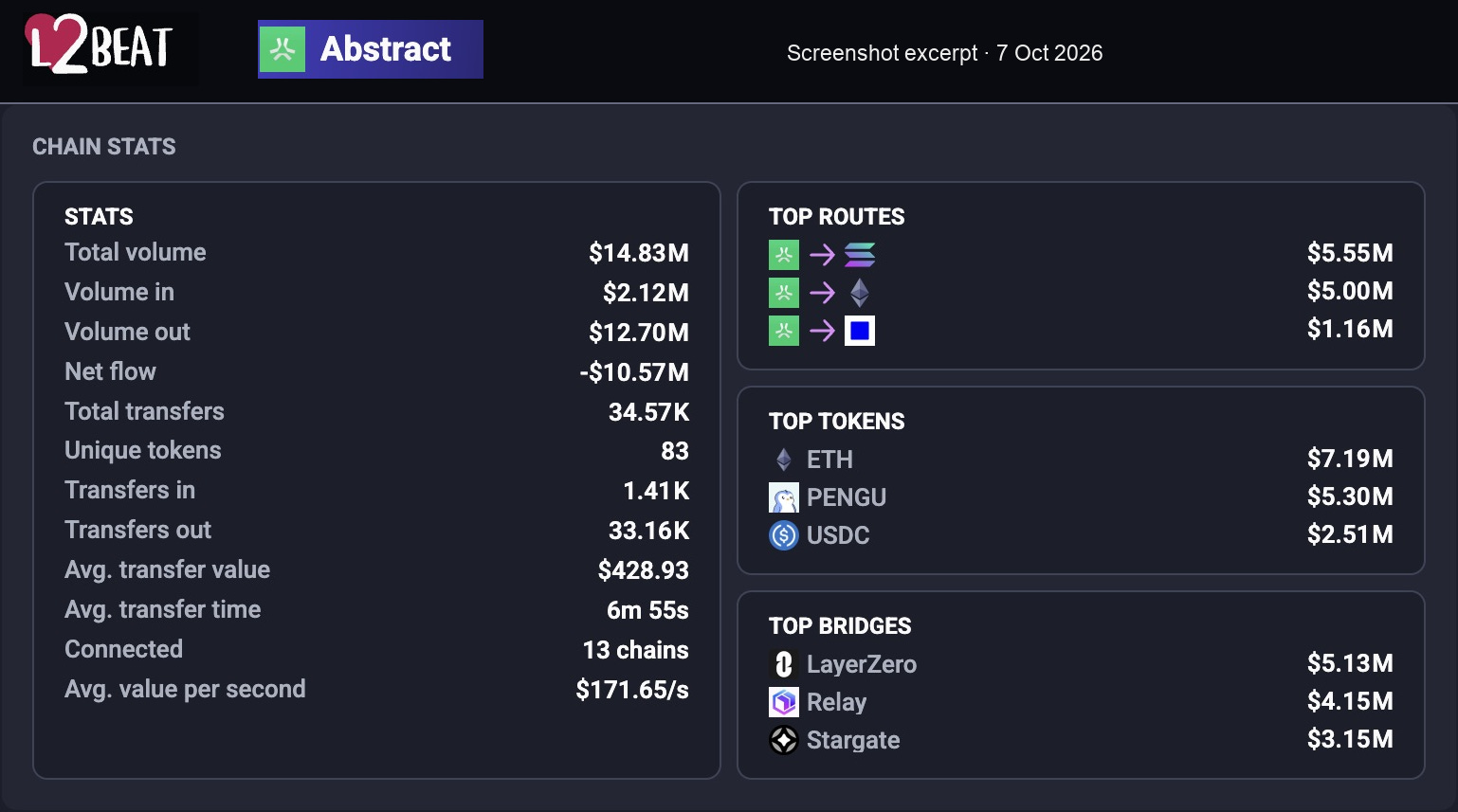
Abstract’s directional transfer figures in the October 7 snapshot. Token transfers do not establish token sales. Source: L2BEAT.
Capital was leaving during the exit window. The separate $5.30 million PENGU transfer volume is gross movement, not measured sales. Bridging, migrations and ordinary portfolio moves can all raise activity during a closure.
Falling fees need the right comparison
The latest seven-day application-fee total is about $483,000, down roughly 39.5% from $798,000 in the preceding seven days. Both windows include time before the closure announcement. DeFiLlama fees series.
Fees were weakening, but this comparison cannot isolate the shutdown’s effect. The dashboard’s roughly 52,000 active addresses also cannot establish customer retention.
Data snapshot: October 7, 2026, around 19:15–19:20 CEST. The flow panel uses its own 24-hour window; API fee totals use the latest completed daily observations. Live charts and partial current-day points can update separately. Rounded figures are used throughout.
Risk signal: the December 15 exit deadline
The official migration page repeats the December 15, 2026 cutoff and warns that remaining assets will become inaccessible. Plan the withdrawal while the network still operates.
Use Abstract’s official website and announcement to find the routes. The X notice links migrate.abs.xyz and native-bridge.abs.xyz; the October 6 Terms of Service link migration.abs.xyz. Verify the final domain before connecting. Replies, DMs and sponsored search results do not establish an official route.
Check wallet assets and app positions separately: LP tokens and loans may need extra steps. Confirm the supported asset, receiving chain and gas required. Official bridge documentation says L2-to-L1 withdrawals can take up to 24 hours. Allow time for the entire process; a front-end estimate cannot guarantee completion for every route.
L2Beat lists Abstract as Stage 0 with an emergency upgrade path without the normal delay. These control assumptions deserve review; they do not predict theft. L2Beat’s risk analysis.
The terms also retain certain XP records for six months after discontinuation, without creating a right to a token, airdrop or payment. Keeping a record does not entitle a user to compensation.
What I would demand from the next consumer chain
A game can be useful with little DeFi capital. Abstract’s problem was sustaining this standalone chain with the available demand, liquidity and funding.
For the next consumer app, I would want a clear reason to run its own network rather than use an established one. Then I would check:
Who keeps the money? Separate app fees, chain revenue and cash reaching holders.
Who pays the costs? Identify the sponsor of gas and incentives, and what happens if funding shrinks.
Will users stay? Look for repeat purchases after rewards fall; value unconfirmed airdrops at zero.
Can my position exit? Check executable liquidity, the bridge route and the operator’s upgrade powers.
This Week’s Intel
Five developments from October 1–7 that change a product, a risk or the route into DeFi.
Drift opens recovery claims
Drift opened DFX claims on October 1 for losses from its April incident. Each verified USDT lost receives one DFX, but the launch redemption value was only about 0.0104 USDT per token. The recovery pool opened with roughly 3.1 million USDT against 299.5 million DFX. Drift’s announcement.
Claiming DFX and redeeming it are separate decisions. Redemption burns the tokens submitted, ending their participation in future deposits. Holders can also retain or sell them. I would compare the amount available now with the future claim being surrendered, while treating promised recovery funding separately from cash already in the pool. Receiving one recovery token for every dollar lost does not mean receiving a dollar back.
Aave proposes closing a GHO carry trade
On October 2, TokenLogic proposed raising the Ethereum Core GHO borrowing rate from 4.25% to 4.50%, matching the Aave Savings Rate. At the rates quoted in the update, borrowers could mint GHO at 4.25% and deposit it into sGHO at 4.50%. The proposal also raises Prime’s base rate from 2.75% to 3.00%. Borrowers should check the live rate before relying on that spread. GHO Stewards update.
The same update reported depleted USDC reserves in the Stability Module, while the other module held about 22.5 million USDT. That concerns redemption liquidity in those modules, not the disappearance of all GHO collateral. Reserve replenishment matters for anyone depending on an immediate redemption route.
Uniswap’s institutional test moves to Japan
SMBC Nikko and Nethermind announced a DeFi Gateway for Japanese investors on October 2. It is being developed on Uniswap v4 with support from Uniswap Labs, Base and Nyx Foundation. Custom pools would use hooks for compliance checks and investor protections across stablecoins, tokenized real-world assets and other digital assets. Completion is targeted for mid-2027. Uniswap Labs.
Uniswap Labs’ announcement of the SMBC Nikko–Nethermind DeFi Gateway. Completion is targeted for mid-2027. Source: Uniswap Labs.
This offers a route for institutional distribution, which Abstract struggled to build. The next test is funded pools and repeat trading after the venue opens, followed by any revenue that actually reaches UNI holders.
Ethereum wants wallets to enforce transaction outcomes
The Ethereum Foundation’s October 5 research update describes native transaction assertions. These are signed conditions checked against what a transaction changes, with its actions reverted if the conditions fail. A wallet could independently require a minimum output, a spending limit or an approval policy, adding a check even when a transaction builder is compromised. Ethereum Foundation.
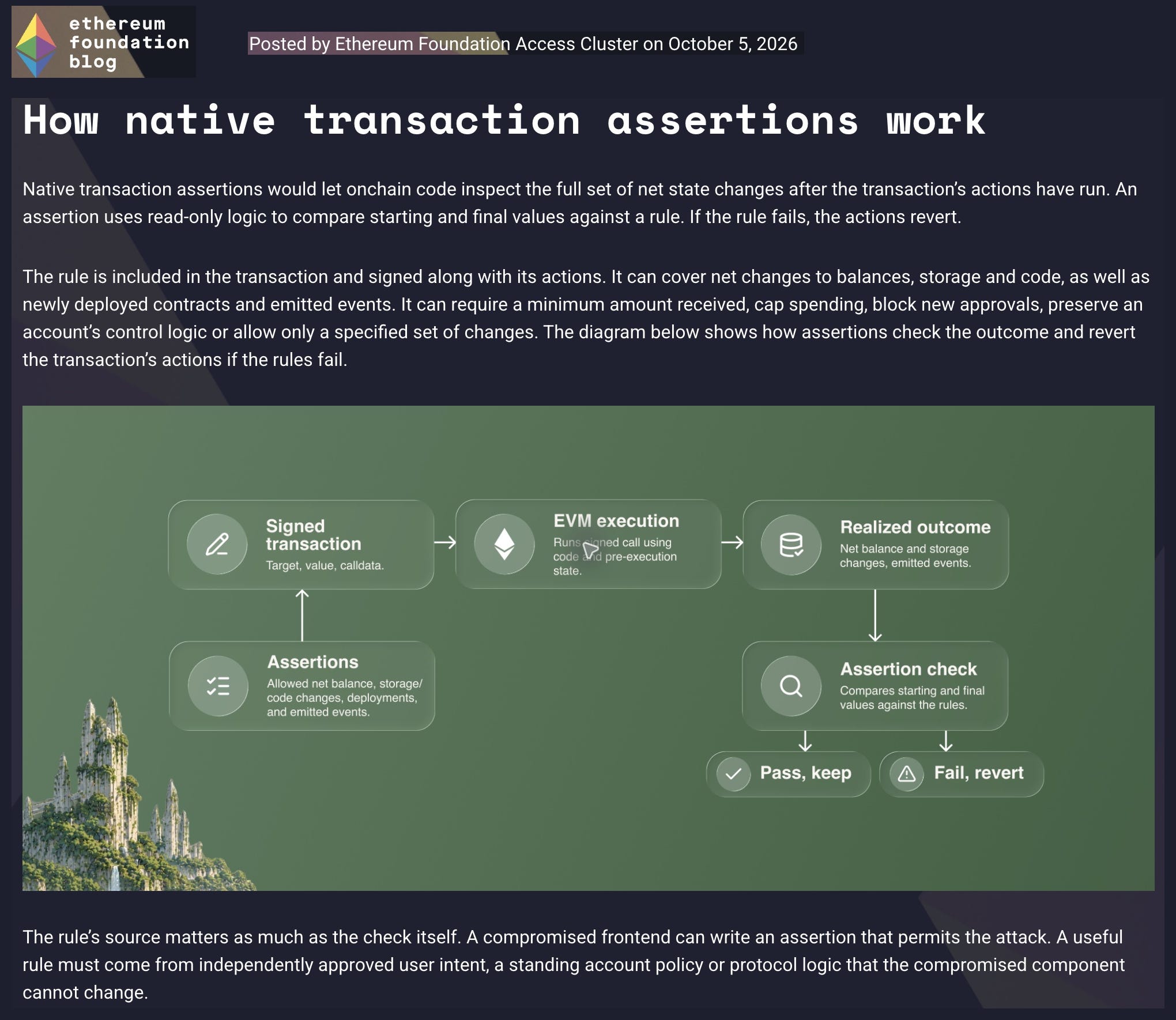
The Ethereum Foundation’s October 5 research update on transaction assertions. This is a proposed design, not an activated protection. Source: Ethereum Foundation.
EIP-7906 is one possible design being considered for Hegotá. It is not a confirmed activation or protection users can assume is already live. The rule also has to come from somewhere trustworthy: a malicious frontend can write an assertion that permits its own attack. I like the direction because it gives the wallet something concrete to enforce beyond a reassuring description of the signature.
FinCEN withdraws two pending crypto proposals
FinCEN announced on October 5 that it was withdrawing its 2020 proposal covering certain transactions involving self-hosted wallets and its 2023 proposal on international crypto mixing. The withdrawal notices list October 6 publication dates. Both proposals would have imposed additional reporting or recordkeeping requirements on covered financial institutions. FinCEN’s announcement, wallet notice and mixing notice.
For privacy and self-custody, this removes two pending policy threats. It does not erase existing anti-money-laundering or sanctions obligations. The mixing notice also leaves open future action against illicit finance.
Podcast Picks
Five recent conversations to pair with this issue.
Alt Season, Zcash, Collectibles & The Tokenization Trade
0xResearch · September 30, 2026
Start at 40:38 for tokenization’s utility, 48:01 for onchain stocks and 56:41 for Aave’s consumer push. The useful question alongside Abstract is what customers can do with their capital after onboarding. The speakers’ case for lending and tokenization is a thesis to test against actual use. Episode and chapters.
Why Reinsurance Could Become DeFi’s Best Collateral
0xResearch · September 23, 2026 · Ryan Connor and Ayyan Rahman
The source of the yield comes at 14:38, the risks that can wipe it out at 26:47, and the discussion of DeFi leverage at 37:53. This is useful background for evaluating returns funded by insurance premiums. “Best collateral” is the episode’s argument; insurance losses and leverage still need their own due diligence. Episode and chapters.
Bankless Rollup: Robinhood, exchange security and prediction markets
Bankless · October 2, 2026
A broader catch-up on market positioning, distribution and venue risk. It pairs well with this issue because a better route into crypto can bring users while leaving custody and operating risks unresolved. Episode.
Why the Near $NRR ETF is Different
Bankless · October 5, 2026 · Hunter Horsley and Sal Ternullo
This interview explores an institutional NEAR wrapper and the treasury-asset thesis with participants from Bitwise and Sovereign. Listen for who supplies the capital and what exposure they are buying. The guests have an interest in the product; their case is useful to examine alongside the distinction between network adoption and token demand. Episode.
Everyone Is Watching AI While Crypto’s Bull Market Builds
Empire · October 2, 2026
Skip to 21:23 for the crypto market discussion, 37:22 for regulation and funding, and 41:42 for whether growth looks different this cycle. The funding discussion helps test how much of the recovery comes from new business. Episode and chapters.
My take
Before funding the next consumer chain, I would want to see returning customers and revenue that covers its costs. For Pudgy, I will watch what Igloo funds next and whether it brings collectors who buy and hold without another reward. I’m still hopeful about the brand; those are the signs that would strengthen my case.
If you own a Pudgy, what would make you more confident in holding it from here? Reply to this email; I’d like to hear your view.
For related research, revisit Aave, Morpho or Pendle? Where I’d Look for Yield and Would I Lock My USDC in Morpho Midnight?. The figures in those earlier editions are dated; the questions about available liquidity and the actual source of a return still apply.
Thanks for reading,
Yannis
For more DeFi commentary between editions, follow me on X.
This newsletter is for educational and informational purposes only. It is not financial, investment, legal or tax advice, or a recommendation to buy, sell or hold any asset. Crypto and DeFi positions can lose some or all of their value through price moves, smart-contract failures, bridge or oracle failures, limited liquidity, changes in governance, chain shutdowns and fraud. Data is a snapshot from October 7, 2026 and may change. Team statements are attributed, and editorial interpretations are opinions. Verify the current terms, supported assets and official addresses before using any service.
Yeah this one hit hard as I have been avid pudgy holder and abstract user. Think selfishly I wabted the TGE but do agree with the choice especially if it is draining your love of working. Crypto takes a lot of passion to thrive as a founder and if it is lost everything else will sturggle. Good insights.