

In this edition of The Weekly Alpha:
🌙 Morpho Midnight vs Blue
🧐 Onchain Analytics
📚 This Week’s Intel
🎧 Podcast Picks
Hello everyone,
Morpho Midnight gives USDC lenders a useful option: agree a rate upfront for a defined term. If floating yields fall while the loan is outstanding, locking a good rate could pay off.
This week’s Ethereum expansion made me want to compare it with the Morpho Blue vaults already competing for that USDC. The first thing I’d check is whether a quoted rate is actually available to a lender. Today’s book makes that question more useful than a headline APY comparison.
Morpho Midnight vs Blue: Where I’d Look 🌙
Midnight matches lending and borrowing offers for fixed-rate, fixed-term credit. Blue remains Morpho’s variable-rate, open-term lending protocol. Ethereum now has listed USDC markets backed by WBTC and cbBTC, alongside the earlier Base deployment.
Start with the side of the book you can fill
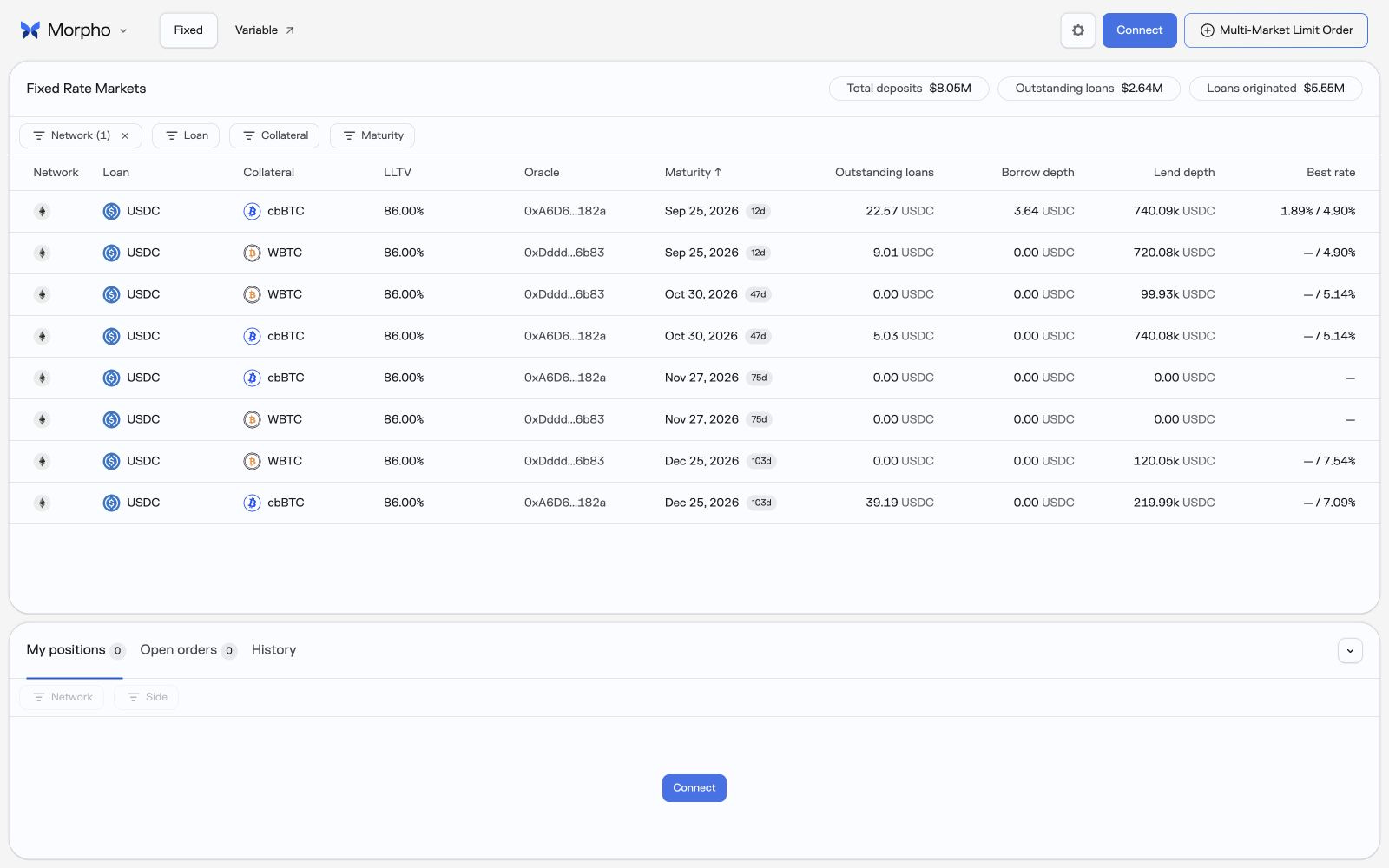
Source: Morpho Markets, captured September 13, around 07:00 ICT. The rows are Ethereum-only. The $8.05M deposits and $2.64M loans header remains unchanged by the filter and represents the overall dashboard, not the Ethereum rows.
The Ethereum cbBTC market maturing September 25 showed roughly 740,000 USDC of lender offers, against just 3.64 USDC of borrower offers. Most other displayed maturities had no borrower offers available at that moment.
For someone supplying USDC, that is a very one-sided book. The large “Lend depth” number is capital other lenders are offering. Borrowers can take those offers. A new lender needs a borrower offer to fill immediately, or can post a lending limit order and wait for someone to take it.
An advertised lending offer is not an executed loan earning that rate. That is why I would not lift the largest percentage in this screenshot and call it “the Midnight yield.” Morpho’s API documentation distinguishes the two sides, and multi-market offers can share a capital budget across markets. Adding every depth number together can count the same capital more than once.
The opportunity is worth watching. On this snapshot, I’d be preparing a target rate and maturity, rather than assuming I could deploy meaningful size immediately.
What a fixed term needs to pay me
Lenders buy credit units at a discount to the amount due at maturity. Different offers have different prices, so the economics depend on the actual fills. Market mechanics
For example, paying 9,900 USDC for 10,000 USDC due at maturity would earn about 1.01% over the term, before costs or losses. The annualized rate depends on the time remaining. That is illustrative arithmetic, not a live quote.
I’d look for a competitive fixed rate and a maturity that matches when I expect to need the money. A small advantage can disappear into transaction costs, moving funds between chains, or selling early at an unattractive price.
Falling floating rates would help that decision; rising rates could leave the fixed position underperforming. And a fixed rate still leaves the lender exposed to collateral losses and bad debt. I’d plan to hold through maturity unless an acceptable exit quote was demonstrably available.
Gauntlet USDC Prime: the larger floating comparison
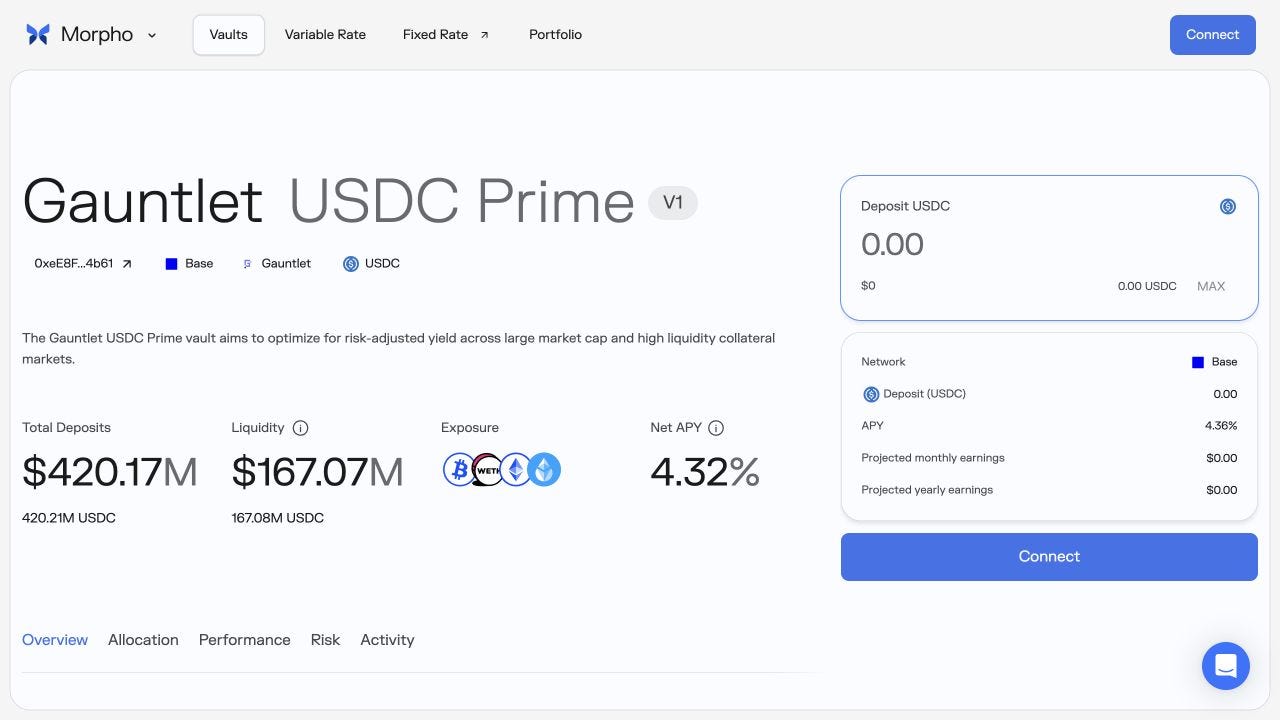
The exact Gauntlet USDC Prime V1 vault on Base displayed 4.32% net APY, about $420.17M deposited and $167.07M of liquidity.
It gives me a practical benchmark for leaving USDC in a curated floating vault. The rate can change. Its size does not establish safety: the curator’s allocations, collateral and liquidation settings still determine what can go wrong.
Source: Morpho vault page, September 13, around 06:50 ICT. Figures use the header’s net APY; the deposit widget showed a slightly different rate at capture.
Steakhouse High Yield: look beyond the extra yield
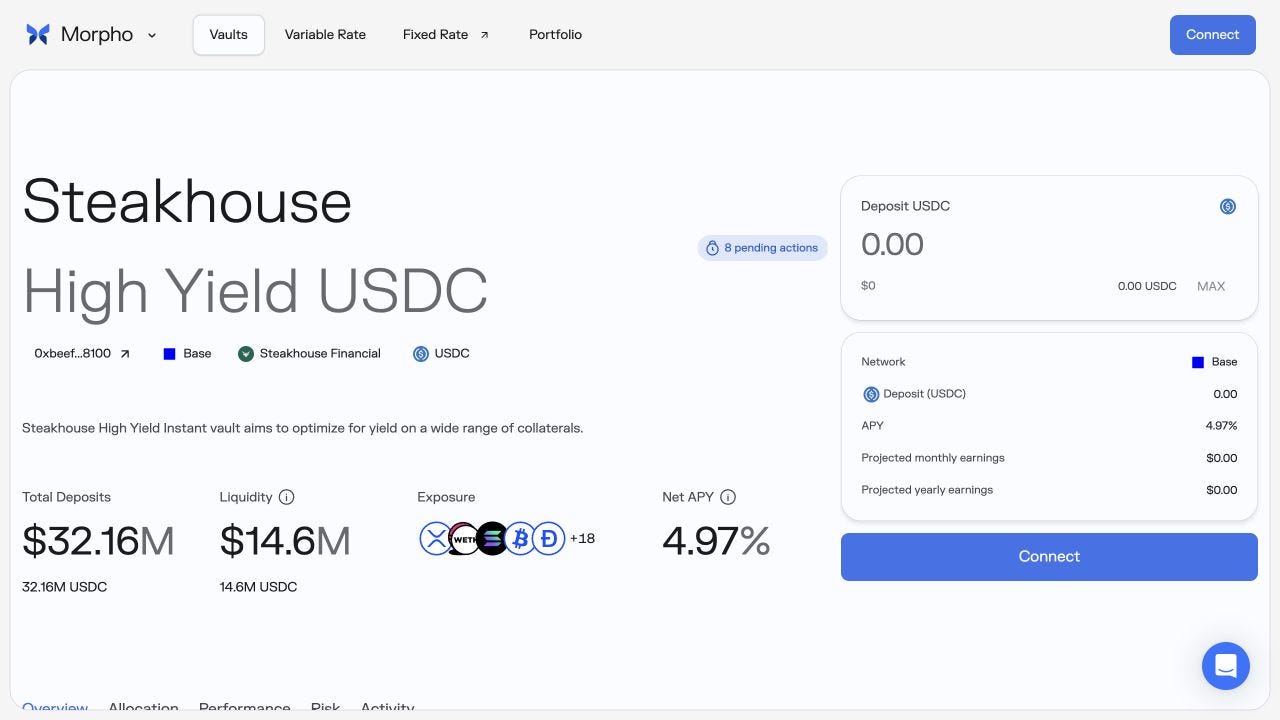
Steakhouse High Yield USDC V2 on Base displayed 4.97% net APY, $32.16M deposited and $14.6M of liquidity, with a 5% performance fee and no management fee.
Its wider collateral range deserves attention before the roughly 0.65 percentage-point premium over Gauntlet. At capture, about 61% of this vault’s allocation was in its USDC market backed by cbXRP. That concentration is a more useful starting point for risk assessment than the APY alone.
The liquidity figure also needs care. It includes about $5.68M available through the liquidity adapter, plus roughly $8.92M that can be pulled back from other allocations without a deallocation penalty. I would still check the actual withdrawal route and available amount before relying on it for an immediate exit.
Sources: Morpho vault UI and GraphQL, September 13, around 06:50–07:00 ICT. Both vault rates are floating snapshots, not promised returns over a future Midnight term. These are Base vaults; the Midnight table above is Ethereum.
What would change my view
I’d become more interested if competitive Midnight quotes were repeatedly available for a useful lending size, with a maturity I co
uld hold. Future vault allocations could deepen the book, although more competing lenders could also compress rates.
On September 5, Paul Frambot said vault access was expected in Q4, following DAO activation. That was an expected rollout, not a guaranteed date or a promise that curators would move their deposits. I would watch implemented access and actual allocations before pricing in that demand.
Before committing USDC, I’d check:
The exact chain, collateral, oracle and liquidation terms.
A fill or limit order for my full size, including fees and maturity.
The expected USDC return against a floating alternative over the same period.
Whether I can hold to maturity if an early exit is unattractive.
Whether the decision still works without future vault inflows.
For now, Midnight stays on my fixed-income watchlist. The product is interesting; today’s thin borrower side gives me a concrete reason to wait for a better fill.
Onchain Analytics 🧐
Ethereum’s TVL rose, while Base slipped
DeFiLlama’s latest daily points put Ethereum DeFi TVL at $50.07B, up 2.03% over seven days, and Base at $5.59B, down 0.82%. Both points are dated September 12 and compared with September 5.
That is a mixed backdrop for a lending launch. Dollar-denominated TVL can move with token prices, so this is not evidence that fresh capital is entering Midnight. I’d follow its own executed loans and usable depth separately.
Source: Ethereum daily TVL and Base daily TVL, retrieved September 13 ICT. DeFi TVL is distinct from a chain’s total value secured.
Vault deposits are not all available for withdrawal
Gauntlet’s displayed liquidity was about 40% of deposits; Steakhouse’s broader displayed measure was about 45%, including the additional deallocation route described above. Those ratios help frame position size, but they are not safety scores and can change as borrowers act or curators move capital.
The practical comparison is between an executable fixed-term loan and a floating vault’s current withdrawal capacity. Neither a large deposit total nor an “open-term” label guarantees the exit you want.
Midnight’s Ethereum book still needs two sides
The eight visible Ethereum rows had only about 76 USDC of outstanding loans in total at capture, even though lender offers ran into much larger amounts. This is a snapshot of the displayed markets, not a claim about every possible market or a complete protocol balance sheet.
I’d watch whether actual borrowing grows across maturities. That would make the fixed-rate comparison more meaningful than counting unfilled offers or attributing the overall dashboard’s millions to Ethereum.
Source: Ethereum-filtered market table, September 13, around 07:00 ICT. Global summary figures stay separate from the filtered rows.
This Week’s Intel 📚
Uniswap gives stablecoin LPs a new fee mechanism
Uniswap Labs launched StablePair Hook on September 10, starting with USDC/USDG and USDC/USDT pools on Ethereum. The v4 hook adjusts fees around a reference price and auctions certain arbitrage opportunities, aiming to leave more of that value with LPs. I’d watch realized fee income and volume before moving liquidity. Its fee logic is upgradeable through governance, and the mechanism does not remove stablecoin or contract risk. Uniswap Labs
Aave lets assistants read positions and prepare transactions
Aave’s September 8 MCP release connects AI assistants to live V3 and V4 data, including rates, positions and health factors. It can simulate an action and prepare a transaction. That could make comparing lending markets and monitoring debt easier, but prepared transactions remain unsigned until the user’s wallet approves them. I’d still review the transaction and resulting health factor. Aave Labs
Ethereum sets its Hegotá priorities
The Ethereum Foundation’s Protocol cluster published its Hegotá priorities on September 7, ranking FOCIL and Frame Transactions as the two leading commitments. FOCIL aims to give eligible transactions an inclusion route that does not depend on centralized builders. Frames support native account abstraction and a route toward new signature schemes. Both matter for DeFi access and wallet security; they remain upgrade priorities, not features already live on mainnet. Ethereum Foundation
Podcast Picks 🎧
Morpho Midnight: The Future of Fixed-Rate Lending | Paul Frambot
Bankless · July 29, 2026 · Background pick
An older episode worth revisiting for this issue. Frambot explains fixed terms, discounted obligations and the gradual rollout. Useful for the mechanics; July’s comments should not be mistaken for today’s market state. Listen and read the transcript
The New Economics of Crypto Tokens | Austin Barack
Bankless · September 7, 2026
Barack looks at application tokens through revenue, growth and value capture, with Venice, Hyperliquid, Pump and EtherFi doing most of the work. A useful companion when separating an interesting DeFi product from an attractive token investment. Listen and read the transcript
That’s it for this week. I’m interested in fixed-rate lending, but I’d want the actual fill to justify giving up flexibility. The rate, the amount and the maturity need to work together.
For the wider stablecoin comparison, revisit where I’d park stablecoins.
Hit reply: what premium would you need to lock USDC for three months?
If this helped, share it with someone comparing Morpho yields.
Thanks for reading,
Yannis
This newsletter is for information only and is not financial advice. DeFi positions can lose capital through smart-contract failures, collateral losses, oracle failures and limited liquidity. A fixed rate does not guarantee repayment. Do your own research and only risk what you can afford to lose.