
In this edition:
🧑🌾 Five live stablecoin yields compared
⚠️ What a $36.14M liquidation says about PT loops
📊 Ethereum and Base: TVL, stablecoin supply and fees
✅ Six questions before taking the extra yield
🎧 Two podcasts worth your time
Hey, welcome back. I disappeared for seven weeks, which is longer than I planned. Thanks for sticking around.
For the first issue back, I worked through a decision I needed to make for my own portfolio. I checked five places I would actually consider parking stablecoins. The APY was the easy part. I spent more time on where the yield comes from and whether I could get out without forcing a bad trade.
Where to park stables this week: five live options compared
The five rates sat in a narrow band, from 3.50% on Aave to 5.11% on Steakhouse. I would not take more risk for 161 basis points until I knew what changed underneath. The real choice is between USDC and USDS, fixed and floating rates, direct lending and curator-managed vaults, and the liquidity available on the day I want my money back.
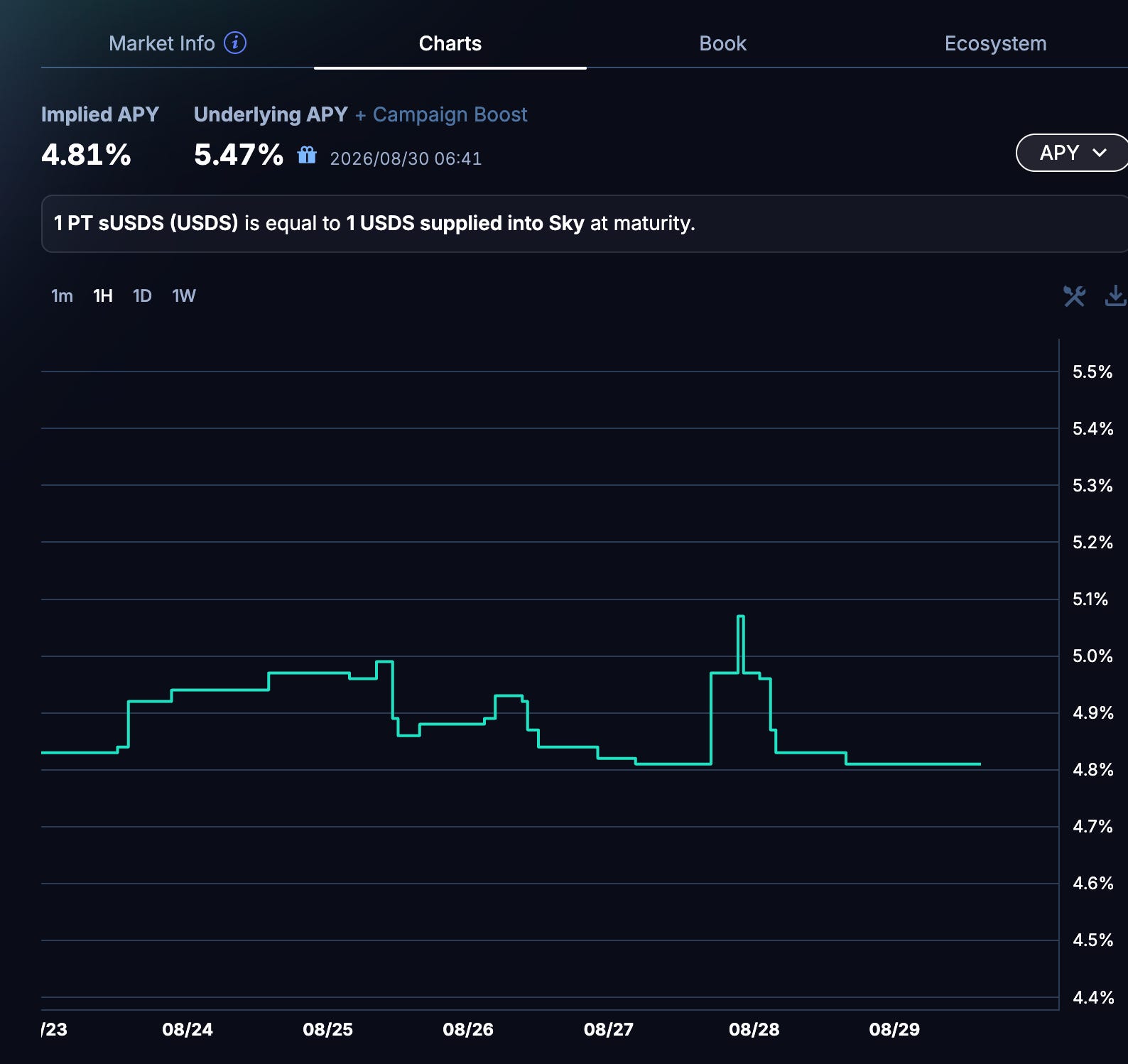
1. Pendle PT-sUSDS 26 Nov (4.81% fixed)
Capital and liquidity: $82.00M market TVL, with $3.47M shown as pool liquidity.
Yield source: Buy PT below par and redeem at maturity.
Main risk: USDS exposure, duration, early-exit pricing and the Pendle contract.
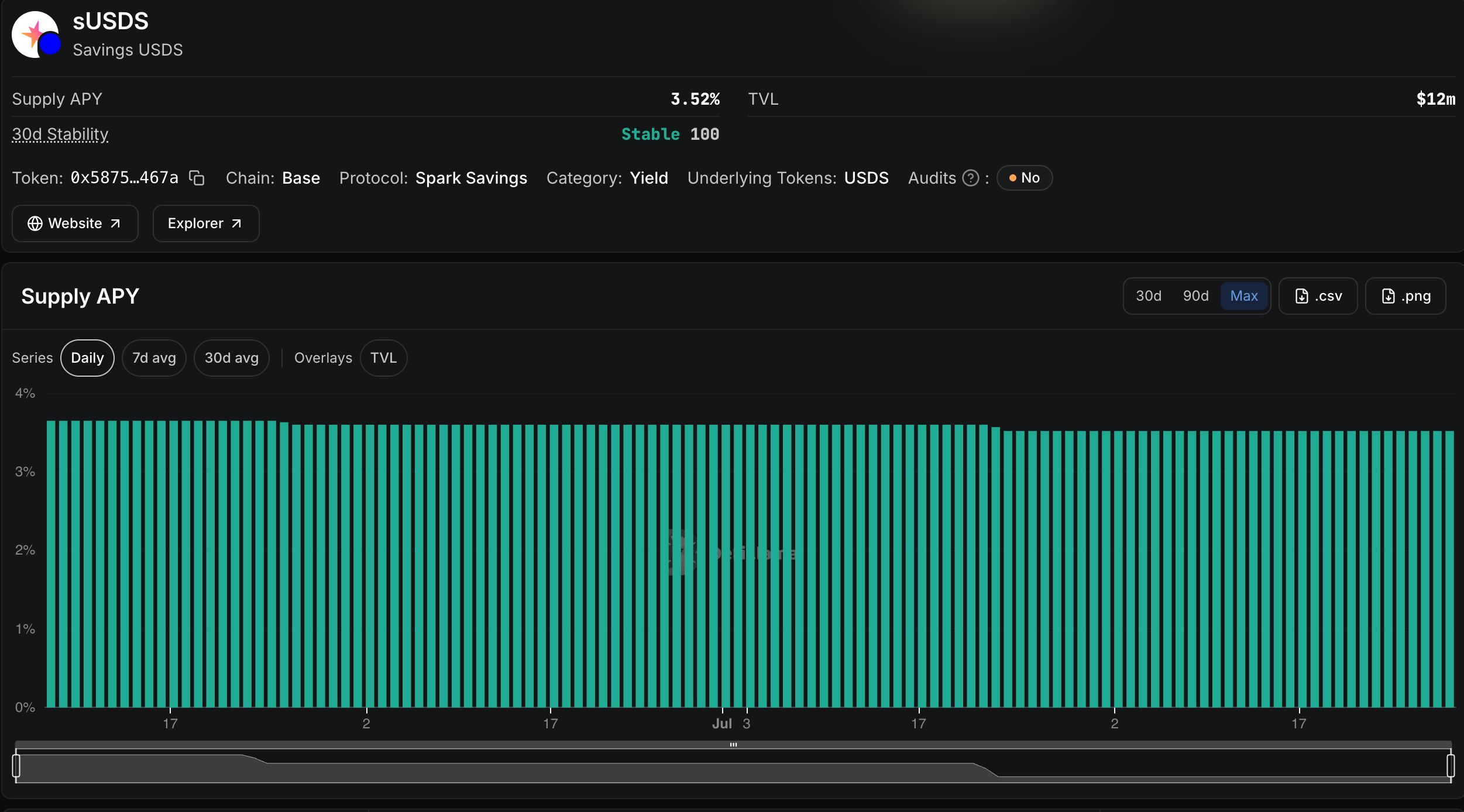
2. Sky sUSDS on Base (3.52% floating)
Capital and liquidity: $12.00M Base TVL.
Yield source: The governance-set Sky Savings Rate.
Main risk: USDS, governance changes and the Base wrapper or bridge.
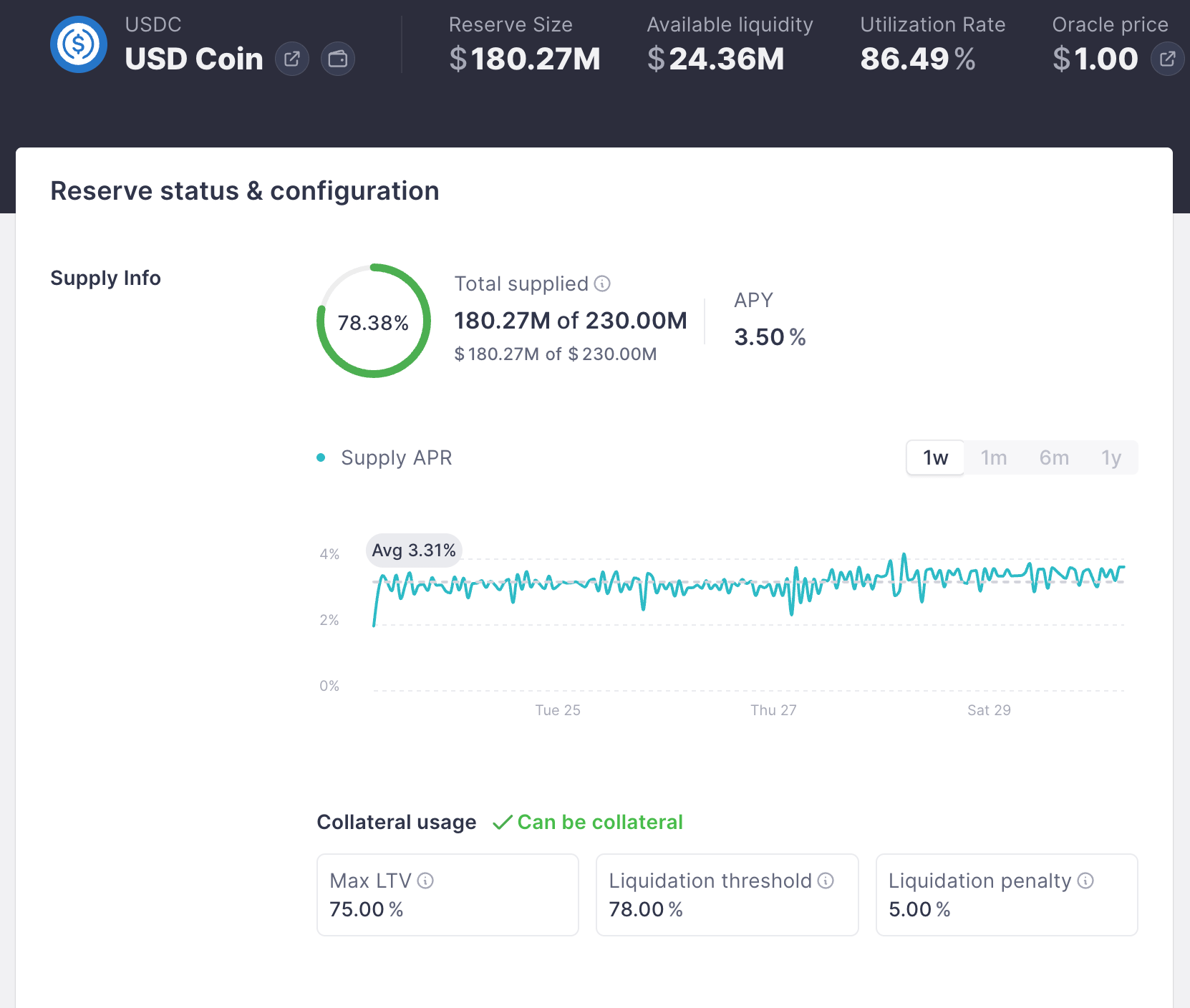
3. Aave v3 USDC on Base (3.50% floating)
Capital and liquidity: $180.27M supplied, with $24.36M available.
Yield source: Interest paid by USDC borrowers.
Main risk: Utilization, the Aave contract, USDC and Base exposure.
4. Morpho / Gauntlet USDC Prime (4.42% floating)
Capital and liquidity: $432.87M deposited, with $158.61M liquid.
Yield source: Morpho lending markets selected by Gauntlet.
Main risk: The curator’s collateral, LLTV and oracle decisions.
5. Morpho / Steakhouse High Yield USDC (5.11% floating)
Capital and liquidity: $36.72M deposited, with $5.81M liquid.
Yield source: Morpho lending markets selected by Steakhouse.
Main risk: Broader collateral, curator and liquidity risk, plus a 5% performance fee.
How I think about the five options
I’ll keep tracking these rates and the liquidity behind them.
Pendle: fixed until 26 November
PT-sUSDS was trading below par, so holding it to 26 November and redeeming at par locked in a 4.81% implied APY at the snapshot. sUSDS itself was paying 3.52%. The extra 129 basis points pays me for giving up flexibility and taking another contract.
That only works if I am happy to hold. If I sell early, the market price, slippage and fees decide the return. The market had $82.00M in TVL but just $3.47M of pool liquidity, so I would size the position around the exit rather than the headline TVL.
The 5.04% figure in CryptoBriefing was for PT-sUSDe, a different underlying from the PT-sUSDS market used here. The article gave a broader 4.74% to 5.38% range for sUSDS markets, so I used the live Pendle quote above.
Sky and Aave: simpler floating rates
Sky is the easiest rate here to explain. Hold sUSDS and the protocol pays the governance-set savings rate. The Base wrapper showed 3.52% and about $12M in TVL. I would use it only if I already wanted USDS and was comfortable with the Base wrapper.
Aave is the plain USDC option. Borrowers pay lenders, and at 06:44 CEST the Base pool had $180.27M supplied with $24.36M available. If withdrawals picked up, I would watch the second number before the APY.
Morpho: the curator matters
Gauntlet USDC Prime was paying 4.42% with $432.87M deposited and $158.61M liquid. The vault looks simple from the outside, but Gauntlet chooses the Morpho markets, collateral caps, LLTVs and oracles. The rate comes with Gauntlet’s risk decisions.
Steakhouse paid the most at 5.11%, but only $5.81M was liquid against $36.72M deposited. It also charges a 5% performance fee and reaches into a broader set of collateral markets. That extra 69 basis points over Gauntlet is not free.
My choice changes with the job. For USDS, Sky is the cleanest floating rate. For direct USDC lending, Aave is easier to monitor. I would use Gauntlet only after checking its current market allocations. PT-sUSDS makes sense when I can hold until November. Steakhouse stays at the bottom of my list until I have reviewed every underlying market.
For context, I covered a 4.59% fixed Pendle lock in Weekly Alpha #54, and Weekly Alpha #55 showed Sky at 4.00%. Those posts still explain the mechanics, but this issue’s comparison replaces their expired dates and rates.
This week’s risk signal: $36.14M liquidated with zero bad debt
On 25 August, trades in a thin Pendle reUSD market pushed the principal-token price down about 2.8%. Morpho recorded 33 liquidations in roughly 14 minutes and repaid $36.14M of debt with zero realized bad debt. The Defiant

Nothing broke in the oracle. It did what it was configured to do and closed positions before lenders took a loss. The borrowers were running with less than a 3% buffer, while a small market was setting the price for much larger leveraged positions. A move that looked minor in the market was enough to wipe out the loopers.
These were Morpho markets using PT-reUSD as collateral. A curated USDC depositor sits on the lending side rather than running the loop. The curator can still allocate deposits to PT-backed markets. I would check the market list, oracle and available liquidity before treating a curated vault as a single risk.
Aave’s official forum described a separate PT-risk control on 28 August. Its LlamaGuard stack is deployed on Ethereum and ready for activation for PT-srUSDe-22OCT2026. The activation AIP still has to register and enable the agents, and the stack does not replace the reserve’s price feed. Aave governance
Capital held up while mainnet activity cooled
Ethereum DeFi TVL ended 29 August at $48.84B, down 1.13% for the week. Base edged up 0.34% to $5.52B.
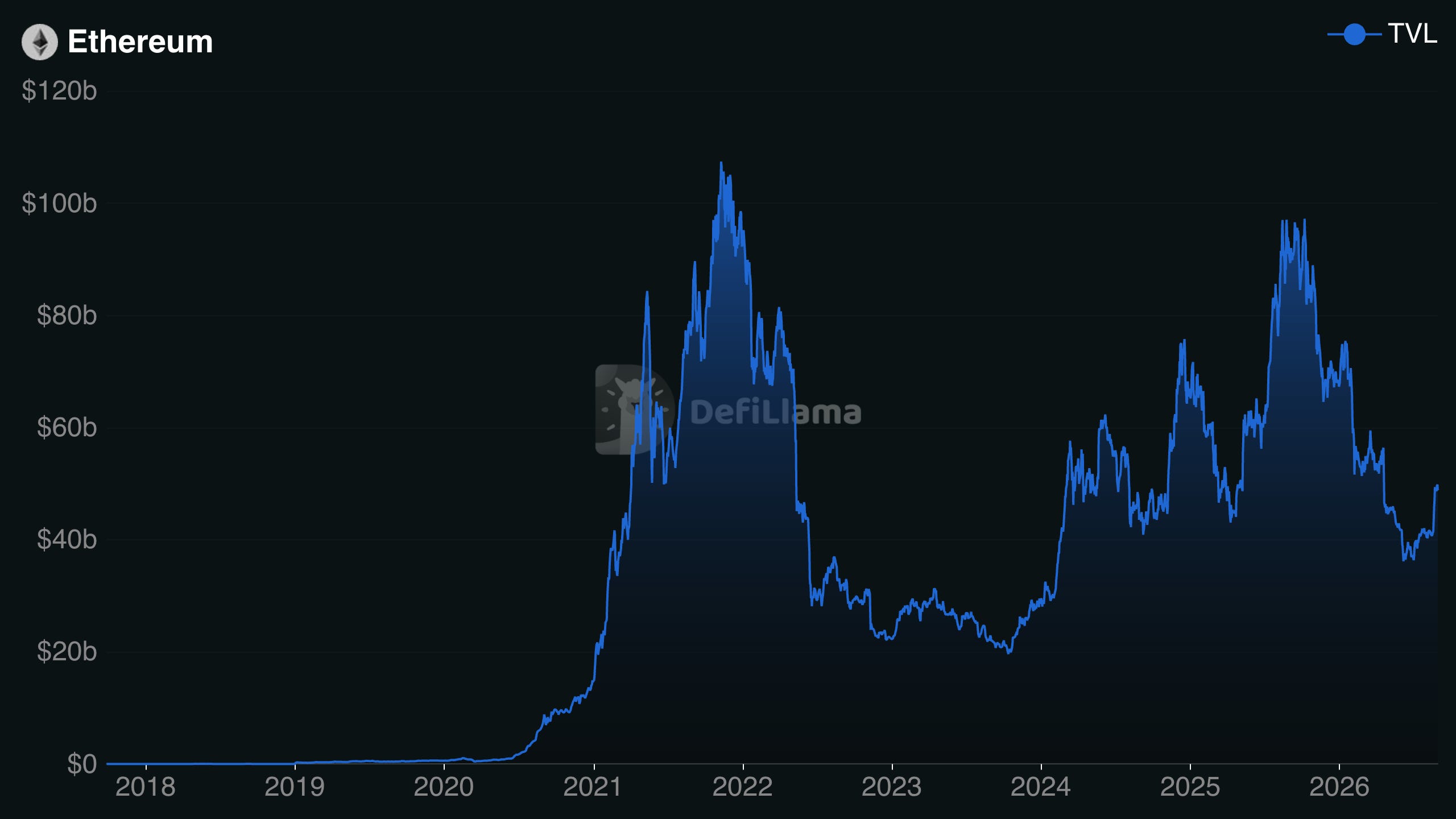
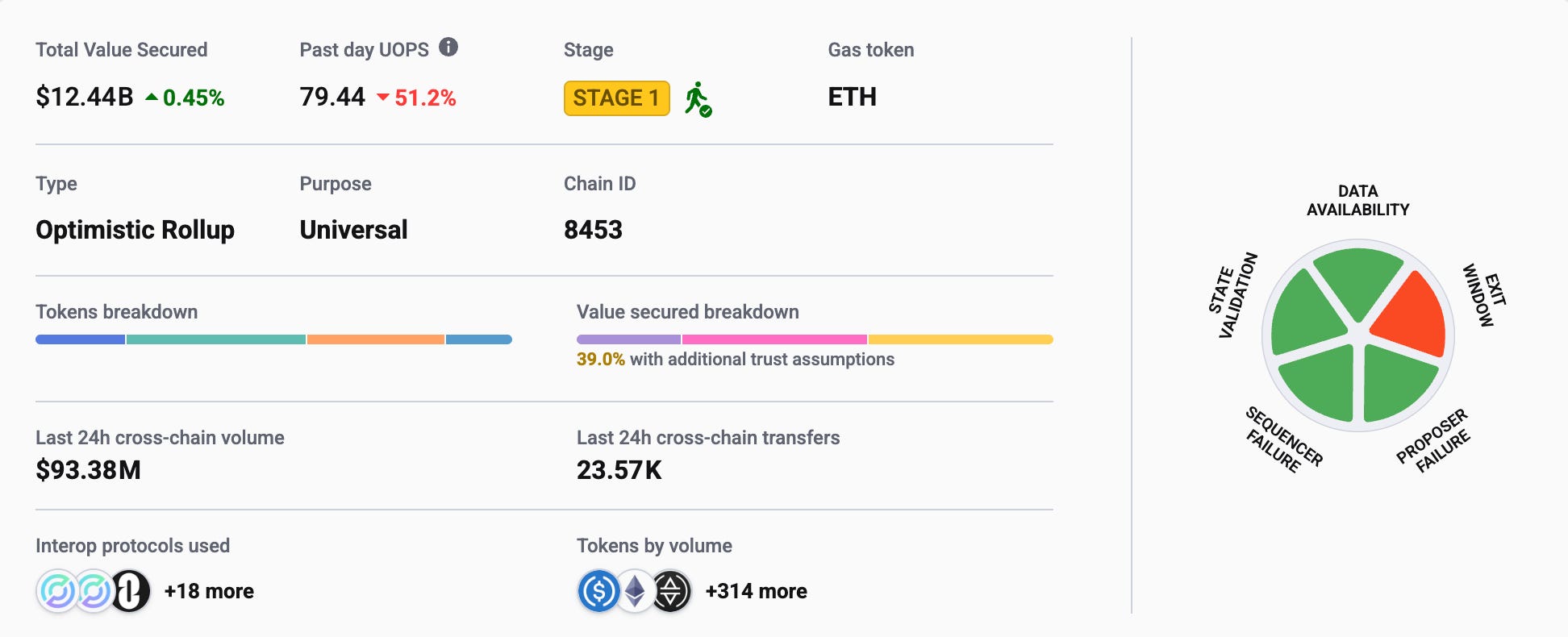
L2Beat showed $12.43B secured on Base. That number includes a different set of assets from DefiLlama’s protocol TVL, so I keep the two separate.
Ethereum mainnet stablecoin supply still grew 0.66% to $161.92B. At the same time, fees paid on 28 August fell 56% from the prior week to $414,179.
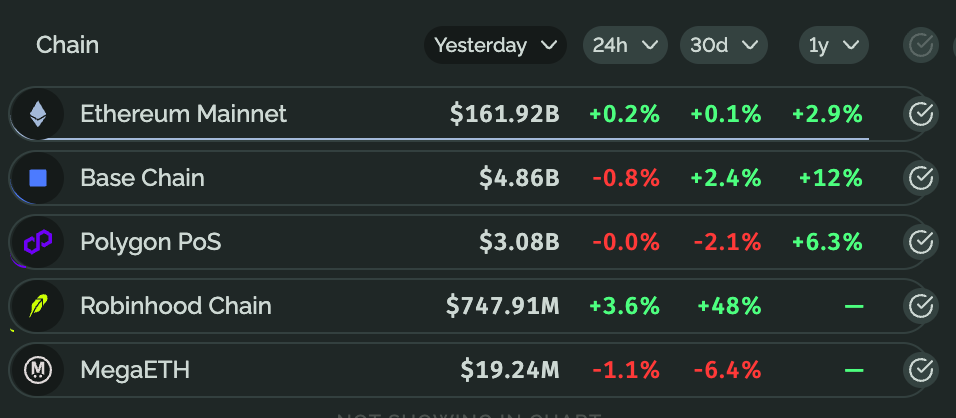
To me, that looks like capital sitting still while people spend less to use L1. One quiet week is not enough to call an Ethereum exit or a clean rotation into Base.
Data checked 30 August from DefiLlama Ethereum, DefiLlama Base, L2Beat Base and growthepie’s stablecoin supply and fees pages.
Six questions before taking the extra yield
The Morpho liquidation reminded me what I want to know before I deposit:
Which stablecoin am I actually holding, and what backs it?
Can I explain the source of the yield in one sentence?
Is the rate fixed or variable, and what changes it?
How much liquidity is available if I need to exit today?
Who selects the collateral markets and configures the oracle?
What extra bridge, wrapper or contract sits between me and the underlying asset?
If I cannot answer all six, I leave the APY alone.
If this was useful, send it to the person who still sorts vaults by APY.
Two podcasts I kept 🎧
Peter Van Valkenburgh on Unchained: He talks through how the GENIUS Act’s freeze-and-seize rules reach the secondary stablecoin market. I listened because peg charts miss this part of stablecoin risk. Listen
Empire on Ethena: The episode gets into the protocol’s tokenomics overhaul and growth. It helped me separate the ENA governance story from the mechanics behind USDe and sUSDe. Listen
That is all for this issue.
I am happy to earn less when I can explain exactly where the money sits and who pays the return. If I need a diagram and ten caveats to justify the APY, I probably should not be there.
If this was useful, send it to the person who still sorts vaults by APY.
None of the information in this newsletter is financial advice. Protocols involve substantial risk, including smart-contract, liquidity, duration, curator, oracle and underlying-asset risk. Do not invest what you cannot afford to lose. Do your own research.
Hi Yannis, I’ve been enjoying The DeFi Digest, especially your coverage of Ethereum, DeFi, onchain activity, and the infrastructure being built around it. I really like the focus on signal over noise.
I also write and work in the crypto and Web3 space. At ITIO Innovex, we help companies build crypto and blockchain infrastructure, including exchanges, wallets, smart contracts, tokenization, DeFi/DAO ecosystems, and blockchain payment solutions across Ethereum, BNB, Polygon, Solana, and more.
I’ve subscribed and would love to connect, support each other’s work, and exchange perspectives. Would you be open to exploring a collaboration down the line if there’s a good fit?