

Welcome back to Weekly Alpha — your curated edge in DeFi, tokenomics, and macro shifts before they go mainstream.
In this edition of The Weekly Alpha:
📚 This Week's Intel
🎧 Podcast Picks
🧑🌾Ethereum Stablecoin Yields in a Bleeding Market
🧐 Onchain Analytics
This Week's Intel 📚
The signal from the noise, this week's developments that actually matter for your DeFi positioning.
I've filtered through the endless stream of headlines, hot takes, and crypto Twitter drama to bring you the stories moving the ecosystem forward. These aren't just news updates; they're intelligence briefings on where capital is flowing, which narratives are gaining traction, and what regulatory shifts could reshape your strategy.
Skip the timeline doom-scrolling. This is your weekly intel drop.
Vitalik Buterin calls for a new DAO design for onchain disputes and governance

Ethereum co-founder Vitalik Buterin is pushing for a major redesign of DAOs, arguing that current token-voting treasury models are inefficient and vulnerable to capture. He's calling for purpose-built DAOs that tackle specific infrastructure needs like oracles, onchain dispute resolution, and anti-scam registries. Buterin suggests different governance approaches for different problems: robust consensus for matters requiring compromise, and decisive leadership for high-stakes bets. With DAO tokens valued at $17.5 billion, he warns that projects building on Ethereum should treat DAO design as half their work, not an afterthought.
read the full cointelegraph article
Base App Pivots to ‘Trading-First’ Six Months After SocialFi Rebrand

Coinbase's Base App is pivoting back to a "trading-first" approach just six months after rebranding as a SocialFi-focused super app. Base lead Jesse Pollak says hundreds of thousands tried the social features, but user feedback was mixed, with many finding it "too close to web2" and overly social-heavy. The app will now prioritize finance and trading functionality, layering social features on top rather than the reverse. The move mirrors Farcaster's recent shift away from social-first and reinforces the view that blockchains work best for moving money, with Base potentially being the last major holdout of the social-first web3 approach.
read the full The Defiant article
Other news
ZachXBT Highlights $282M Theft of Bitcoin and Litecoin in Hardware Wallet Scam - read
Ethereum validator exit queue falls to zero as staking demand soars - read
ETH derivatives reset and the next retail trade - read
Paradex refunds $650K to 200 users after maintenance bug triggers liquidations - read
Ethereum L1 Activity Exceeds L2s, But Researchers Point to ‘Address Poisoning’ - read
Bitcoin Hovers Around $90,000 As Dollar Drops, Gold Surges - read
Podcast Picks 🎧
This week’s audio alpha: handpicked conversations that shaped my thinking and could shift yours too.
I sift through hours of DeFi content so you don't have to. These are the episodes worth your commute, the insights that made me pause and rewind, and the perspectives that are moving markets before they hit mainstream media.
Queue these up and stay ahead of the narrative.
Bell Curve: The Intersection of AI and Crypto: What Worked, What Didn’t, and What’s Next - listen
The Chopping Block: Banks vs. Crypto: The $1T Yield Fight - listen
Empire: AI Breaking Software Economics, CLARITY Bill, & Debating BitGo’s IPO - listen
All-In Podcast: Coinbase CEO's Top 3 Crypto Trends for 2026 - listen
Forward Guidance: Markets Are Entering A Wartime Economy - listen
Ethereum Stablecoin Yields in a Bleeding Market
As markets bleed and volatility dominates price action, strategic positioning into solid stablecoin yields becomes essential for preserving capital while maintaining productive deployment. I've consistently chosen Ethereum as my settlement layer for stablecoin strategies due to its unmatched economic security and battle-tested infrastructure. With recent market conditions prompting a reassessment of my positions, I'm evaluating three stable lending markets that prioritize security over flashy APYs. These protocols offer moderate but sustainable returns, backed by substantial TVL and smart contracts that have withstood years of real-world stress testing.
syrupUSDC/USDT Pool on Maple Finance
Risk: Low to Medium 🟡
APY: 5.1%
Total Supply: $3.90B
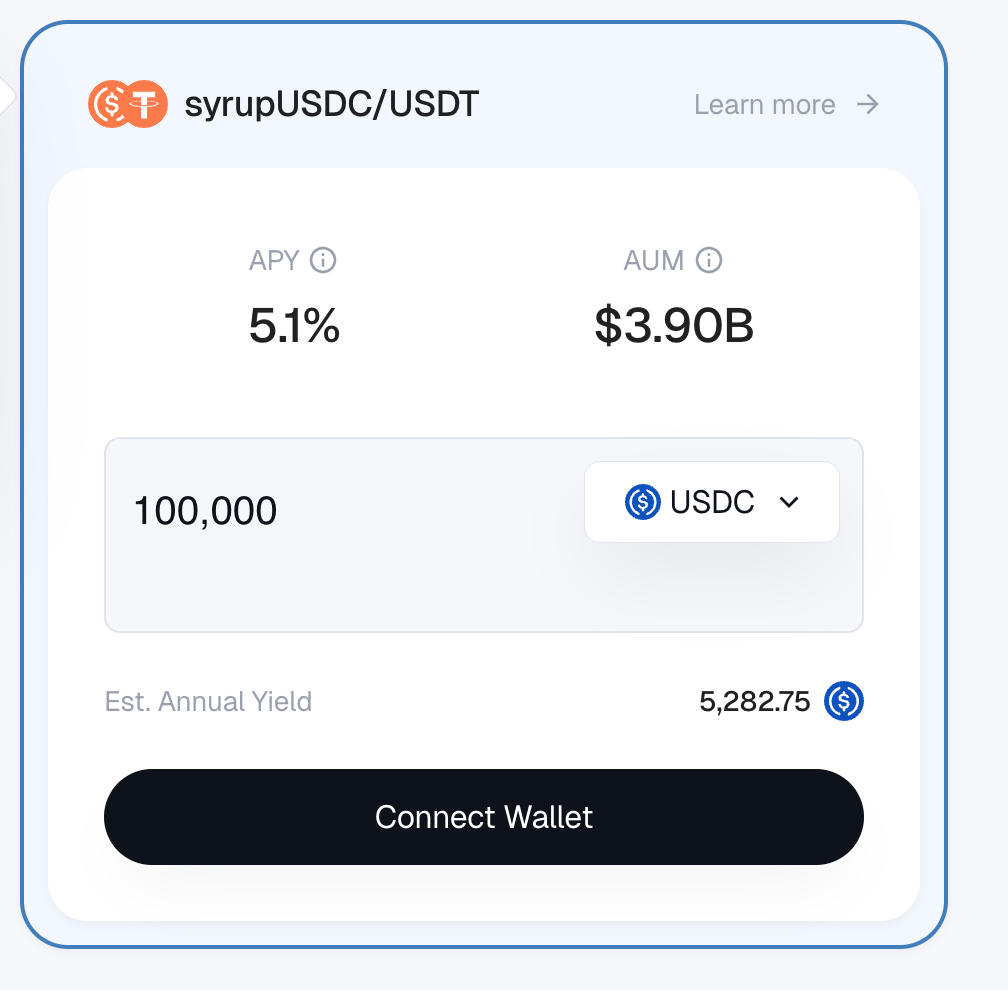
The syrupUSDC/USDT pool offers a competitive 5.1% APY on Ethereum, translating to approximately $5,282 in annual yield on a $100K position. This represents solid returns for stablecoin strategies, particularly during bear market conditions when preserving capital while earning sustainable yield becomes paramount. Maple Finance’s institutional-grade underwriting and multi-year track record provide additional comfort for those seeking a reliable parking spot for Ethereum-based stablecoins without chasing unsustainable rates.
RLUSD on Euler Finance
Risk: Medium 🟡
APY: 7.62%
Total Supply: $189.96M
RLUSD on Euler Finance
Euler Finance has been my go-to protocol for stablecoin positions on Arbitrum, and this RLUSD pool on Ethereum has caught my attention with its attractive 7.62% APY. The yield is currently boosted by a rewards mechanism running until January 29th, likely incentivized by Ripple to drive adoption of their stablecoin on Ethereum. While an extension of the program isn’t guaranteed, the base rate remains compelling even without additional incentives.
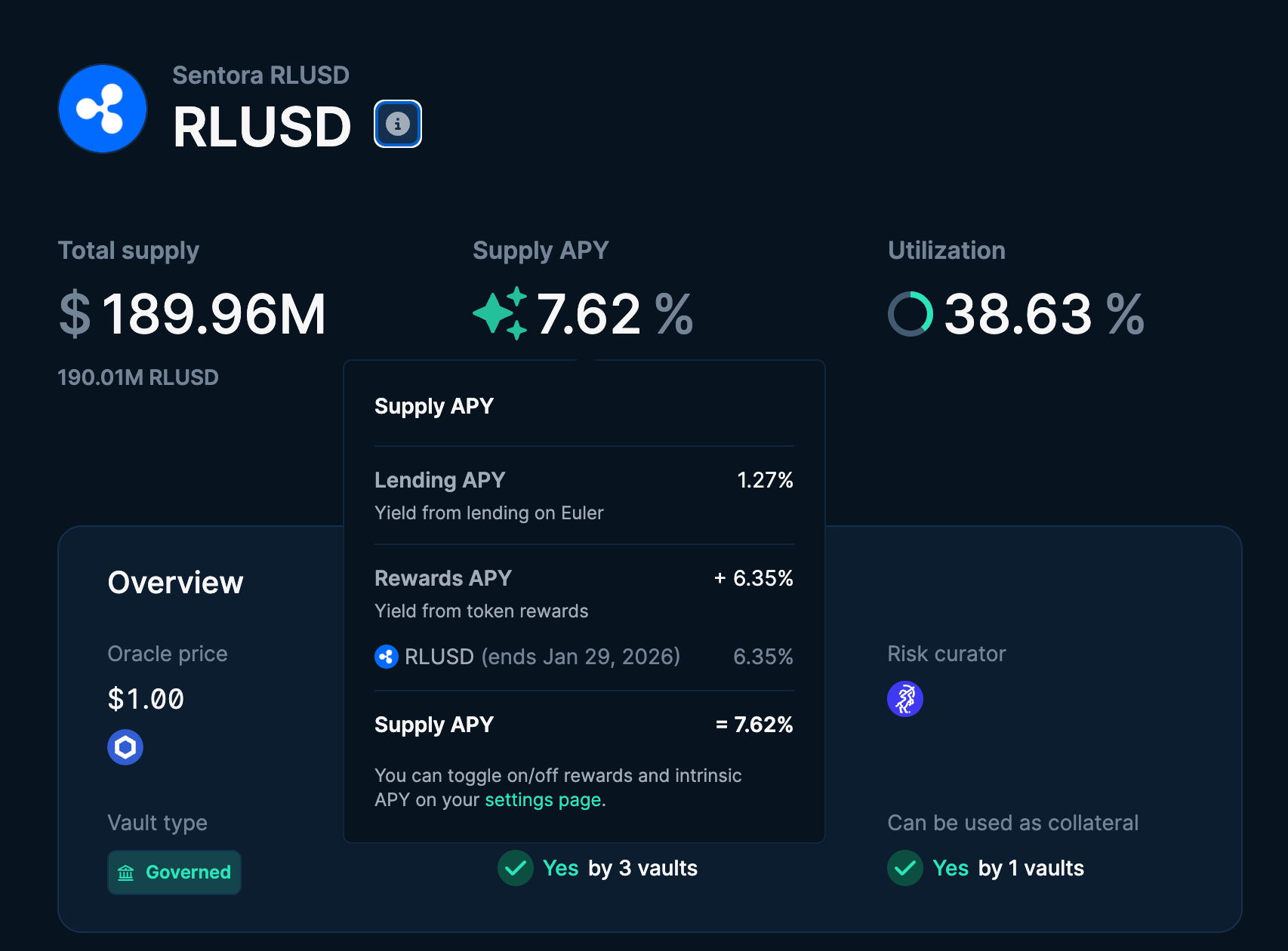
RLUSD represents Ripple’s entry into the stablecoin market, and despite my general skepticism toward Ripple’s ecosystem, the fact that this deployment sits on Ethereum’s secure settlement layer combined with Euler’s battle-tested infrastructure makes it an attractive opportunity for above-average stablecoin yields.
Beyond the APY, this pool offers valuable diversification away from the USDT/USDC duopoly. With ongoing regulatory uncertainty and periodic FUD surrounding both Tether and Circle, allocating a portion of stablecoin holdings to alternative assets like RLUSD on a smaller scale helps mitigate concentration risk. As the saying goes, never put all your eggs in one basket, especially when those baskets face persistent scrutiny.
GHO on Fluid Lending
Risk: Low 🟢
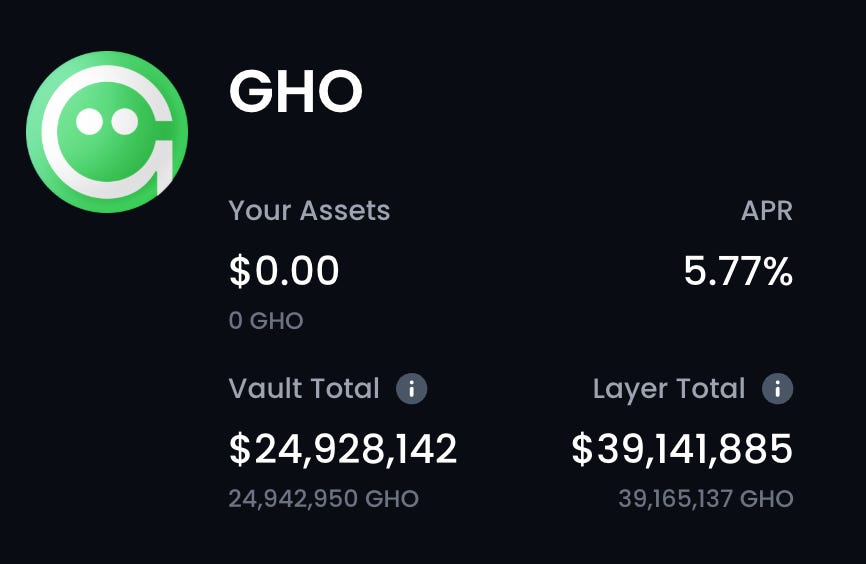
APY: 5.77%
Vault Total: $24.928M
Fluid Lending has established itself as a solid protocol with substantial TVL, and the GHO pool offers an attractive 5.77% APR, composed of 4.79% in GHO rewards plus 0.98% in Fluid’s native token. As Aave’s native stablecoin, GHO represents an interesting opportunity to gain exposure to the ecosystem that dominates DeFi lending while earning sustainable yields.
I’ve been consistently impressed with Fluid’s execution and innovation, and the protocol continues to present compelling opportunities for strategic positioning. If there’s interest, I’m considering launching a detailed tutorial on maximizing Fluid positions, so leave a comment if you’d like to see that content.
While I’m not currently allocated to this pool, I’m evaluating GHO as a potential destination for reallocating capital from higher-risk assets during this market downturn. As a long-term Aave bull, gaining exposure to GHO at these levels while earning 5.77% feels like a strategic play, especially for DCA strategies. Yes, GHO is relatively new compared to USDT or USDC, but modest exposure to emerging stablecoins backed by proven protocols can be valuable for diversification. The 5.77% APR isn’t flashy or “degen” by any means, but that’s precisely the point of this analysis: finding sustainable, inflation-beating returns that prioritize capital preservation. In bear markets, we take the small wins.
Onchain Analytics 🧐
Bitcoin Exchange Reserve Dynamics
The chart reveals a compelling inverse relationship between Bitcoin held on exchanges and price action. From February through October 2025, exchange reserves (purple line) declined steadily from approximately 2.85M BTC to 2.45M BTC while price (black line) remained relatively resilient within the $100K-$120K range despite notable volatility. This inverse correlation typically indicates accumulation by long-term holders, reducing available supply on exchanges and alleviating selling pressure.
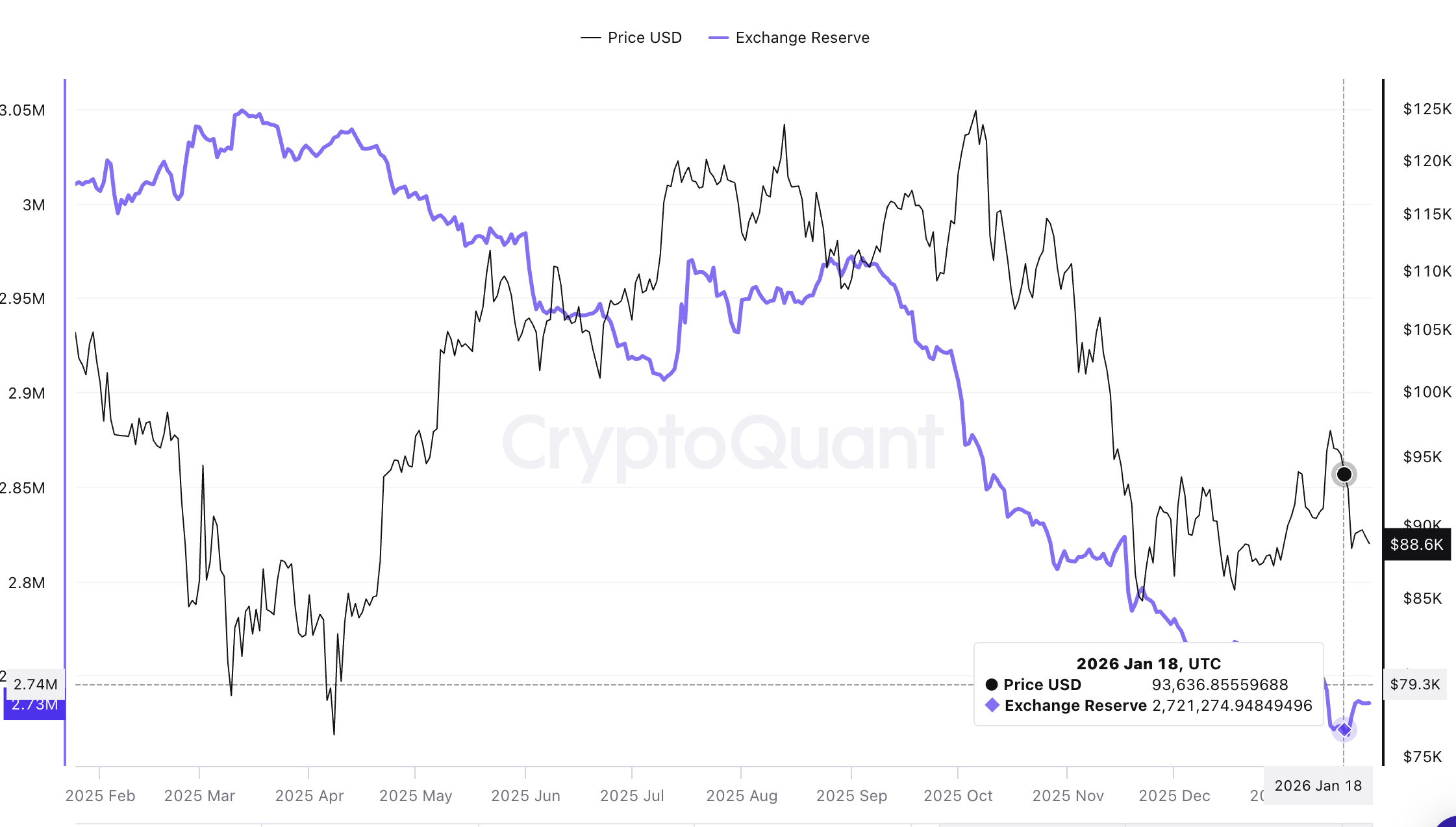
However, late December 2025 marks a critical inflection point. Exchange reserves have plummeted from ~2.45M BTC to 2.35M BTC as of January 18, 2026, while price simultaneously collapsed to $88.6K. Unlike the earlier period’s gradual reserve reduction, this rapid dual deterioration signals panic-driven behavior. Holders are aggressively withdrawing coins from exchanges, likely to either secure holdings amid uncertainty or realize losses.
The severity and velocity of this movement warrant concern. Such dramatic reserve depletion during a price collapse historically precedes heightened volatility and potential capitulation events, particularly in derivative markets where reserve dynamics often serve as leading indicators of major price swings.
Aave's Market Dominance
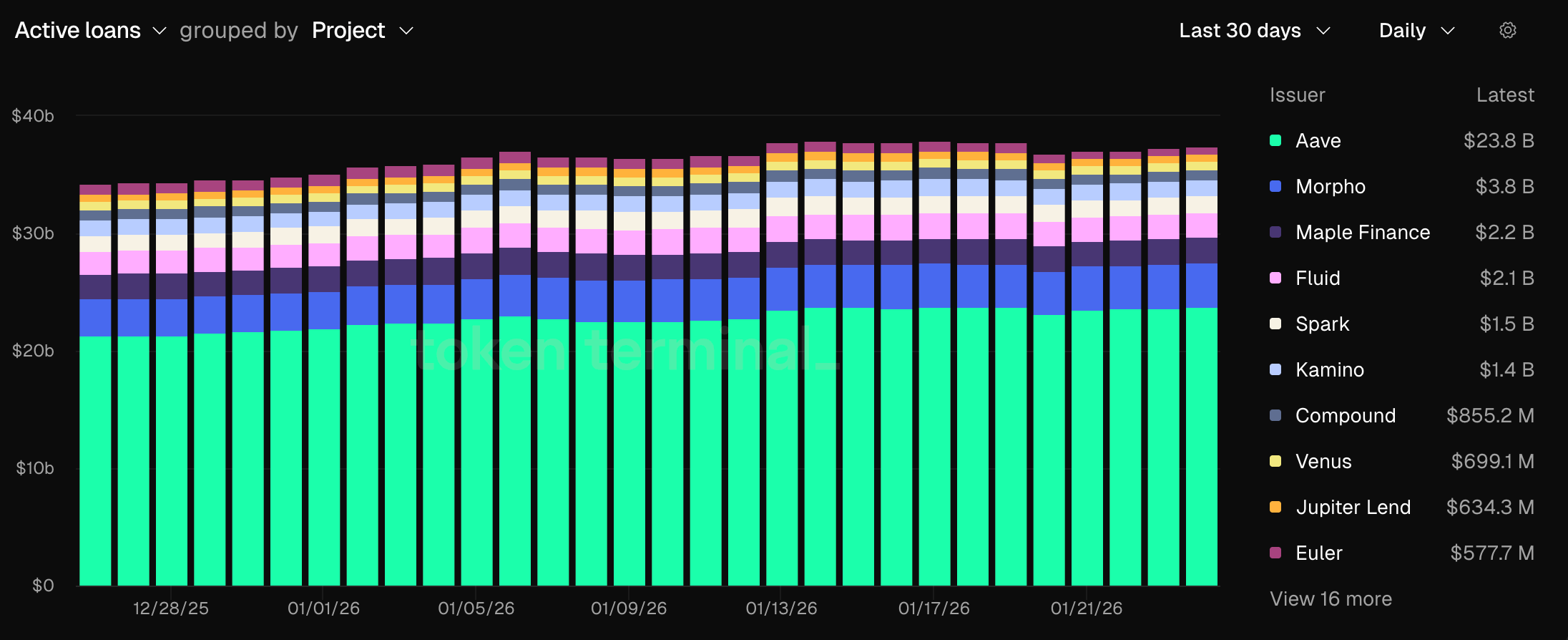
The stacked chart illustrates Aave’s commanding position in the DeFi lending sector, where it maintains over 50% market share with the protocol shown in green vastly outpacing competitors such as Morpho, Maple, and Venus. Through late 2025 and into early January 2026, Aave’s active loans have remained steady between $23B and $23.8B, even as the broader crypto market experienced significant stress with Bitcoin falling below $90K amid geopolitical pressures.
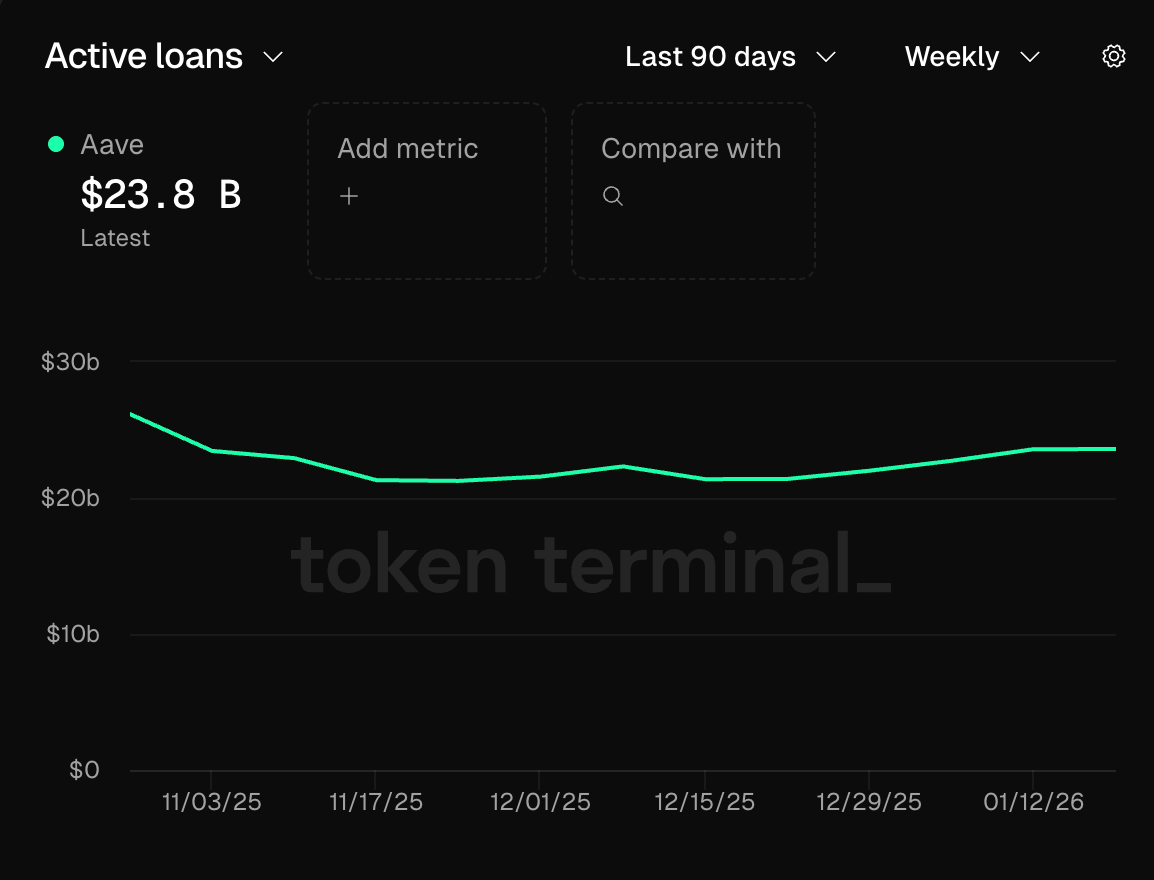
The line chart reveals the protocol’s resilience over time, showing only minimal fluctuation from December’s $30B peak to current stable levels. Notably, this stability comes as the total sector has grown to $26.8B in active loans, suggesting that Aave is not only retaining its position but maintaining borrower confidence during uncertain times.
This performance amid early 2026 market headwinds points to the continued maturation and growth potential of DeFi lending as a sector. Aave’s ability to hold steady likely stems from its borrower-friendly features, including flexible collateral options and competitive rates, which have helped the protocol approach nearly $1T in cumulative loan issuance since inception.
The reason for this placement is that you want readers to first see the market share distribution when you introduce Aave’s dominance, then immediately after discussing the dollar amounts and timeframes, you show them the temporal trends that prove the stability you’re describing.
That’s it for this week.
If you found this edition valuable, please consider sharing it with your network.
None of the information in this newsletter constitutes financial advice. While I personally use most of the protocols that I discuss, it's important to understand that they involve substantial risk. Don’t invest what you can’t afford to lose
Good framework. In this kind of tape I’m also leaning into capital preservation: stay invested, earn steady stable yields (ideally on ETH), and ride out the winter. Security and sustainability beat headline APY right now.