

Hello everyone,
Apple and Nvidia tokens already trade against USDC on Aerodrome. There is an opportunity to earn from that activity, but the return depends on the position you choose: trading fees for an unstaked LP, or AERO incentives for a staked one.
My take: the stock pools are worth investigating for eligible readers who want equity exposure and can manage a liquidity range. I’d keep wtSGOV on the watchlist until its product terms are clearer. The Aero merger also makes today’s emissions a short-term variable, so I would assess a position’s fee economics after incentives change.
The first check is access. Coinbase’s stock tokens are intended for eligible non-US investors. A working DEX interface does not establish eligibility, and European access needs a jurisdiction-specific check. US readers can follow the market development without assuming these products are available to them. Product information.
What the three pools show
The figures below were displayed on Aerodrome’s Stocks screen on October 13, around 13:07–13:08 Stockholm time. They are floating interface estimates, rather than forecasts of the return on your deposit.
There are two separate APR measures. Emissions APR values AERO rewards against staked liquidity in the current tick-spacing band. Your full position can span a wider range. Fee APR is an annualized proxy using current-epoch fees accruing to voters and the pool’s total token reserves. It is not the net yield an unstaked LP earns. The two rates should not be added.
Apple: AAPLc / USDC
The screen showed $1.41 million in TVL, an emissions APR of 7,115%, and a fee APR proxy of 56.21%. That emissions estimate is especially sensitive to the amount of staked liquidity in the current band. It is not a 7,115% forecast for your whole deposit.
Apple-linked inventory gives this position equity exposure as well as AMM risk. A fall can leave an LP holding more AAPLc; a rally can sell that inventory into USDC. A narrow range can stop earning when price leaves it.
AAPLc pool · AAPLc prospectus.
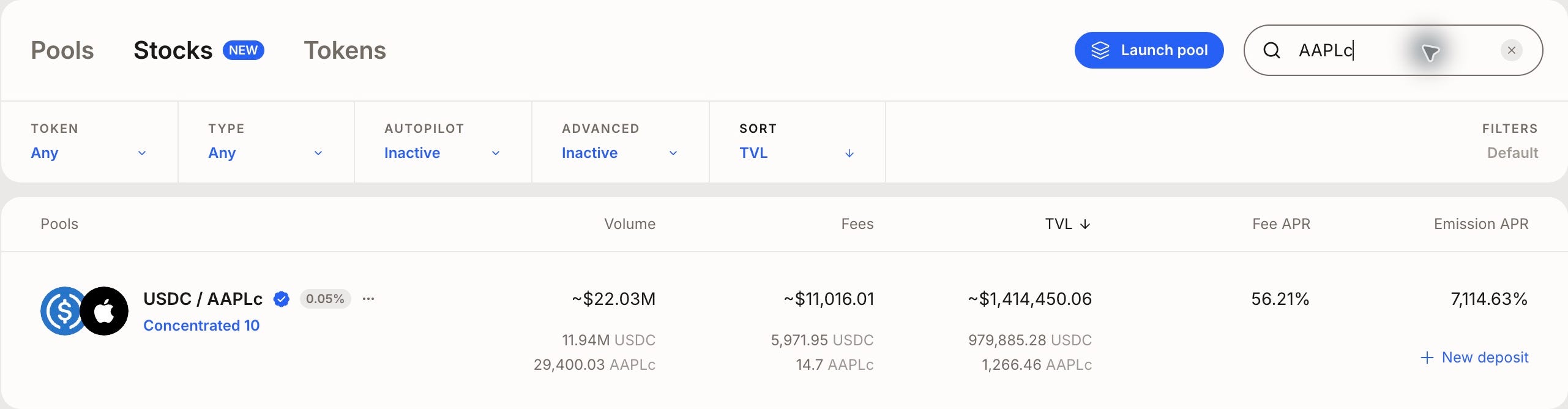
AAPLc / USDC on Aerodrome, captured October 13 at 13:07 Stockholm. Displayed TVL: $1.41M; emissions APR: 7,115%; fee APR proxy: 56.21%. These rates use different denominators and should not be added. Emissions APR is an active-band estimate, not a return forecast for the full deposit. Source · Captured 2026-10-13T13:07:59+02:00.
Nvidia: NVDAc / USDC
The screen showed $1.95 million in TVL, an emissions APR of 1,332%, and a fee APR proxy of 47.38%.
A high annualized rate against a small active band says little about the return on every dollar deposited. Nvidia exposure, time in range, reward allocation and the AERO price all affect the result. Holding both stock pools also keeps the same Coinbase issuer, Base and Aerodrome exposures.
NVDAc pool · NVDAc prospectus.
Both stock tokens represent beneficial interests in shares held through Coinbase Onchain SPV Ltd, with Alpaca as custodian/broker. Unvested DEX holders retain a beneficial interest, but direct redemption and voting instructions require KYC and vesting. Dividends are generally reinvested through the backing ratio after tax and issuer fees, rather than paid directly as cash. The terms also give the issuer blacklist, freeze, pause and burn powers. Those rights and restrictions belong in the LP decision alongside the stock price.
Treasury ETF wrapper: wtSGOV / USDC
This pool showed about $210,700 in TVL, an emissions APR of 37.69%, and a fee APR proxy of just 0.07654%. The incentive is AERO paid to liquidity providers; it should be assessed separately from the ETF’s underlying return.
wtSGOV wraps tSGOV exposure to the iShares 0–3 Month Treasury Bond ETF. The issuer structure differs from the Coinbase stock tokens: st0x describes holders as unsecured contractual creditors of S01 Issuer GmbH. The issuer’s hedge does not give token holders a trust or a secured claim over those assets.
The programme provides for in-kind redemption to a holder’s KYC’d account at an eligible broker, with a $10 minimum. Product-specific Final Terms govern access and other conditions. The research did not locate SGOV-specific Final Terms, so I’d leave eligibility, fees and distribution terms open rather than infer them from the programme’s general retail-offer countries. US persons are excluded.
wtSGOV pool · SGOV product · Holder rights · Base prospectus.
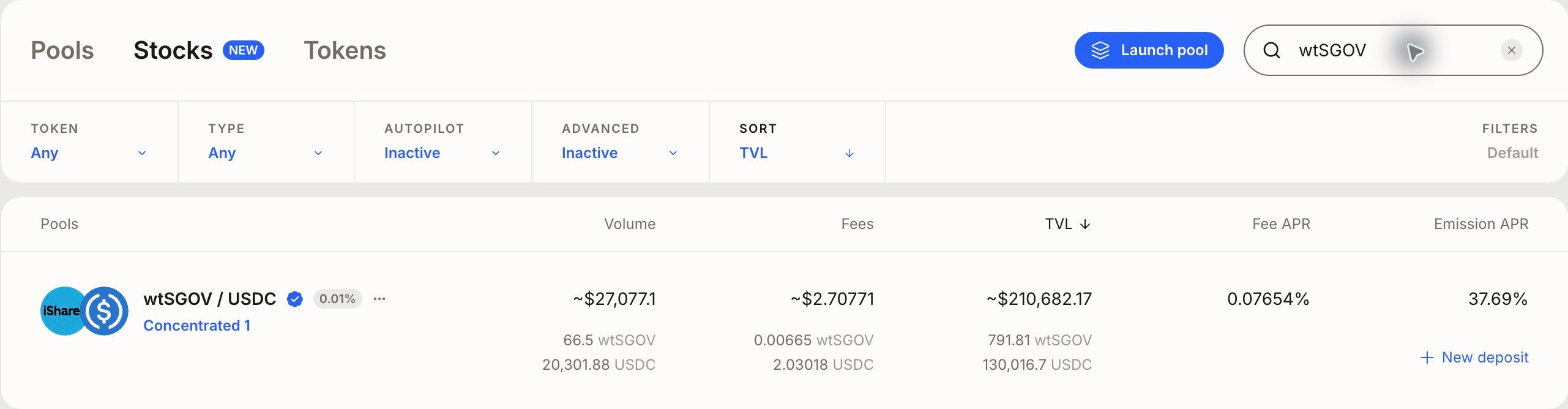
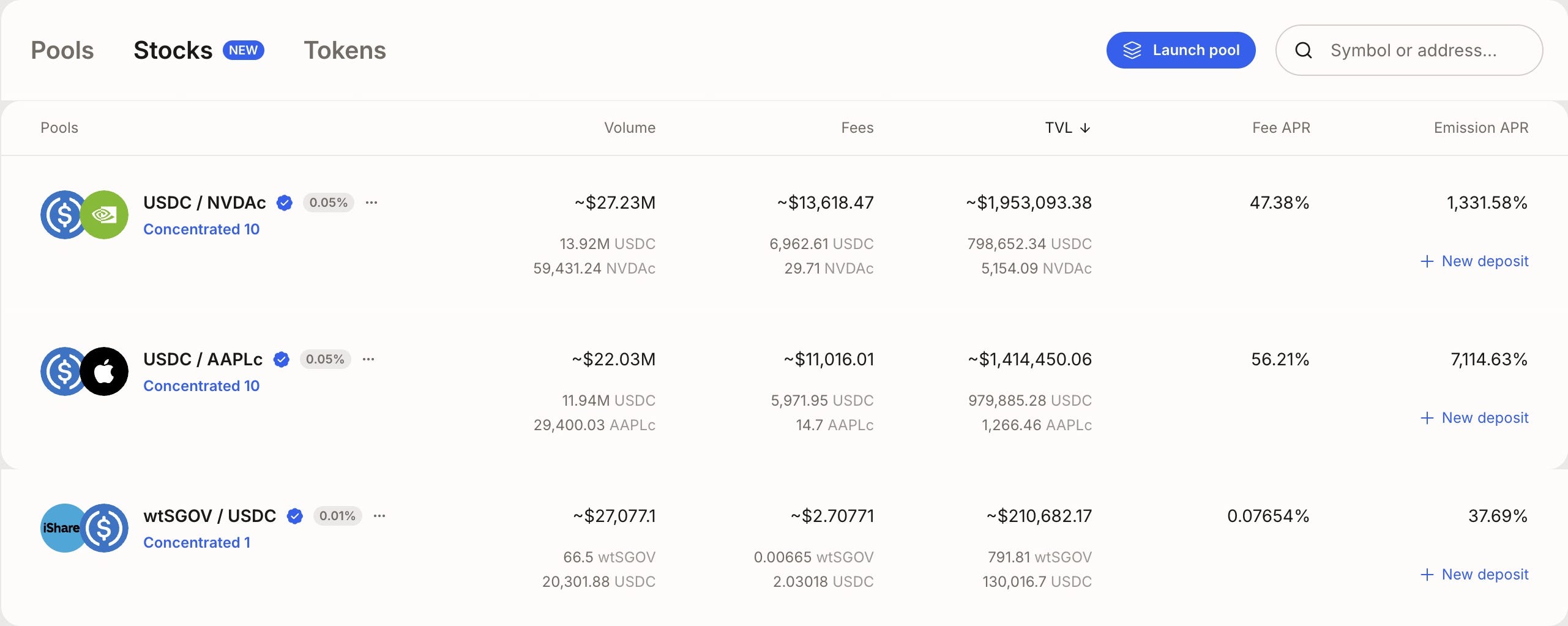
Combined source excerpts of three selected pools, captured around 13:07–13:08 Stockholm time. TVL: AAPLc $1.41M; NVDAc $1.95M; wtSGOV $210.7K. Emissions APR estimates: 7,115%, 1,332% and 37.69%. Fee APR proxies: 56.21%, 47.38% and 0.07654%. The source rows were cropped and combined without changing their figures. APRs use different denominators and should not be added; the displayed volume is not a trailing-day series. Source · Captured 2026-10-13T13:08:00+02:00.
Trading activity helps. Execution still needs checking.
At 08:33 Stockholm time, the research pull recorded DefiLlama one-day volume of $6.17 million in AAPLc and $11.27 million in NVDAc. Its one-day field is a trailing snapshot measure, not a completed Monday session. Its window differs from the Aerodrome screen’s displayed volume. That is a reason to investigate fee income through more than one observation. It does not establish LP profit. DefiLlama yields data.
The morning KyberSwap quotes put a $100,000 AAPLc buy about 0.058% above pool spot through Aerodrome, and a corresponding sale about 0.058% below. For NVDAc, the buy was about 0.097% above spot, and the sale about 0.071% below.
wtSGOV was a different market. A $100,000 buy came out 23.6% above spot through Aerodrome alone, or 7.4% above spot on the best aggregator route. A $50,000 buy was around 0.01% above spot. Position size changes the economics sharply.
These were KyberSwap-only quotes at 08:32 Stockholm time, before US pre-market. The comparison includes swap fees, route effects and a small timing gap against pool spot. A quoted buy cost also does not establish how an LP position will exit after a price gap. Requote the direction and size you intend to use. KyberSwap.
Who gets paid on Aerodrome?
An unstaked LP earns its in-range share of trading fees, less the applicable protocol take. Morning research checks found a 10% take in these three pools. Their swap fees were 0.05% for AAPLc and NVDAc, and 0.01% for wtSGOV.
A staked LP earns AERO emissions; fees generated by that staked liquidity flow to veAERO voters. Voters can also receive separate voting incentives. Buying liquid AERO alone does not collect those fees.
AERO rewards add reward-token exposure to the inventory you already hold. To assess the position, model the full deposit, time out of range, execution costs and the value of the rewards when sold. Annualizing a momentary active-band rate leaves those costs out.
Protocol mechanics · Public calculation code. The emissions calculation was checked against public source code; a match to the deployed calculation contract remains unverified.
What changes at the Aero launch?
The official launch update schedules Aero for October 21 at 8pm New York time: October 22 at 00:00 UTC, or 02:00 in Stockholm. It is a planned upgrade, not a completed merger.
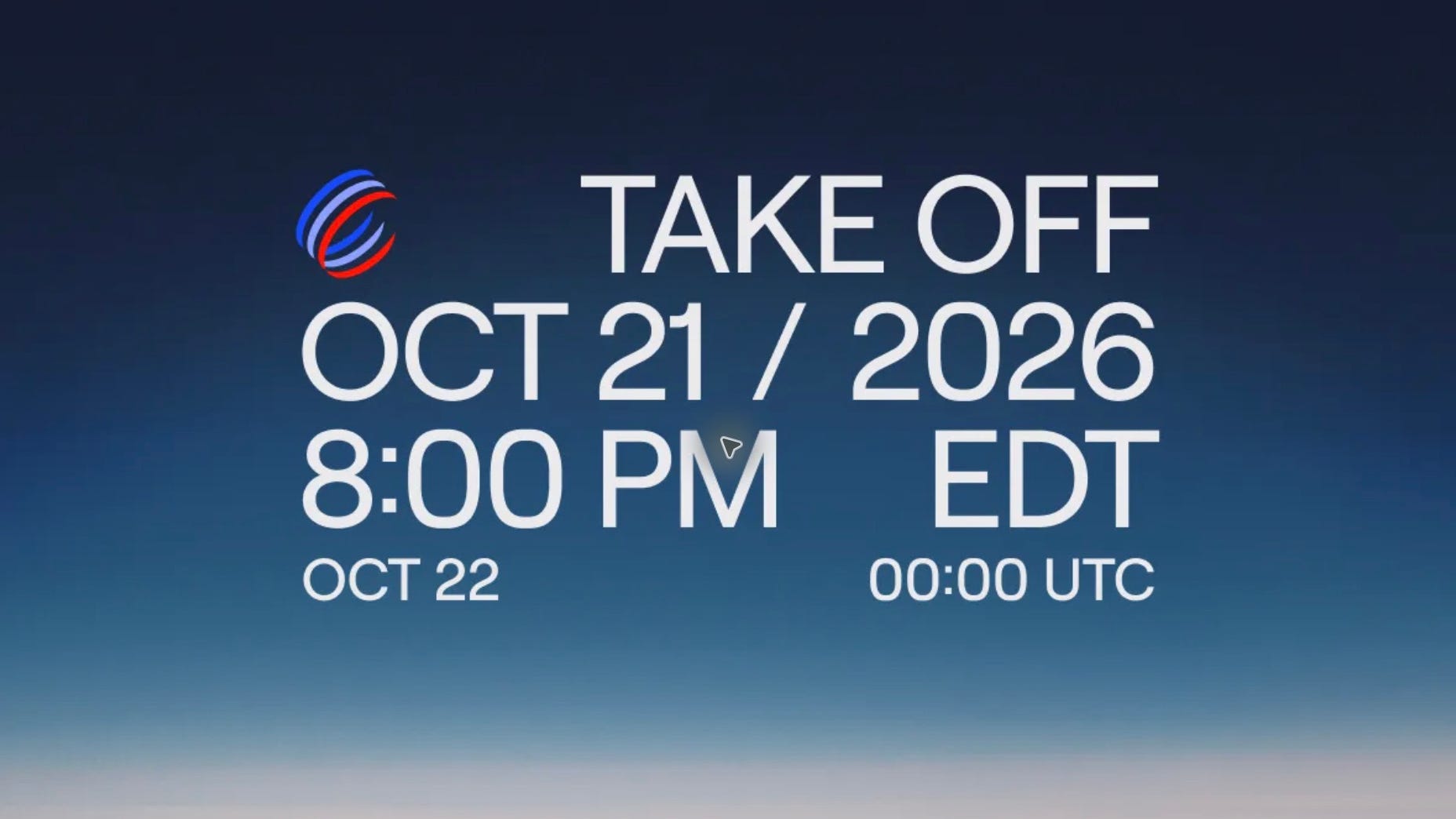
Official Aero launch graphic: October 21, 2026 at 8pm EDT equals October 22 at 00:00 UTC, or 02:00 in Stockholm. This is the announced schedule, not evidence that the upgrade has executed. Source · Captured 2026-10-13T13:05:37+02:00.
Legacy AERO converts 1:1 into new AERO. The published VELO conversion is approximately 0.044 new AERO per VELO, with the final ratio dependent on supply. The stated allocation split is 94.5% Aerodrome and 5.5% Velodrome.
Existing veAERO and veVELO locks become sAERO, keeping their remaining duration rounded up to a week. Permanent locks become maximum-duration stakes. The new system replaces weekly voting with continuous allocation and removes rebases. There is no early unstaking, although the stake NFT can be transferred.
For LPs, legacy emissions are scheduled to end at launch. The morning snapshot’s current reward period ends October 15, so today’s APR cannot be projected unchanged through the transition. The hub’s separate October 15 deadline is for protocol incentive deposits; it is not a blanket October 15 cutoff for LP emissions.
For existing holders, the hub says the self-custody upgrade is manual and irreversible, with no migration deadline currently stated. It tells Aerodrome ALM depositors to withdraw as soon as possible and Relay users to withdraw veNFTs by October 20. It also says to claim outstanding rewards before upgrading: unclaimed amounts cannot be recovered afterward. Follow the current official hub rather than an old announcement or a link sent in a DM.
Launch update · Official upgrade hub.
What would make these pools worth using?
For the stock pools, I’d want repeat trading, fees that compensate for inventory risk, and a range I can manage through an equity-market gap. The underlying market closes while the DEX keeps trading, so weekend liquidity and redemption access deserve their own check.
For wtSGOV, I’d resolve the product terms and test execution at the intended size before treating its headline rate as an opportunity. The issuer claim and the small market can matter more than the Treasury label.
AERO itself is a separate investment case. Exchange activity has to translate into rewards under the new staking system, while price and supply still matter. More tokenized assets trading on Aerodrome does not by itself establish a return for a liquid AERO holder.
Would you rather hold the stock token outright, or manage an LP position to earn from its trading?
Onchain Analytics
Blur’s website is closing; its contracts still hold assets
Blur plans to retire its website on November 12, while its marketplace contracts remain operational on Ethereum. Its separate Blend announcement says new loan matching stops that day, asks borrowers to repay or allow their loans to default, and promises an asset-withdrawal tool afterward. A service closing its interface changes how users manage positions even when the contracts continue to exist. Blur announcement · Blend announcement.
Two contracts from Blur’s official registry show different movements. Just before the announcement, at 21:59 Stockholm time on October 12, the bidding pool held 6,967.35 ETH. At the finalized October 13 snapshot, 14:06 Stockholm time, it held 6,832.62 ETH. That is a net decrease of 134.73 ETH, or 1.93%. The balance was still 1.47% higher than seven days earlier. Those are ETH units, so a changing ETH price does not explain the comparison. This measures capital remaining in the bidding pool; it does not measure marketplace revenue or how much NFT trading took place. Bidding contract.
Blend’s Pudgy holdings moved more sharply. The lending contract held 295 Pudgy Penguins before the announcement and 233 at the later block, a decline of 62, or 21.0%. The intervening ERC-721 logs record 97 transfers out and 35 in, which reconcile exactly with that net change. The count had already fallen from 343 a week earlier to 295 before the announcement, so the full weekly decline cannot be attributed to the closure notice. Blend contract · Pudgy contract.
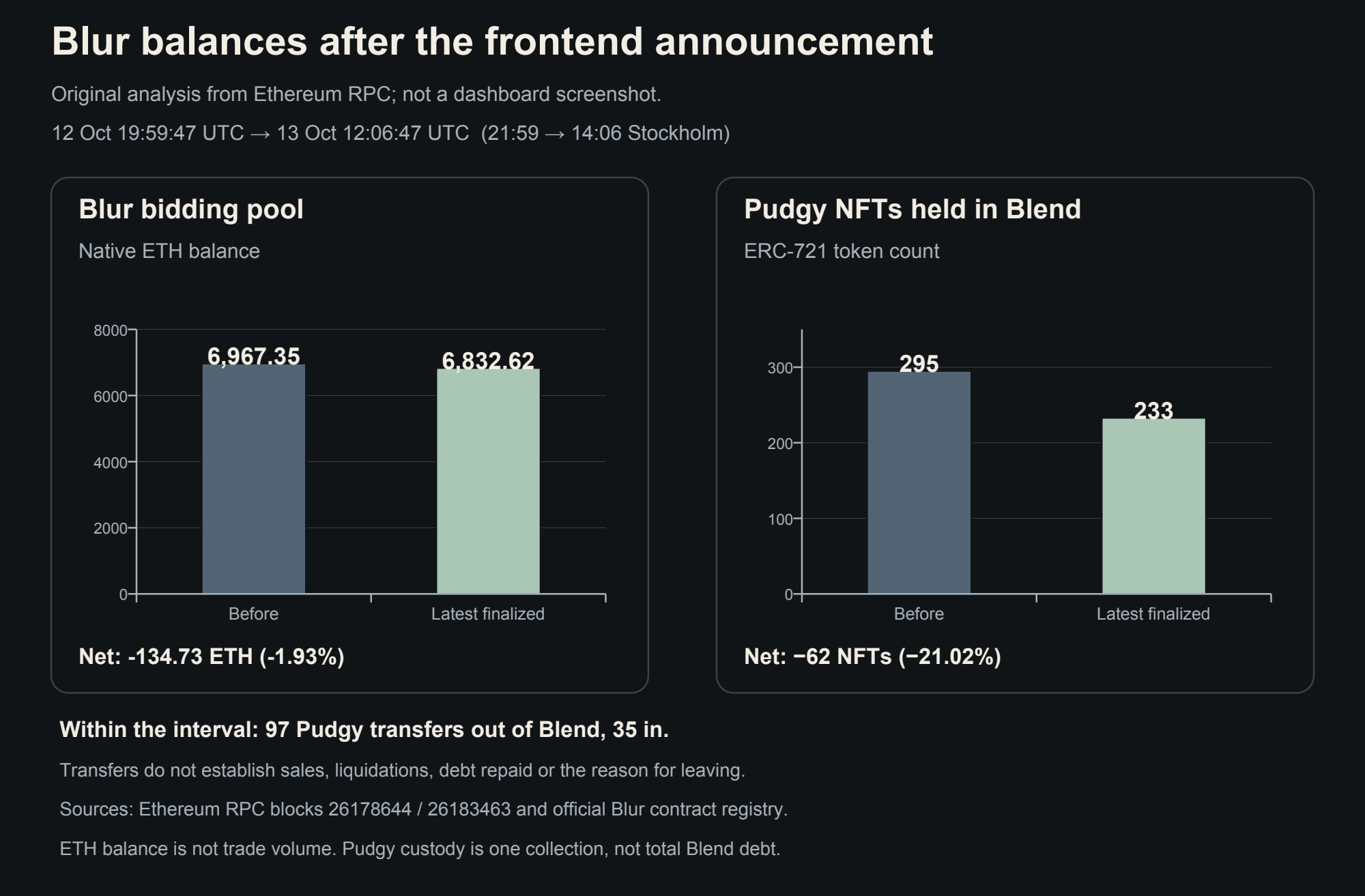
This counts one collection’s custody at Blend. It does not establish that every NFT backs an active loan, or measure total Blend debt. The transfer logs also do not tell us how many moves were repayments, sales or liquidations. Blend’s original design lets lenders trigger refinancing auctions; when an auction fails, the lender can take the collateral. Protocol mechanics.
I’d check the actual loan’s terms and the current official exit instructions before relying on an old interface. A lower contract balance shows assets moving; it does not by itself explain where they went or why.
Five developments from October 7–13 affecting DeFi markets, products and access.
Blur closes its website; the marketplace contracts remain
Blur announced on October 12 that its website will be deprecated on November 12. The marketplace protocol will remain operational onchain, with $BLUR retaining fee-switch control. Blend will also stop matching new loans on November 12. Its notice addresses how borrowers resolve existing loans and promises a withdrawal tool afterward. It does not establish that every loan automatically matures on that date. See Onchain Analytics for the marketplace, lending and borrower implications. Blur’s announcement · Blend update.
Sky receives a B3 counterparty rating
Sky Frontier Foundation said on October 7 that Moody’s assigned Sky Protocol a B3 counterparty risk rating with a stable outlook. The release identifies reserves as a central concern and describes retaining part of net protocol surplus to build them. B3 is below investment grade on Moody’s scale. Institutions have another credit framework for assessing Sky, while the USDS peg, collateral liquidity and contract risk still need separate checks. For an sUSDS position, the capital buffer belongs alongside the savings rate in the decision. Foundation release · Moody’s scale.
Unichain prepares for OP Stack interoperability
Uniswap Labs announced on October 9 that Unichain will move to OP Enterprise, with testnet migration scheduled for October 13 and mainnet for October 29. Existing chain ID, balances, contracts and Uniswap deployments are expected to stay the same. Optimism will run the production infrastructure. The stated goal is native transfers between OP Stack chains, starting with ETH, once interoperability launches. LPs and app users should separate the migration dates from the later availability of native cross-chain transfers; interoperability is not live simply because the infrastructure changes. Uniswap Labs.
Orca and Loopscale combine as tokenholders revisit fees
Orca and Loopscale announced their merger on October 7, with the combined team operating as Formation. Orca’s October 8 council update confirmed the deal and rescheduled its tokenholder vote for October 11–16. The associated proposal would cut the direct xORCA allocation of protocol fee revenue from 40% to 10%, put another 10% toward discretionary ORCA buybacks, and assign 80% to operations. Those changes remain a proposal in the inspected sources. If the proposal passes, xORCA holders would receive a smaller direct fee allocation; the discretionary buybacks would need their own execution record. Merger report · Council update · Fee proposal.
Samsung brings USDC into its wallet
Samsung announced on October 7 that eligible US Galaxy users will gain USDC transfers in Samsung Wallet in the last week of October. The service uses Bastion with Coinbase Prime as sub-custodian; Solana and Sui are named infrastructure partners. Samsung’s 82 million figure counts compatible US devices, not adopters. Bank transfers cover eligible accounts in more than 60 countries, with fees depending on the route. This is a distribution test for stablecoin payments: actual repeat transfers and conversion costs will tell us more than the device count. Samsung announcement.
Podcast Picks
Five recent conversations on collateral, execution, liquidity, security and the routes into DeFi. Descriptions and chapters guide the selections; no full listening is claimed.
Kamino’s plan for useful tokenized assets
Empire · October 12, 2026 · Michael Weisz
Kamino’s new CEO makes the case for adding credit to tokenized assets. Start at 23:34 for private-asset lending, 27:23 for collateral selection and 43:28 for liquidations. It pairs with this issue’s stock pools: trading a wrapper and borrowing against it solve different problems, with different exit requirements. Episode and chapters.
Hyperliquid beyond perpetuals
Empire · October 7, 2026 · Jeff Yan
Hyperliquid’s co-founder discusses institutional access, options and the tradeoff between speed and execution. The relevant chapters begin at 07:17, 11:46 and 18:19. Useful for comparing exchange models: what does the venue improve for a trader, and how much of the founder’s roadmap is already available? Episode and chapters.
Does Ethereum still have the liquidity advantage?
0xResearch · October 7, 2026
The panel debates Ethereum’s liquidity moat as activity spreads to other chains. Skip to 30:35 for liquidity, 43:00 for the Ethereum bull case and 55:14 for value capture. A useful companion to Aerodrome’s expansion: more trading on an Ethereum L2 does not settle which token captures the resulting value. Episode and chapters.
NEAR Intents’ account of the recovery
Unchained · October 9, 2026 · Alex Shevchenko
NEAR Intents’ general manager gives the team’s account of the bridging bug, loss coverage and recovery effort. The discussion separates the contract failure from the response, including who absorbs the loss and which services can be halted. Recovery figures in the episode remain the guest’s account. Episode and publisher notes.
DeFi fundamentals and public-market wrappers
The Edge · October 9, 2026 · Kyle (@zeroxkyle), DeFiLlama research analyst
Start at 22:19 for the StablecoinX/Ethena treasury trade and 27:29 for bringing DeFi yield to public markets. Kyle also explains his investing framework. The useful question here is what a listed wrapper changes about access to a DeFi business, and whether that distribution creates a better investment. Episode and chapters.
Two useful reads
Base’s stock-token launch: how the products and their liquidity venues fit together.
Aero’s upgrade hub: current conversion, managed-position and migration instructions.
Thanks for reading,
Yannis
For more DeFi commentary between editions, follow me on X.
For education and information only, not financial, investment, legal or tax advice. Access depends on eligibility and issuer terms. Positions can lose value through equity moves, issuer or custody failures, contract failures, inventory losses and illiquidity. APRs are variable annualized estimates, not verified net returns.
Yield on a tokenized Apple share is really yield on the wrapper, not the stock. The LP fees come from traders, and those traders need a price feed that works when Nasdaq is closed. What happens to the pool on a weekend gap? That’s the risk I’d want priced before chasing the APY.